




13 Nov 2026
Americans rely on transportation navigation and timing technology every day, even if it’s not top of mind. The global positioning system (GPS) is essential to the automated localization, synchronization, and communication of airplanes, cars, ships, and drones.
But these signals are vulnerable to interference, and as they’re increasingly jammed or manipulated, transportation systems are experiencing delays — and, worse, causing misguided vehicles to crash.
How do we know a navigation system is safe from cyber-physical attacks?
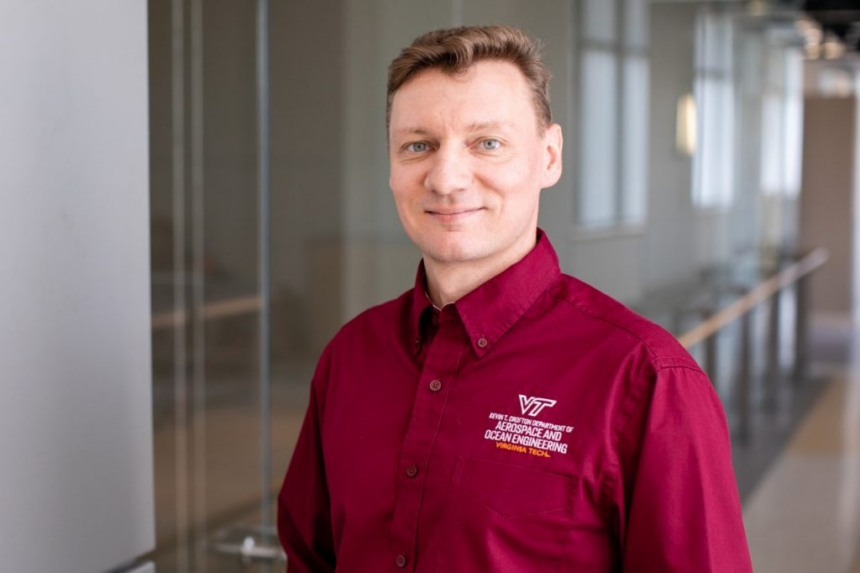
Mathieu Joerger, an associate professor in the Kevin T. Crofton Department of Aerospace and Ocean Engineering, has recently been awarded a National Science Foundation Faculty Early Career Development (CAREER) award to develop new ways to measure, predict, and improve how well GPS-reliant systems can continue operating when their signals are jammed, disrupted, or otherwise unreliable.
“For a society that is heavily and globally dependent on GPS for localization and timing, interference that is growing in frequency and sophistication is a widespread concern,” said Joerger. “Right now, solutions for navigation resilience are scattered across the field. New approaches are always being proposed, but there isn't a consistent way to evaluate how effective they are.”
A major goal of this project will be to create a framework and a set of metrics for measuring resilience of global navigation satellite systems. Joerger and his team want to define what resilience actually means, and then establish methods for evaluating it.
The team will be building experiments, collecting data, designing systems, and testing navigation solutions to better assess promising resilience technologies. They plan to:
Study how real-world interference impacts navigation errors. The impacts of interference depend on vehicle motion, signal reflections, and environmental conditions that widely vary by location and time. The researchers are finding innovative ways to test realistic, live interference along highways, at airports, and in maritime ports, monitoring data at thousands of locations.
Figure out worst-case interference scenarios. Sources of spoofing and jamming can be intentional or not. By determining the kinds of disruptions that cause navigation systems the most trouble, engineers can design better defenses.
Test alternatives when GPS becomes unreliable. Combining GPS signals with external data, including measurements of a vehicle’s movement from inertial sensors like accelerometers, can help continue estimating its position when GPS is compromised.
One of the biggest challenges researchers face? It is illegal to spoof or jam signals in public environments, even in the name of research. While physical experiments can be conducted in specialized shielded facilities, the team can’t fully recreate real-world conditions such as tracking vehicle motion, radio frequency signal reflections, and weather.
“One particularly exciting theory is that a vehicle’s motion may actually improve navigation resilience,” said Joerger. “The shortest path between two points is a straight line, but the most resilient path may not be.”
Collaborating with industry partner VIAVI’s Inertial Labs on sensor augmentation, Joerger’s team has received advanced navigation sensors and equipment capable of providing sensor data as well as precise ground-truth measurements. By installing these sensors on vehicles for road testing, researchers can conduct collaborative navigation experiments in the field and evaluate navigation performance without relying entirely on GPS.
“Early on in my career, I focused primarily on navigation safety,” said Joerger. “As interference became more sophisticated and pervasive, my research at Virginia Tech evolved towards protecting, toughening, and augmenting positioning, navigation, and timing. Now those two areas are coming together. Safety involves measuring, predicting, and managing risks. This project applies those same concepts to resilience, helping us evaluate and predict how navigation systems perform under interference.”
Chelsea Seeber
540-231-2108
Virginia Tech demonstrates impact as a global land grant – progressing sustainability in our community, through the Commonwealth of Virginia, and around the world.
Get Directions
See All Locations
Contact Virginia Tech
For the media
© 2026 Virginia Polytechnic Institute and State University. All rights reserved.
Mathieu Joerger’s NSF CAREER award supports research on safer, more resilient navigation systems – Virginia Tech News



Leave a Comment

