


Hi, what are you looking for?
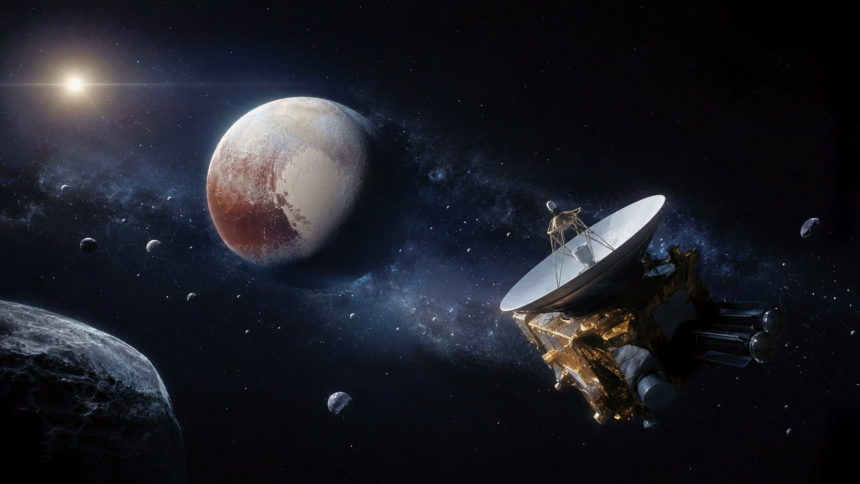
The fastest spacecraft ever launched. A nine-year journey across three billion miles. A world that, for 85 years, had been almost nothing but a smudge of light. When New Horizons swept past Pluto in 2015, it found a 1,000-kilometer heart-shaped glacier of frozen nitrogen and a surface so young it rewrote what scientists thought they knew. Now, 5.7 billion miles out, the probe has gone quiet — waiting to see if NASA will wake it again.
By
Published
NASA’s New Horizons Explained: NASA’s New Horizons spacecraft, which left Earth nearly two decades ago and has transformed scientific understanding of Pluto, has entered into the longest hibernation period of its journey so far.
The probe made history during its 2015 flyby of our most distant planet – or dwarf planet, as it is known today. And since then, the probe has become the most distant spacecraft to ever explore an object in the Kuiper Belt.
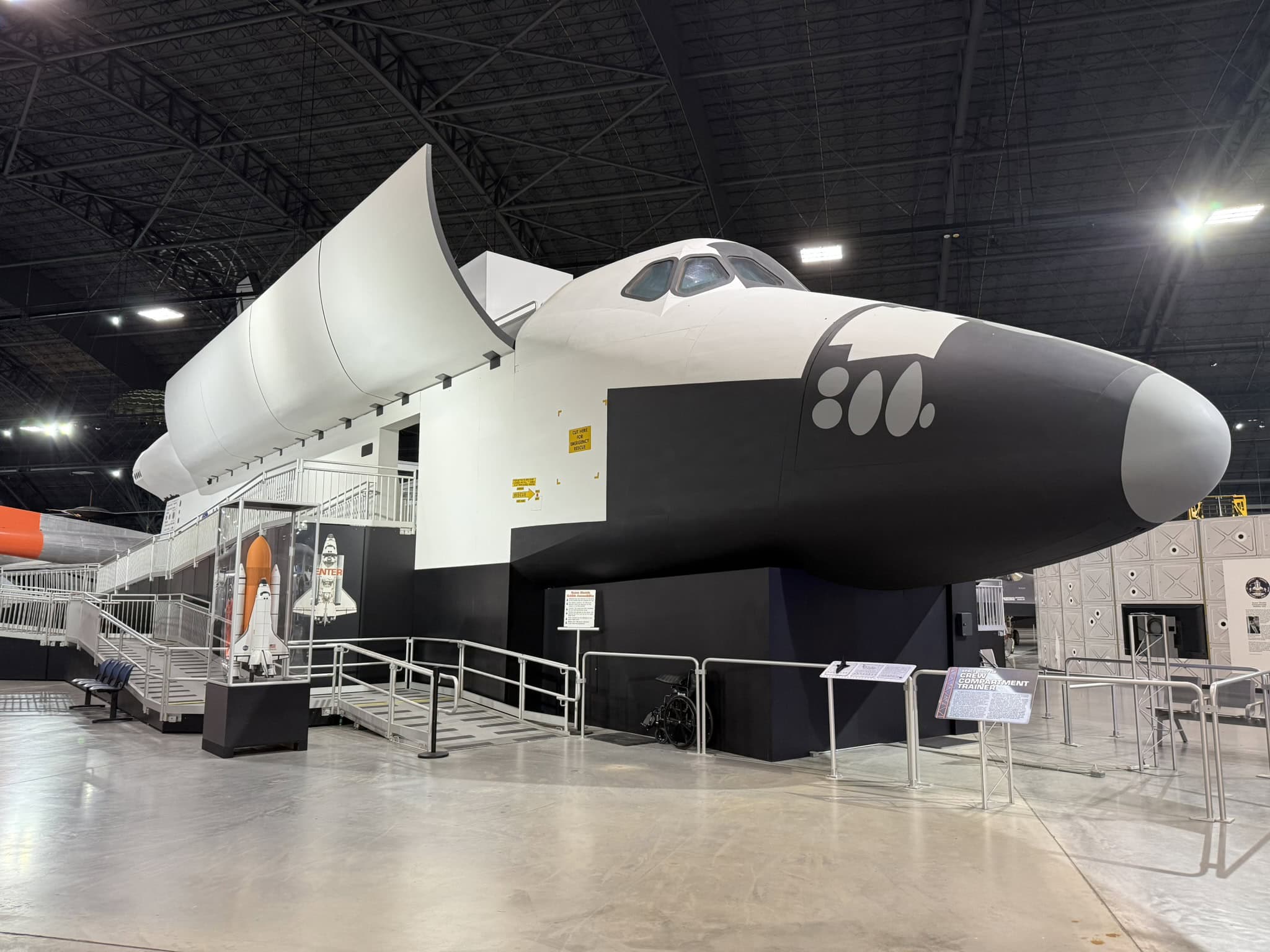
NASA Space Shuttle Demo at the National Museum of the U.S. Air Force. Taken by Harry J. Kazianis, July of 2025.
NASA Space Shuttle Demo at the National Museum of the U.S. Air Force. Taken by Harry J. Kazianis, July of 2025.
New Horizons is more than 5.7 billion miles from Earth today, traveling inside the Kuiper Belt – a massive region of icy galactic bodies and dwarf planets located beyond the orbit of Neptune and Pluto. In August 2025, the probe’s controllers at the Johns Hopkins Applied Physics Laboratory confirmed that the spacecraft had entered hibernation mode after a software upgrade was implemented to improve its ability to operate much farther away from the Sun than originally planned.
The decision came after the spacecraft spent months collecting data and was then moved into a low-power “hibernation” state, where its systems were temporarily switched off.
Its onboard computers continued to monitor its health and transmit regular status updates back to Earth, but because of the vast distances involved, those signals still took more than eight hours to reach controllers back on Earth.
The latest news that the spacecraft had entered hibernation is different, however. NASA said that New Horizons may not be woken up until June 2026, but there has still been no news about when it is expected to be switched back on. NASA was waiting for the agency’s Fiscal Year 2026 budget to make the decision.
Importantly, though, the spacecraft is not useless while it is traveling in hibernation – New Horizons is still collecting some data as it lies dormant and waiting for an opportunity to transmit those findings back to Earth when it is next switched on.

NASA Space Shuttle Demo at the National Museum of the U.S. Air Force. Taken by Harry J. Kazianis, July of 2025.
The Mission That Changed Everything
NASA Space Shuttle Demo at the National Museum of the U.S. Air Force. Taken by Harry J. Kazianis, July of 2025.
New Horizons is a spacecraft designed to explore the outer reaches of our solar system. While it is not the most distant human-made object, it is certainly among those that have traveled the furthest. The spacecraft was built by the Johns Hopkins Applied Physical Laboratory and led by Alan Stern, a planetary scientist from the Southwest Research Institute. The probe was designed to be the first to reach Pluto, the dwarf planet discovered by astronomer Clyde Tombaugh in 1930.
In the decades that followed, very little was known about Pluto. It was long one of the least-understood objects in the Solar System, even when it was officially designated a planet.
Spacecraft had been able to visit planets like Mercury, Venus, Mars, and even Jupiter, Saturn, and Uranus throughout the 20th century – but Pluto was simply too far away. In 2001, NASA approved the New Horizons project.
By 2006, the spacecraft was ready and was launched from Cape Canaveral, Florida, in January of that year. It was sent into space aboard an Atlas V rocket and left Earth faster than any other spacecraft had before. It reached a speed of 36,000 miles per hour – and even with such great momentum, the spacecraft still faced a roughly decade-long journey.
The spacecraft was tasked with flying close enough to Pluto to get high-quality photographs and to study its moons, atmosphere, and geology.
And once it did that, it would be sent deeper into the Kuiper Belt and eventually beyond. After traveling more than three billion miles across the Solar System, New Horizons officially reached Pluto in July 2015.
What New Horizons Found
Alan Stern, the Principal Investigator for the New Horizons project, listed the top ten things that the probe has found so far in a piece published by NASA in 2016.
According to Stern, the probe determined that the complexity of Pluto and its satellites is “far beyond what we expected,” and added that the “degree of current activity on Pluto’s surface and the youth of some surfaces on Pluto are simply astounding.”
He explained how Pluto’s atmospheric hazes and “lower-than-predicted atmospheric escape rate” upended all models and predictions from before the flyby.
He also described how Pluto’s moons, which can be age-dated by surface craters, appear to have roughly the same ancient age, which he says adds weight to the theory that they formed together in a collision between Pluto and another Kuiper Belt planet.
What’s more, he described how New Horizons discovered Pluto’s 1,000-kilometer-wide heart-shaped nitrogen glacier, which has been informally named the Sputnik Planum.
What Next?
For now, New Horizons is still drifting through the Kuiper Belt and collecting data in hibernation mode.
Whether it is reawakened for a new phase of deep-space exploration will depend on NASA funding decisions that have yet to be made.
About the Author: Jack Buckby
Jack Buckby is a British researcher and analyst specializing in defense and national security, based in New York. His work focuses on military capability, procurement, and strategic competition, producing and editing analysis for policy and defense audiences. He brings extensive editorial experience, with a career output spanning over 1,000 articles at 19FortyFive and National Security Journal, and has previously authored books and papers on extremism and deradicalization.
Jack Buckby is 19FortyFive’s Breaking News Editor. He is a British author, counter-extremism researcher, and journalist based in New York. Reporting on the U.K., Europe, and the U.S., he works to analyze and understand left-wing and right-wing radicalization, and reports on Western governments’ approaches to the pressing issues of today. His books and research papers explore these themes and propose pragmatic solutions to our increasingly polarized society.
Your email address will not be published.
Copyright © 2026 19FortyFive.