e-Edition
Sign up for email newsletters
Sign up for email newsletters
e-Edition
Trending:
“Dirt made my lunch, dirt made my lunch. Thank you dirt, thanks a bunch.”
For anyone who grew up around environmental education in Santa Cruz County, those familiar lyrics from the Banana Slug String Band are hard to forget. The song’s simple message carries an important truth: healthy soil makes healthy food possible.
The rich agricultural lands of the Pajaro Valley and southern Santa Cruz County help feed our region and much of the nation. Strawberries, lettuce, broccoli, artichokes and countless other crops nourish our families and support an agricultural economy that has shaped our communities for generations. The people who plant, harvest, transport and prepare that food are essential to our local identity.
Yet alongside this abundance, important questions continue to emerge about how our food is grown and what impacts agricultural practices may have on the health of nearby communities. That concern is at the heart of the Campaign for Organic and Regenerative Agriculture, known as CORA.
Over lunch a few weeks ago, I had the opportunity to speak with Carolyn Rudolph, co-owner of Charlie Hong Kong. For decades, the Soquel Avenue restaurant has built its reputation around serving healthy, locally sourced food. Rudolph spoke about how Charlie Hong Kong sources produce that fuels our bodies and how CORA is supporting farming practices that are healthy for both consumers and farmworkers.
For many residents, choosing organic produce may be an option. For others, particularly families living and working near agricultural fields, the conversation is not simply about what they buy at the grocery store. It is about what happens outside their homes, schools and neighborhoods.
CORA emerged from the work of the Center for Farmworker Families and a coalition of residents, educators, health advocates, environmental organizations and community members who are calling for a transition toward organic and regenerative farming practices in the Pajaro Valley. The campaign’s vision is ambitious: to create a future where agricultural production protects both public health and the environment while continuing to support a thriving farming economy.
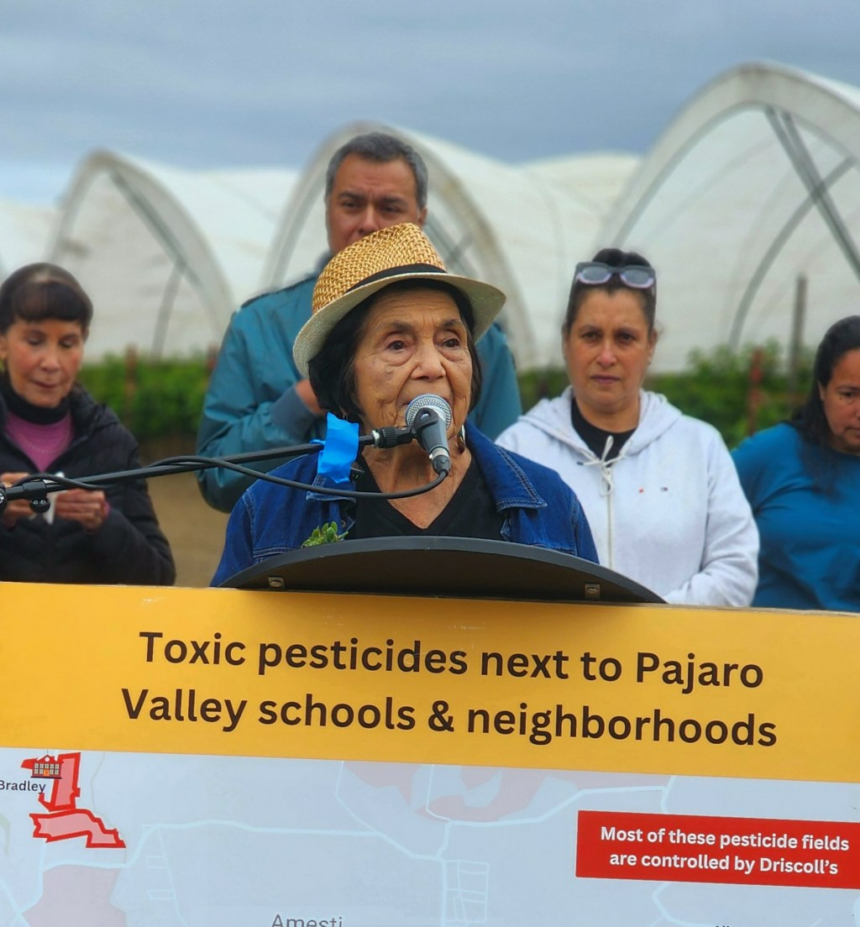
One of CORA’s primary concerns is the use of pesticides on fields located near schools and residential neighborhoods. The organization has highlighted data that many South County schools are located in close proximity to agricultural operations where pesticides are used. Their campaign calls for transitioning fields near schools and homes to organic production and creating larger buffer zones between pesticide applications and sensitive community locations.
The issue has drawn attention from educators, healthcare professionals, farmworker advocates and local residents. Former school nurses, public health advocates and community leaders have raised concerns about children’s exposure to pesticides and the potential long-term health implications. At the same time, growers and agricultural organizations note that pesticide use is highly regulated by state and federal agencies and plays an important role in maintaining crop productivity. The discussion is complex, and the stakes are significant for everyone involved.
Healthy soils are not just an agricultural issue. They are a climate issue, a public health issue and a water quality issue. When soil is rich in organic matter, it can better absorb rainfall, reduce erosion and keep sediment from washing into rivers and streams. Healthier soils can reduce runoff that ultimately reaches the Pajaro River and the Pacific Ocean. Water connects our fields, our communities and our ocean.
Every winter, rain carries water through our watersheds toward Monterey Bay, picking up whatever is on the landscape, including soil, nutrients, pollutants and, in some cases, agricultural chemicals. The health of Monterey Bay begins far upstream. Protecting the ocean requires paying attention not only to what happens along the shoreline, but also to what happens in the fertile valleys that feed us.
The good news is that many local organizations are rising to the challenge. We are reminded that healthy communities and healthy agriculture are not competing goals. Farmworker advocates are amplifying community voices. Restaurants and consumers are supporting growers who embrace organic practices. Environmental organizations are connecting soil health, climate resilience and watershed protection. Community leaders are exploring policy options and incentive programs that could help farmers transition to new approaches while remaining economically viable.
The Banana Slug String Band got it right all those years ago. Dirt made our lunch.
The question before us is what kind of soil, what kind of farming system and what kind of future we want to cultivate for the next generation. Because when we invest in healthy soil, we are also investing in healthy children, healthy watersheds, healthy farms and a healthy ocean. And that is something worth growing together in our ocean backyard.
Tracey Weiss is the executive director of the O’Neill Sea Odyssey. She is working to support the residents of Santa Cruz County with the information that allows them to connect, impact and understand the ocean ecosystem and the regional environment we call home. She can be reached at osoexecdirector@oneillseaodyssey.org.
Copyright 2026 Santa Cruz Sentinel. All rights reserved. The use of any content on this website for the purpose of training artificial intelligence systems, algorithms, machine learning models, text and data mining, or similar use is strictly prohibited without explicit written consent.