


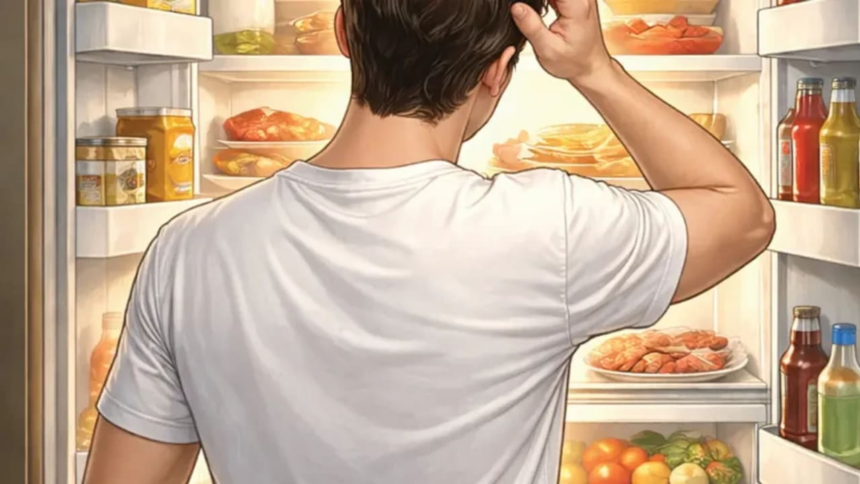
Why do we continue to want to eat even after we are full? The answer, according to a new study, is simple and troubling: The brain does not really “update.” Even though the meal is over, even if it was satisfying, suddenly “something small,” sweet or salty, calls from the kitchen. Without hunger, without a real need, and yet the hand reaches out. If this happens to you, it is not a matter of weakness. It is a known biological mechanism.
A new study, published about a month ago in the scientific journal Appetite, showed that even when people are completely full, their brains continue to respond strongly to food-related stimuli. In the study, conducted by researchers from the University of East Anglia in collaboration with the University of Plymouth, brain electrical activity was examined using EEG – a non-invasive method that measures brain waves through electrodes attached to the scalp.
76 participants took part in a task in which they learned to associate images of foods such as chocolate and snacks with a reward. In the middle of the experiment, they ate the same food until a full feeling of satiety, meaning until they no longer wanted to eat it at all. Indeed, behaviorally, they showed a clear decrease in interest in the food and even rated it as less tempting. However, when they were shown images of the same food again, the brain’s reward areas continued to respond with the same intensity as before eating.
This gap between behavior and brain activity is one of the central findings of the study. It also explains a phenomenon I encounter in the clinic: People who finish a full meal and then find themselves in front of the refrigerator, not out of real hunger, but out of an impulse that is hard to explain.
It is customary to think that eating is controlled mainly by hunger and satiety, that is, by the body’s physical need for energy. Indeed, there is a complex biological system that regulates these sensations. When energy levels in the body drop, the hormone ghrelin is secreted, which increases the feeling of hunger. After eating, hormones such as PYY and GLP-1 are released, signaling satiety, while leptin reflects the state of energy stores in the long term.
But alongside this, another system operates, no less powerful – the brain’s reward system. This system does not deal with energy needs but with pleasure and learning, and it responds to stimuli such as the sight of food, smell, advertisements or memories of pleasant eating experiences. When we are exposed to such stimuli, dopamine is released, a chemical in the brain involved in pleasure and motivation, and it is what encourages us to approach food and eat, even when there is no physical need.
A broad review published in 2021 in the scientific journal Nature Reviews Gastroenterology & Hepatology, by researchers from the Universities of Copenhagen and Cambridge, shows that the reward system can operate independently of the body’s energy needs. That is, even when the body does not need additional energy, mere exposure to appealing food can trigger an urge to eat.
The new study adds an important layer to this understanding. It shows that it is not just a momentary response, but also that the brain continues to assign food a high reward value even after satiety. Moreover, the researchers did not find a significant link between measures of conscious decision-making and the intensity of this brain response. That is, even people with high self-control are not immune. In other words, there are situations in which the brain operates almost on “autopilot,” without a conscious decision entering the picture.
One hypothesis is that this is a learned response. Over the years, a repeated connection is formed between certain foods and a feeling of pleasure, until the response becomes automatic. In such a state, eating is not always the result of a conscious decision, but a response that is quickly activated in the presence of a stimulus.
In recent decades, there has been a dramatic increase in the availability and marketing of ultra-processed foods, characterized by a combination of sugar, fat and salt, which particularly enhance the activation of the reward system. Researchers describe this reality as part of an “obesogenic environment,” that is, an environment saturated with stimuli that encourage eating even without hunger.
Systematic reviews from recent years point to a consistent link between the consumption of ultra-processed foods and an increase in calorie intake and impairment in eating regulation. The meaning is that our brain not only responds to stimuli, but responds especially strongly to foods designed precisely to activate this system. Some studies indicate that there is variability between people in sensitivity to food stimuli.
From my experience as a dietitian, this also explains a sentence I hear quite often in the clinic: “I am not hungry, but I feel like something.” This is not a contradiction, but an expression of two systems operating in parallel.
First of all, change the perspective. Instead of interpreting eating without hunger as a lack of control, it is worth understanding that this is a predictable biological response. This reduces guilt and allows for more mindful conduct.
Second, address the environment. If it is known that the brain responds to stimuli, it is worth reducing unnecessary exposure. This can be a small change, such as not leaving snacks visible, cookies in a transparent jar on the counter or reducing exposure to eating in front of screens that increase stimulation, such as cooking shows.
And finally, it is possible to adopt a simple but effective tool: Wait a few minutes before acting. In many cases, an urge to eat that does not stem from hunger fades on its own if not acted upon immediately. This time can be used for a short and enjoyable activity such as a shower, a conversation or watching an episode of a favorite series. If afterward there is still a desire to eat, it is possible to choose to do so consciously, out of a decision and not out of an automatic response.
This is why sometimes it is almost impossible to stop in front of a small snack. Not because of a lack of willpower, but because the brain responds exactly as it was designed to respond. Once this is understood, it is possible to try to start working with it, and not against it.
Copyright ©2026 Jpost Inc. All rights reserved
•
•