




Audio Option is available to paid subscribers. Upgrade your plan
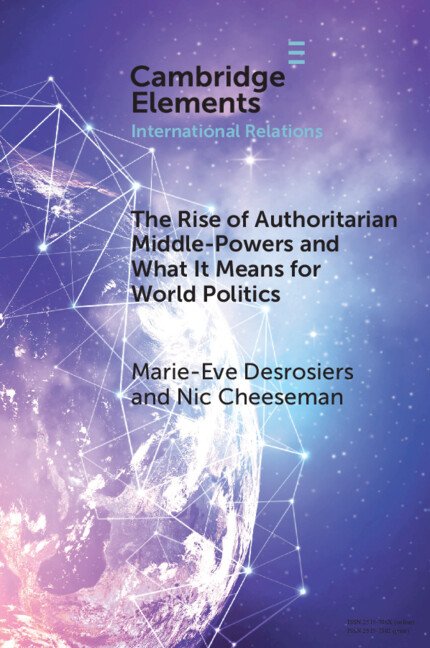
What role do authoritarian middle powers play in international relations? Do they withdraw from multilateral institutions, or do they use them to gain wider acceptance for their autocratic methods? These are the questions that Maroe-Eve Desrosiers and Nic Cheeseman try to answer in The Rise of Authoritarianism and What It Means for World Politics. The book, which is a part of the Cambridge Series Elements in International Relations, adds to the presently burgeoning scholarship on middle powers by examining the policies of countries like Turkey, Venezuela, Saudi Arabia and the UAE and the role they play in sustaining conflicts, destabilising their respective regions and undermining the efforts of multilateral organisations to uphold international democratic standards.
The theoretical gap that this element seeks to fill is the relative neglect of authoritarian or autocratizing middle powers within IR and comparative politics. Historically, middle powers like Canada, Norway, and Australia were associated with liberal internationalism. Lacking the coercive capacity of great powers, they relied on multilateralism, norm-building, and principle-based diplomacy, deriving legitimacy from domestic egalitarianism and an outward commitment to cooperative global governance.
Desrosiers and Cheeseman complicate this image by focusing on non-Western middle powers that have emerged since the end of the Cold War. Many of these states are either authoritarian or undergoing autocratisation and differ immensely from traditional middle powers. Rather than being “sovereignty-eroding” through multilateral engagement, they tend to be sovereignty-reinforcing, often adopting revisionist positions and showing a greater willingness to use hard power at the regional level. While both traditional and authoritarian middle powers employ similar soft-power strategies, including transactional aid and prestige diplomacy, the latter use such tools to obscure their coercive practices. Such participation, the authors argue, helps secure both international legitimacy and domestic acceptance, while simultaneously diluting liberal norms.
Yet the book’s analytical strength is undercut by a tendency towards a West-centric reading of global politics. The erosion of democratic norms is largely attributed to the non-Western world, while similar developments in Western states, particularly the United States, are treated as aberrations. This framing also leads the authors to interpret demands for reform of institutions like the United Nations Security Council as illiberal “counter-norms,” a claim that remains completely unsubstantiated. Conversely, reforms within authoritarian states are often dismissed as mere “window dressing.” Nevertheless, the book offers a timely and important contribution. By highlighting the growing influence of authoritarian middle powers, it challenges established assumptions within international relations and opens new avenues for research at a moment when the liberal international order appears increasingly fragile.
Stay updated with the latest developments.
©2025 – All Rights Reserved
The Rise of Authoritarian Middle-Powers and What It Means for World Politics, by Maroe-Eve Desrosiers and Nic Cheeseman – India’s World Magazine



Leave a Comment

