


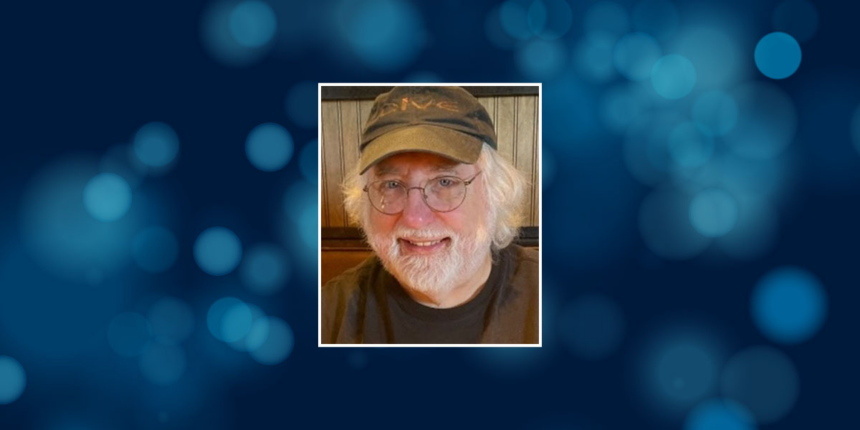
Richard L. Cross, a researcher devoted to studying how adenosine triphosphate, or ATP, is made by the ATP synthase, died Feb. 7. He was 82. Cross was a longtime member of the American Society for Biochemistry and Molecular Biology and served on the editorial board of the Journal of Biological Chemistry for 24 years.
Born August 26, 1943, in Hoboken, New Jersey, Cross received his B.A. in chemistry from Hartwick College and his Ph.D. in chemistry from Yale University in 1970. After his Ph.D., he completed postdoctoral research at UCLA, in the lab of Paul Boyer, who later shared the Nobel Prize in Chemistry in 1997. In 1973, Cross joined the faculty of the State University of New York Upstate Medical University, in the Department of Biochemistry and Molecular Biology.
Cross played a key role in studying ATP synthase, the molecular motor enzyme that produces most cellular ATP. In 1973, Cross, Boyer and William Momsen published a paper that marked the beginning of the binding change mechanism, as Boyer later highlighted in his Nobel Prize lecture. In this work, they proposed: “In oxidative phosphorylation, energy from electron transport causes release of preformed ATP from the catalytic site. This release could logically involve energy-requiring protein conformational change.”
After establishing his lab, Cross co-authored two studies that provided critical support for a second key feature of the binding change mechanism: cooperativity between multiple catalytic sites. Later, his lab provided strong evidence for a third key concept: the cooperative, alternating action of three catalytic sites involves rotation of a central stalk subunit relative to the surrounding catalytic sites.
According to long-time departmental colleagues at SUNY Upstate, Patricia Kane, distinguished teaching professor, and Thomas Duncan, associate professor emeritus, Cross was an amazing mentor to faculty and students. He provided wise, fair and practical advice and had an unparalleled ability to encourage and inspire those he mentored to continually reach higher.
Cross is survived by his wife, Kathryn Davis; his daughter, Emily; and his brother, Greg.
Become a member to receive the print edition four times a year and the digital edition monthly.
Jessica Desamero is a graduate of the biochemistry Ph.D. program at the City University of New York Graduate Center and an ASBMB volunteer contributor.
Enter your email address, and we’ll send you a weekly email with recent articles, interviews and more.
The RNA Society awards Brenda Bass, Can Cenik and Karin Musier–Forsyth for their achievements in RNA research and innovation. Winners will be recognized at the closing awards ceremony of the RNA 2026 annual meeting.
Payton Stevens never planned to become a pancreatic cancer researcher. A temporary job set him on a path from rural Kentucky to leading research on Wnt signaling and metastasis, where he now pairs discovery with mentorship and science advocacy.
He plans to develop a first-year chemistry lab program designed to help students build essential laboratory skills and connect core chemical concepts with real-world challenges.
She was a pioneer in the study of yeast genetics and lipid metabolism and was an editorial board member of the Journal of Biological Chemistry.
The group, led by Cedric Owens, is being honored for its commitment to scientific engagement, mentorship and community building, creating meaningful opportunities for students in biochemistry and molecular biology.
He is one of three individuals who will receive $90,000 to fund their research.
In memoriam: Richard L. Cross – American Society for Biochemistry and Molecular Biology



Leave a Comment