


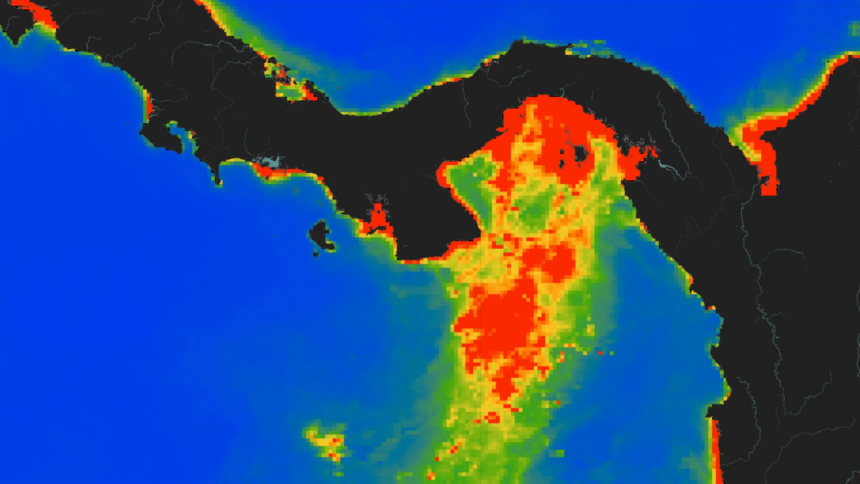
Each year during Central America’s dry season (generally between December and April), strong northern trade winds help drive an important ocean process in the Gulf of Panama. These winds push surface waters in a way that allows colder, nutrient-rich water from deep below to rise toward the surface.
This process, known as upwelling, plays a major role in the region’s marine life. It fuels highly productive fisheries, helps shield coral reefs from heat stress, and keeps the water along Panama’s Pacific beaches cooler during the busy "summer" vacation season.
A 40-Year Pattern Suddenly Changed
Scientists at the Smithsonian Tropical Research Institute (STRI) have tracked this seasonal upwelling for decades. Their records show that from January to April, the event has been a reliable and predictable part of the Gulf of Panama for at least 40 years.
But in 2025, researchers documented something they had never seen before. For the first time in their records, this essential oceanographic process did not occur. The usual seasonal cooling was weakened, and the expected surge in ocean productivity was also reduced.
Weaker Winds May Be the Cause
In a recently published article in the journal PNAS, the scientists suggest that a major drop in wind patterns likely drove the unprecedented failure. The finding shows how quickly climate disruption can interfere with basic ocean processes that have supported coastal fishing communities for thousands of years.
Researchers caution that more work is still needed to identify the exact cause and understand what the event could mean for fisheries.
Tropical Oceans Need Better Monitoring
The discovery points to the rising vulnerability of tropical upwelling systems. These systems are enormously important for ecosystems and coastal economies, yet they remain poorly monitored in many parts of the world.
The findings also highlight the need to improve ocean climate observation and forecasting across tropical regions.
The result is one of the first major outcomes from the collaboration between the S/Y Eugen Seibold research vessel from the Max Planck Institute and STRI.
Story Source:
Materials provided by Smithsonian Tropical Research Institute. Note: Content may be edited for style and length.
Journal Reference:
Cite This Page:
Scientists Say Adding This Unusual Seafood to Your Diet Could Reverse Signs of Aging
Scientists Say a Hidden Structure May Exist Inside Earth’s Core
Why Popular Diabetes Drugs Like Ozempic Don’t Work for Everyone: The “Genetic Glitch”
Doctors Surprised by the Power of a Simple Drug Against Colon Cancer
Stay informed with ScienceDaily’s free email newsletter, updated daily and weekly. Or view our many newsfeeds in your RSS reader:
Keep up to date with the latest news from ScienceDaily via social networks:
Tell us what you think of ScienceDaily — we welcome both positive and negative comments. Have any problems using the site? Questions?
Panama’s ocean lifeline vanishes for the first time in 40 years – Science Daily



Leave a Comment