The popular story goes that AI agents are swallowing more programming work and developers are headed for obsolescence. A new paper from researchers at Chalmers University of Technology and the Volvo Group argues that view misses the point.
The researchers offer a different take: agent-based AI systems expand software engineering with what they call “semi-executable artifacts.” These include prompts, workflows, policies, escalation rules, and decision routines. They shape system behavior just as directly as code, but they rely on human or probabilistic interpretation to actually run.
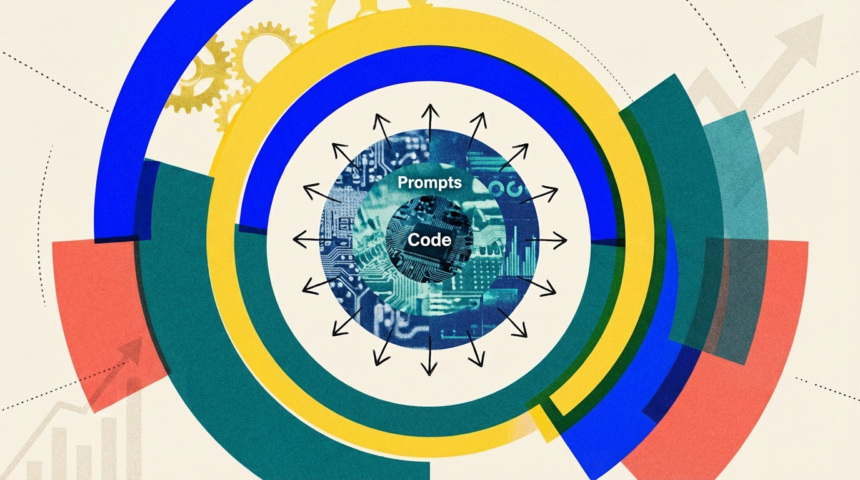
At the heart of the paper is the “Semi-Executable Stack,” a diagnostic model built from six rings. At the center sits classic code as ring 1, followed by prompts and natural language specifications as ring 2, and orchestrated agent workflows as ring 3. Ring 4 covers control systems like guardrails and monitoring. Ring 5 represents operational organizational logic, such as decision-making routines. Ring 6 captures the social and institutional fit, including frameworks like the EU AI Act.
The authors point out that software engineering has historically focused on rings 1 and 2. Now, rings 2 through 5 are turning into high-priority engineering objects, and ring 6 increasingly decides what actually works in practice.
The biggest gap, according to the researchers, sits in the outer rings 5 and 6. Engineering methods for code have existed for decades, but equivalents for decision routines, governance, and institutional fit are still missing. Most research continues to concentrate on code generation, bug-fixing, testing, and benchmarks in rings 1 through 3.
The researchers back their argument with three observations: first, AI doesn’t need to match the best engineer to change how teams work; it just has to be good enough. Second, scale matters more than peak performance. Many small, everyday AI deployments deliver more value to an organization than rare access to a top expert. Third, as more domain experts build their own systems using natural language, the need for clean engineering practices grows rather than shrinks.
Rather than brushing off the usual criticisms around reliability, messy code, and the like, the researchers reframe them as engineering tasks. When agents hallucinate, testing and monitoring become more important, not less. When AI cranks out code faster, maintenance costs climb along with it. Take “prompt drift,” where someone tweaks a prompt, the system starts behaving differently, and nobody can figure out why later.
When organizations struggle with this shift, the transition itself turns into an engineering challenge. And the fact that nuanced judgment is difficult to automate is undoubtedly why it becomes more valuable, not less, as low-level tasks get cheaper and more automated, the researchers write.
For practitioners, the paper makes one thing clear: “The scarce skill shifts from building faster to deciding what is worth building or changing, which ring is actually being changed, how that change will be validated, how it will be governed, and how it will be maintained over time.” Teams that treat AI as just an efficiency tool for rings 1 and 2 may see local productivity gains, but they’ll miss the bigger question of organizational redesign.
The paper accompanies a keynote by Robert Feldt at the Agentic Engineering 2026 Workshop in Rio de Janeiro and draws in part on industrial work in the automotive sector with Volvo partners.
Subscribe to THE DECODER for ad-free reading, a weekly AI newsletter, our exclusive “AI Radar” frontier report six times a year, full archive access, and access to our comment section.
Stay in the loop on AI. Clear, useful, no fluff.
Follow The Decoder for AI news, background stories and expert analyses.
Stay in the loop on AI. Clear, useful, no fluff.