




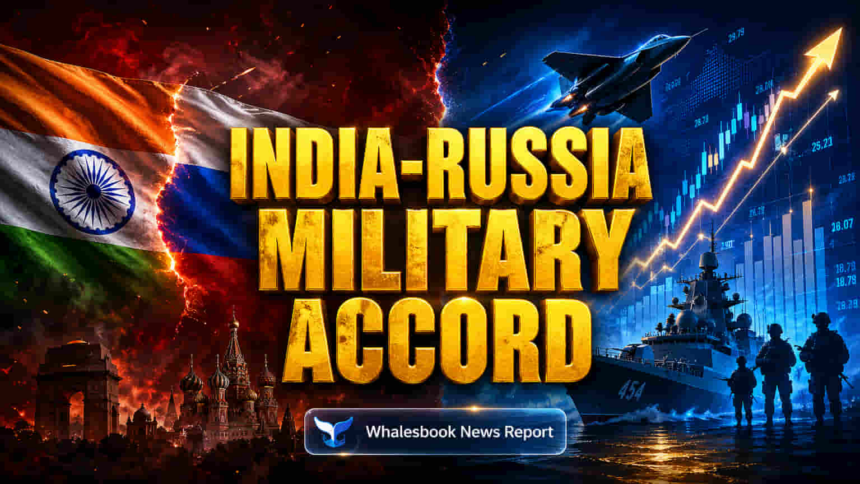
The India-Russia Reciprocal Exchange of Logistics (RELOS) agreement is now operational, allowing each country to host significant military assets from the other. The pact permits stationing up to 3,000 troops, five warships, and ten aircraft. This marks a strategic step for India to boost its defense procurement diversification and strengthen supply chains amid global pressures and a shifting arms market.
Used by 10,000+ active investors
Select the stocks you want to track in real time.
Receive instant updates directly to WhatsApp.
The India-Russia Reciprocal Exchange of Logistics (RELOS) agreement going live is a key development in New Delhi's defense strategy. The pact allows each nation to station significant military assets – including up to 3,000 troops, five warships, and ten aircraft – on the other's territory. This formalizes mutual access to military bases, showing increased trust which is vital in today's uncertain global security situation.
The RELOS agreement's activation occurs as India adjusts its defense buying plans. Historically, Russia supplied a large share of India's military hardware, estimated at 60-70%. However, India has been diversifying its sources, partly due to pressure from the United States and the demand for advanced technology. The pact with Russia ensures India can still get necessary equipment and spare parts for its older systems. At the same time, India is building ties with Western suppliers like France and the U.S. for newer technologies. This strategy of working with multiple partners aims to secure its supply chains, a key need as global defense spending is expected to rise significantly, reaching $2.75 trillion in 2026 and $4.27 trillion by 2035. India's own defense budget for FY 2026 is projected around $93 billion, showing its focus on modernization and domestic manufacturing.
Russia has historically offered technology transfer and flexible payment terms, but faces competition from Western suppliers who provide advanced systems, often at higher costs and with more restrictions. The RELOS agreement helps India manage these different approaches, potentially using Russian access for older equipment support while seeking advanced Western technology. This is crucial for Russian defense exporters, whose global market share has dropped significantly. Retaining customers like India is now very important for them. Meanwhile, Western defense firms are benefiting from increased NATO spending and strong global demand for advanced arms, viewing India as a key market. India's own defense industry is growing rapidly, boosted by initiatives like 'Make in India'. Exports reached $2.8 billion in FY25, with ambitious future targets. This growth aims to reduce reliance on imports and establish India as a major global arms exporter.
India's defense buying has changed greatly since the Cold War, when Soviet weapons, offered with favorable payment terms, were central to its military. The risk of U.S. sanctions under CAATSA, especially for deals like the S-400 air defense system, showed the strategic dangers of relying too heavily on Russia. However, the RELOS pact's activation suggests India is balancing these geopolitical pressures by strengthening core relationships while still diversifying. The global defense industry is in a period of high spending due to increased geopolitical tensions. This trend is leading to higher valuations for defense stocks; for example, Lockheed Martin trades at an earnings multiple of about 31 times future profits. This environment also encourages mergers and acquisitions as countries focus on future military technology.
Even as India diversifies and boosts domestic manufacturing, its significant reliance on Russian military equipment remains a challenge. Keeping older hardware operational requires ongoing access to Russian parts and expertise. The RELOS agreement helps manage this need but doesn't remove the dependency. This continued reliance risks straining relationships with Western partners, especially the U.S., which has previously used sanctions threats like CAATSA to influence defense deals. While India has often obtained waivers or managed sanctions due to its strategic value, the risk of future pressure persists. Moreover, the performance of Russian military gear in recent conflicts has raised questions about its technological edge compared to Western systems, despite lower production costs and higher output. This could cause strategic differences if India's modernization focus shifts strongly towards Western technology.
India's defense industry is set for growth, fueled by government policy and its expanding domestic sector. However, companies face hurdles. Defense manufacturing involves long project timelines, so financial results are heavily dependent on government orders and stable policy. The global defense market is also becoming more concentrated, with major Western companies benefiting from large budgets in Europe and North America. Smaller Indian firms may find it difficult to compete on size and advanced technology without strong partnerships and steady investment in research and development. Ongoing supply chain disruptions, a common issue in the defense industry, also complicate planning and cost control.
India's defense sector is pursuing strategic growth, supported by growing domestic capabilities, strong government backing, and an expanding export market. The RELOS agreement strengthens India's position to balance relationships with major global powers, helping secure its supply chains amid geopolitical uncertainty. Analysts expect continued strong earnings growth for private defense companies, driven by domestic production and export success. This points to ongoing positive valuation trends for the sector. However, managing complex international relationships and keeping pace with global defense leaders will be key for sustained success.
Quarterly results, bulk deals, concall updates and major announcements delivered in real time.
Used by 10,000+ active investors
Select the stocks you want to track in real time.
Receive instant updates directly to WhatsApp.
India & Russia RELOS Deal Goes Live, Reshaping Defense Buys – Whalesbook



Leave a Comment

