


WASHINGTON – The Supreme Court sounded open on March 24 to letting the federal government send back asylum-seekers at the U.S.-Mexico border, although the justices also debated whether they can even rule on a policy that’s not currently being used.
“We don’t have an actual policy,” Justice Ketanji Brown Jackson, one of the court’s three liberals, said during more than an hour of oral arguments. “None is on the table.”
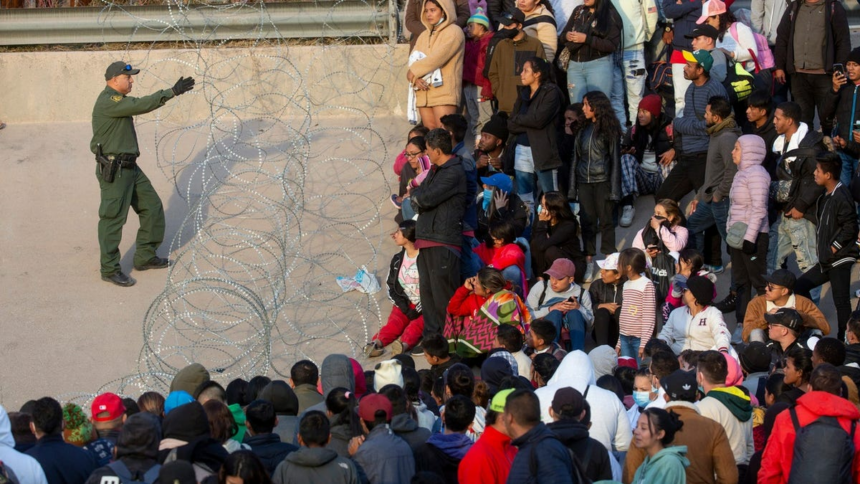
The practice often called ”metering” – used by Democratic and Republican administrations alike to manage the number of people who can claim asylum each day – was rescinded by the Biden administration.
But the Trump administration − which already has a sweeping ban on asylum at the border that is facing a different legal challenge − wants to be able to use it, calling the policy a “critical tool for addressing border surges.”
“I can’t predict when the next border surge occurs,” Vivek Suri, an attorney for the Justice Department, told the Supreme Court during oral arguments. “But I can say that when it does occur, this is a tool (the Department of Homeland Security) will want in its tool box. It’s not something the court should leave to future uncertainty.”
The Justice Department asked the Supreme Court to overturn a ruling that the government is required to process a claim once someone reaches a port of entry.
Immigrant rights organizations and asylum-seekers challenging the policy argue the government has used it to turn away people who are desperate, even when there’s sufficient staffing and other resources to deal with them.
“This case was never about capacity,” said Nicole Elizabeth Ramos of Al Otro Lado, an immigrant rights group that helped bring the initial 2017 class action lawsuit. “It was about cutting off access to a group of people that the government – specifically the president and his administration – deem undesirable.”
In a 2020 report, internal watchdogs at the Homeland Security Department said that, regardless of a port’s actual capacity and capability, border patrol agents at some crossings routinely told migrants they weren’t able to process them.
When Justice Sonia Sotomayor, another of the court’s liberals, pressed the Justice Department about that report, Suri disputed it. He also said that the question the court is being asked to decide is whether the policy is legal under any circumstance.
But under questioning from Justice Brett Kavanaugh, one of the court’s six conservatives, Suri acknowledged the government believes it can turn back asylum-seekers even when border ports are not overwhelmed.
U.S. Customs and Border Protection has said it needs flexibility to manage its varied agenda, which includes stopping drug trafficking and facilitating lawful trade and travel.
To be granted asylum – a process that can take years – an applicant must demonstrate they have faced persecution based on one of five protected grounds: race, religion, nationality, political opinion or membership in a particular social group.
The 1986 Immigration and Nationality Act allows anyone “who is physically present in the United States or who arrives in the United States” to apply for asylum.
The San Francisco-based 9th U.S. Circuit Court of Appeals said the best way to interpret “arrives in” is that it doesn’t mean the same thing as “physically present,” which would be redundant.
Instead, the term “encompasses those who encounter officials at the border, whichever side of the border they are standing on,” a divided panel of judges said.
Otherwise, the court said, the law gives migrants an incentive to try to circumvent border crossings, something Congress likely did not intend.
The Justice Department says that interpretation defies the plain text of the law.
“You can’t arrive in the United States while you’re still standing in Mexico,” Suri said. “That should be the end of this case.”
He faced the most skeptical questions from the court’s liberal justices, including Sotomayor who pressed Suri on whether the administration’s interpretation violates the letter or spirit of federal law protecting refugees.
Some of the court’s six conservative justices gave Suri a chance to emphasize the issues the government was trying to address when it used the policy.
Suri said ports of entries were overwhelmed with asylum seekers, including not always having enough food or shelter to house them.
Kavanaugh wondered if the court should even focus on the definition of “arrives in” when deciding if the policy can be used.
“The bigger question, it seems to me, is can the government physically stop people before they get to wherever that line is, no matter how we define it,” he said.
The practice of not letting an asylum-seeker pass through a checkpoint was used periodically during the Obama administration, when border officers began turning away hundreds of Haitian asylum-seekers at ports of entry in California.
Customs and Border Protection officers could stop undocumented migrants from physically setting foot on U.S. soil whenever they considered a border crossing too busy.
The policy was formalized during the first Trump administration, and the Biden administration lifted the policy but allowed exceptions.
As a result, immigrant rights groups say, asylum-seekers lived for months in makeshift camps on the Mexico side of the border without reliable food, shelter or safety.
Their lawsuit is backed by the Catholic Church and other religious organizations.
“Every major faith tradition makes protecting the stranger a core value,” said Liz Theoharis, executive director at the Kairos Center for Religions, Rights, and Social Justice. “For Christians like myself, protecting and welcoming the immigrant is one of Jesus’ first and most powerful teachings.”
More: Will the majority-Catholic Supreme Court listen to the church on immigration?
But Eric Wessan, the top appellate lawyer for the Iowa attorney general’s office, said the justices probably agreed to take the case because they believe the appeals court misread the law.
“As a textual matter,” he said, “I just find it really hard to believe that the Supreme Court that we have is going to interpret ‘in the United States’ to include people stopped outside the border that are not in the United States.”
'We don't have an actual policy.' Supreme Court debates limits on asylum-seekers – USA Today

Leave a Comment