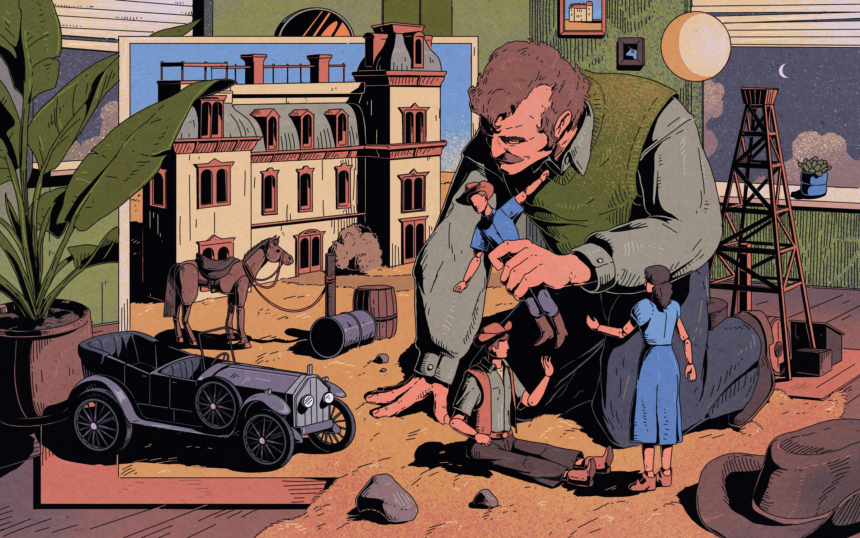
Seventy years ago, the movie held up an unflattering mirror to Texas that we can’t help but admire ourselves in.
When it comes to cultural relevance, seventy years is an eternity. If you’ve ever yearned to feel the cold grip of time’s cruel indifference, try asking somebody under 25 to name their favorite Elvis Presley song or pick Doris Day out of a lineup. Yet Giant has remained a cornerstone of the Texas canon ever since its release on November 24, 1956. Chances are good that the movie will play somewhere near you within the next year, because Texas’s repertory cinemas seem to use Giant the way audiophiles test their speakers with Steely Dan. Watching Rock Hudson, Elizabeth Taylor, and James Dean squabble grandiosely over land and love for three-plus hours remains a rite of passage for every native or aspiring Texan (although each successive generation may undertake it more grudgingly than the last).
All our stories in one daily email.
You agree to our Privacy Policy
Giant might no longer quite be our “state religion,” as Texas Monthly contributor John Bloom (a.k.a. Joe Bob Briggs) once opined. But it has earned a vaunted place among our foundational myths, exerting a lasting influence on the way we Texans like to imagine ourselves. That ardor is even more remarkable considering Giant doesn’t exactly return the favor. Both Edna Ferber’s 1952 novel and the screenplay she helped adapt for director George Stevens make Texans out to be a largely vicious, bigoted, almost primitively backward bunch. In the movie, the men, like the staunchly traditionalist cattle rancher Bick Benedict (Hudson), are portrayed as blithe chauvinists at best. They’re all desperately in need of a stern talking-to (or three) from Bick’s uninhibited new bride from Maryland, Leslie (Taylor), who serves as the mouthpiece for Ferber’s East Coast morality and dares to upend Bick’s stodgy social order. At their worst, Texans resemble the callous cowhand Jett Rink (James Dean): petulant, narcissistic opportunists hell-bent on taking revenge on the wider world.
When Giant was first published, Ferber’s acidic view of Texans proved so insulting to certain high-minded citizens of the state that they threatened to shoot her on sight. But her intent wasn’t to ridicule. Throughout the book, Bick holds up Texas as “a different country altogether” from the rest of the United States, and Ferber didn’t mean it as a compliment. She wrote Giant as a warning, indicting Texas as a rogue state whose unchecked greed, racism, and arrogant exceptionalism foretold a dark future for America. Despite the author’s unflattering portrayal, however—or because of it—Texans snapped up copies of her book. The movie packed theaters across the state. And in the decades since, “Texas. It’s Like a Whole Other Country” has been adopted as a tourism slogan, while any respectable list of the greatest Texas films ever made remains incomplete without Giant—a searing critique of our whole way of life that has become one of our most sacred texts. Well, I suppose the Bible called us sinners too.
Why do we still love Giant? Some credit is clearly due to James Dean, who died tragically mere weeks after he completed filming and whose legend is thus immortalized in every frame. Even seventy years on, the movies have yet to yield an image of “the Texan” that’s as cool as Dean with his boots kicked up on the side of a vintage car, his rakishly tipped Stetson cattleman casting an inscrutable shadow over his eyes. And, although Texans have rarely been painted uglier than we were in Giant, the state itself has arguably never looked more beautiful, or more like heaven on earth, than in the scene where Rink paces off his newly inherited land while silhouetted against a glorious West Texas sky. Through the painterly lens of Giant’s Oscar-nominated cinematographer William C. Mellor, even the Benedicts’ sprawling ranch, Reata, its ludicrously massive Victorian mansion squatting conspicuously in the desert scrub, reads as less absurd than otherworldly, the sort of Southwestern Shangri-La dreamed of by every plutocrat who’s ever moved here with too much money.
We continue to revere Giant because it’s the rare Texas film that was actually shot in Texas. Stevens joked that the backlash to Ferber’s book was so hot, “we’ll have to shoot it with a telephoto lens across the border from Oklahoma.” But by the time production began in Marfa, any lingering indignation was lost in the starry-eyed excitement over so many itinerant celebrities. After the film proved a critical and commercial smash (it received ten Oscar nominations, including a win for Stevens), whatever shame might have remained around our depiction had been replaced, in an exceedingly Texan manner, by fervent local pride. That sense of ownership continues today. Marfa’s Hotel Paisano, where the cast and crew lodged during production, featured a dedicated Giant room crowded with memorabilia (the historic property is currently closed for renovations under new owners). Along the stretch of U.S. 90 that runs near the rotting remains of the windmill Dean famously climbed, fifteen-foot-tall plywood cutouts of the film’s stars stand, Ozymandias-style, in the desert. Giant has become part of Texas’s iconography, as familiar as the armadillo and the Alamo.
The film’s visuals still pop in 2026, more so than its plot, which has only grown more bloated and sluggish with the passing of time. The performances, Dean’s tempered method acting aside, seem more melodramatic, verging on soap opera camp in our postmodern age. But Giant’s vision of Texas feels both more poignant and more alluring now, particularly after decades of developers whacking up the state’s remaining wilderness for real estate. The film serves as a historical document, but more potently, it’s become a Texas fantasy, like the Wild West tales that kids in 1956 would have devoured from seventy years before their time. Giant captures a people and a place caught between a frontier past and a looming corporate future, embodied here by the insidious creep of oil (and the more charismatic creep that is Jett Rink). Now the “future” has become ancient history, and the present that’s replaced it is not nearly so cinematic. If Giant took place today, Reata would probably be a dude ranch, with Bick fretting over the croissant count for the next big corporate retreat.
Perhaps we still come to Giant because its text—power, inequality, upheaval—remains the story of Texas itself. It’s a tale that has not yet reached its denouement. There are still Bick Benedicts lording over Texas—men who believe themselves to be fundamentally decent and hardworking yet remain blinkered to, or indifferent toward, the ways their empires are built on structural inequalities. There are Leslies too: women who refuse to be silent supplicants, who call out prejudices and aid the disempowered, even as many of them remain beholden to the social order that keeps them comfortable. And unfortunately, there are still Jett Rinks kicking around, still elevated by a system that conflates wealth with worth and still using the chips on their shoulders to justify every self-serving move they make. Today’s Jett would surely be a Joe Rogan–worshipping manosphere brat, his big windfall arriving through a cryptocurrency scam or Polymarket bet. In that version of Giant,he’d be selling off his land to make room for a fleet of data centers.
Like Bick, who longs for the good ol’ days when everyone rode horses and women knew their place, we can’t help but mourn the Texas of Giant, when our moral decrepitude at least had some panache. Writing on the film’s fortieth anniversary, Larry McMurtry argued that Texas audiences embraced Giant because they were already nostalgic for “the glorious flamboyance that once existed in the state,” epitomized by real-life characters like oil magnate Glenn McCarthy, the not-so-secret inspiration for Jett Rink. Even in 1956, McMurtry noted, the oil business was being passed down from the flashy wildcatters to cautious puritans and Ivy League–educated businessmen who didn’t know how to party. Whatever fun remained to be wrung from Texas’s relentless greed was exhausted by the eighties heyday of Dallas, the spiritual sequel to Giant. Even that was nearly a half century ago now. One can only imagine McMurtry’s dismay at Texas’s current nouveau riche class, embodied by the performative, try-hard eccentricities of Elon Musk, a man who may one day get us to Mars but will never, ever look cool in a cowboy hat.
In this era of dog whistles and ICE raids, even Giant’s portrayal of racism feels almost nostalgically quaint. The saga of Texas selling its soul to oil and avarice is just the historical backdrop for Giant’s smaller morality play about the state’s bigotry—which, in Bick’s case, seems rooted in tradition more than any animus. At the very least, he cloaks his prejudices in nineteenth-century gentility, admonishing Leslie early on about “making a fuss over those people” after she dares to ask the names of the Mexicans who serve them. When Bick’s new bride suggests that perhaps the workers who run his ranch shouldn’t have to live in segregated squalor or be denied access to a doctor, Bick shoots back, “I’m not the Red Cross, I’m a cowman!” His eventual conversion is hardly road-to-Damascus stuff. Softened by his new half Mexican grandson, Bick—in a scene newly invented for the film—stands up to a racist diner owner and then gets his lights punched out. It’s a minor redemption that stands in for what felt at the time like an inevitable social reckoning, with a more lasting harmony just over the horizon. Who would have guessed that seventy years later, we would still be having these same fights, or that in certain corners of Texas, Bick might be considered a radical?
We’re not at the post-racial utopia that Giant’s ending promised us, with Bick and Leslie beaming at their grandchildren while a black calf and a white lamb graze symbolically in the background. But maybe that’s also why we keep coming back to Giant—not just to lose ourselves in the past but to bask in the film’s optimism about the future and our capacity for greatness, not just grandiosity. For all the criticisms it lobbed, for all the caricatures its author created, Giant saw true beauty in Texas, even at its ugliest.
That Texas can embody both humanity’s worst aspects and its deepest potential is what makes the state so confounding and exciting, and so endlessly useful as a canvas for storytelling. And clearly, Texas still has the capacity to surprise: Even in Ferber’s and Stevens’s most utopian fantasies, they could hardly have imagined that seventy years later, this state would elect a Mexican American woman as its governor. Giant remains relevant because it’s about change. In Texas, that’s a story that has yet to fall out of fashion.
By Taylor Prewitt
By Sean O’Neal
By Hannah Smothers
By Dan Solomon
By Texas Monthly
By Sean O’Neal
Subscribe today to view and add comments.
Already have a subscription? Log In.
By Josh Alvarez
By Christopher Hooks
By Paul L. Underwood
By Eric Benson
By Forrest Wilder
By David Griscom
By Forrest Wilder
By Texas Monthly
By Paula Forbes
We report on vital issues from politics to education and are the indispensable authority on the Texas scene, covering everything from music to cultural events with insightful recommendations.
Copyright © 2026. All Rights Reserved.