




COP31 President: Climate Deal Not Approved
BBC News
This video can not be played
COP31 climate talks in Turkey are at risk of collapsing after the EU formally rejected the latest draft agreement – we're bringing you the latest updates and analysis here
The summit's president says the deal has not been approved, something our reporter Esme Stallard, who is at the summit in Antalya, says represents an almost unprecedented development
An EU representative has accused some oil states of hijacking talks after the bloc had been pushing to restore a commitment to move away from fossil fuels – the fourth draft still contains no mention of fossil fuels
Russia defend opposing its inclusion – after producers led by Saudi Arabia had called for its removal – and was directly critical of the EU in its speech
The latest draft acknowledges the goal set by the 2015 Paris Agreement of keeping the rise in global temperatures below 1.5C is going to be missed – as warming goes beyond this the effects of climate change will ramp up significantly
The summit is now the longest-running in history, with negotiations continuing two days after it had been due to end – here's a timeline of how we got here
Should countries be unable to reach consensus, negotiations could be suspended until next year, which has happened only once before at a COP summit
This video can not be played
Edited by Jamie Whitehead and Tinshui Yeung, with Esme Stallard and Justin Rowlatt reporting from the summit in Antalya, Turkey Esme Stallard
Senior climate and science journalist, reporting from COP31 Antalya
China has just taken to the floor.
It has raised concerns about the document but says it will accept it.
In the absence of the US, China is one of the most influential parties at these talks.
But it falls into two camps.
Despite being one of the world’s biggest emitters of greenhouse gases, it’s also the biggest generator of renewable energy.
It’s confident it can meet the target of 35% of energy consumption being provided by electricity by 2035 – perhaps even earlier.
Its position of supporting the text while raising issues reflects this dual character.Esme Stallard
Senior climate and science journalist, reporting from COP31 Antalya
Earlier, Russia used its speech to defend its position on why fossil fuels shouldn’t be mentioned in the text.
"From year to year we are urged to have a rapid phase out of fossil fuels," the delegate says. "But let's turn not to slogans."
The representative points to the work of the UN climate body, the Intergovernmental Panel on Climate Change (IPCC).
"Even the most ambitious IPCC scenarios limit warming to 1.5C and [require] deep cuts to fossil fuels, but not their disappearance altogether."
They warn that if the world moves away from fossil fuels too quickly, it will lead to "fuel poverty".
Then, in a direct pushback to the EU, the delegate switches from Russian to English and addresses it directly.
They point to the way the EU’s provision of climate finance in the form of loans adds to the burden on developing countries.
The spokesperson for the UK delegation, Kate Hughes, says "we must act with even greater urgency" to reduce emissions and build resilience to climate shocks.
"This situation calls for greater ambition," she says.
"What is before us is not commensurate with the urgency of overshoot, the scale of the climate crisis, or the impacts already being felt by the most vulnerable people and communities around the world," she tells the conference.
She says this is why consensus could not be found.
She calls the draft text the "lowest common denominator" when the situation called for "bold collective action".
She lists three areas where the UK believes ambition fell short: adaptation finance; reducing emissions in line with 1.5C; and protecting the world's forests, oceans and mountain regions.
"Because of our disappointment [today], we remain determined to work together on these issues," she says.
The EU representative says the COP31 summit has been "hijacked by some oil states".
Irish minister Darragh O'Brien, speaking on behalf of the EU, tells the AFP news agency that the conference "should be a reset moment for reality" and that climate policy "should be based in reality".Esme Stallard
Senior climate and science journalist, reporting from COP31 Antalya
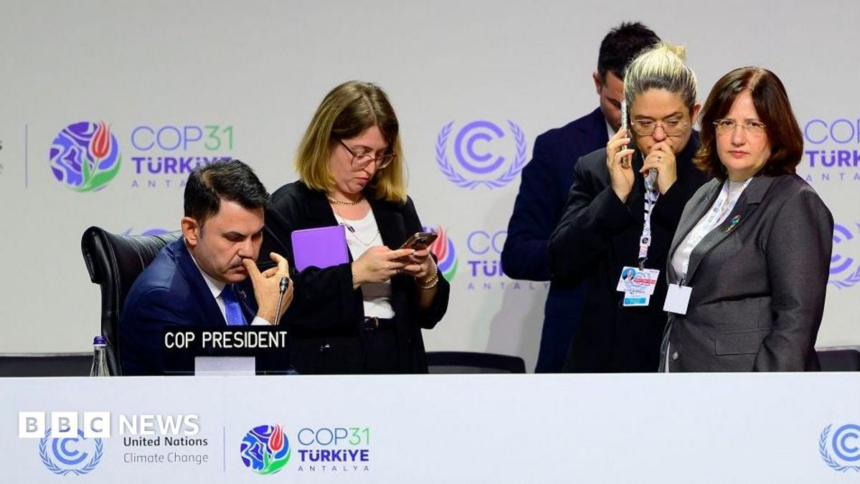
The COP president, Murat Kurum, has already said that "decisions have not been accepted".
But he has not yet formally closed this particular item of discussion, so the talks are still continuing.
This allows other countries to put on record their rejection or support for the deal.
But considering that dozens of countries have now rejected what’s on the table – all EU countries, the Marshall Islands, Panama and more – consensus has been lost.
The president now has a couple of choices.
He can push this deal to a COP-bis – a sort of halfway meeting in Bonn, where the UN climate body is based. This is what happened in 2000, the last time talks collapsed.
Or he could choose to delay decisions until next year’s COP conference. Ethiopia, which is hosting it, might take issue. There’s a risk these talks will be polluted by the acrimony we’re leaving this one with.
Saudi Arabia's delegate Mohammad Ayoub says Arab countries "continued to engage in good faith" despite "all of the issues that were taken off the table" during the conference.
He says countries "need to acknowledge" how they got to a situation where the 1.5C scenario is going to be exceeded.
"This is because four-fifths of the carbon budget for limiting warming to 1.5C were already consumed," he says, "leaving only one fifth for those countries that have not consumed it".
He says the 22 member states of the Arab League represent less than 2% of historic greenhouse gas emissions.Esme Stallard
Senior climate and science journalist, reporting from COP31 Antalya
This is an almost unprecedented moment for the UN climate summit.
I’ve been to five COPs, and there are people in this room who’ve been to 20 – we’ve never seen anything like this.
We are yet to confirm the talks have officially collapsed, but if it does, you have to go back a long way to find a time when COP didn’t reach consensus.
The pointed remarks from Saudi Arabia and Russia towards the EU, and the latter’s description of these talks as "greenwashing", reflect not just the state of climate action but the global order.
It feels as if other world events, including the Russia-Ukraine war, are bleeding into this room.
Countries are still speaking and saying they remain committed to multilateralism and continued climate action.
The Marshall Islands has also rejected the deals, but adds: "We will come back and continue this work. It is only together [that] we can solve this crisis."
We can now bring you more from COP31 President Murat Kurum.
He tells countries the summit had listened to "different ideas" and tried to "offer solutions".
"There were some sacrifices made on our behalf," he says.
"We have to accept the will of the parties," he goes on, adding: "We did not force anyone to accept [the draft]."
"I understand that there's no agreement on this text. For that reason, these decisions have not been adopted," he says, before opening the floor to more comments from parties.
COP31 President Murat Kurum says there is no agreement on the draft text and the decisions have not been adopted.
We’ll bring you more shortly.Esme Stallard
Senior climate and science journalist, reporting from COP31 Antalya
Panama has now joined the EU in rejecting the deal on the table.
It praises the COP meetings but says this agreement doesn’t go far enough.
"Let me start with what [COP] has achieved," he says. "It gave us the Paris Agreement."
"Before Paris, the world was heading towards 4C. Current policies point towards 2.8C. That is clear progress. But 2.8C is not safe."
"Science does not negotiate. The planet cannot continue to wait."
This speech has received the biggest cheer in the room so far. Eleanor Doyle
BBC Newsbeat
“There was a sense of energy and optimism that civil society could still put pressure on negotiators,” climate activist Isabel Ritchotte says, describing how she felt when she arrived in Turkey for her first COP earlier this week.
But now, "it feels pessimistic,” the 25-year-old tells BBC Newsbeat.
“It felt very bleak in the negotiation rooms and outside.
“There’s just a real sense that things aren’t coming together, and it feels like there’s a real risk of there just not being a consensus this year on the draft text.
"Sometimes a bad text is worse than no text at all," she says.Esme Stallard
Senior climate and science journalist, reporting from COP31 Antalya
Irish Minister Darragh O'Brien, who is representing the EU here, is standing up and waving to the COP president to get the floor.
He wants to make clear again that the EU "strongly objects" to the deal.
"We are saying that on behalf of our citizens," he says.
"These decisions go nowhere near the level of ambition needed to tackle climate change. It is unconscionable that we would have a climate pact that makes no mention of fossil fuels."
More countries have signalled that they want to speak.Esme Stallard
Senior climate and science journalist, reporting from COP31 Antalya
The most important climate deal – the Paris Agreement – was signed more than a decade ago.
One of its most important targets is the commitment by countries to "pursue efforts" to keep the rise in global temperatures below 1.5C.
As warming goes beyond 1.5C and gets closer to 2C, the impacts of climate change, including extreme heat, will ramp up significantly.
That goal has been reaffirmed at every COP meeting since.
In the draft of Antalya Pact – as the agreement will officially be known if adopted – countries acknowledge for the first time that the goal will be missed.
The importance of this cannot be overstated. The last time the planet was consistently as warm as it is now was more than 100,000 years ago.
In preparation for this new, warmer world, the text explicitly references "carbon dioxide removal" technologies.
These are used to take greenhouse gases out of the atmosphere. Carbon dioxide can be removed naturally by planting trees, although there are limits to the scale and permanence of this approach.
There are other technological solutions, but they’re controversial because they’re not sufficiently developed.Esme Stallard
Senior climate and science journalist, reporting from COP31 Antalya
Irish Minister Darragh O’Brien, speaking on behalf of the EU, says the bloc formally rejects the deal.
He criticises the draft for being published so late in the day.
He said the EU cannot accept a text that doesn’t mention fossil fuels, and called it "greenwashing".
The statement was met with cheers from NGOs at the back of the room, where I’m sitting.
Climate talks in Antalya have now become the longest in COP history, surpassing the delay in negotiations at COP25 in Madrid.
Negotiations at COP25, held in Madrid in 2019, took an extra two days and nights to reach a compromise between parties.
Before COP25, talks at COP17 in Durban stretched beyond 06:00 local time on the Sunday morning of the conference, according to reports at the time.
As our colleague from the science team has just mentioned, carbon capture, use and storage (CCUS) is one of the issues mentioned in the latest draft deal.
But what is CCUS?
Put simply, it's a technology that aims to capture carbon dioxide (CO2) emissions and prevent them from entering the atmosphere.
CO2 is the main greenhouse gas contributing to global warming.
Emissions can be captured from industrial processes and power plants, for example.
The captured CO2 can be used in industry or stored underground. Justin Rowlatt
Climate editor, reporting from Antalya
The words "fossil fuels" have become so toxic at these climate conferences.
Whenever they are brought up, there is a huge debate.
Countries like Saudi Arabia, Russia and India have pushed back on including any reference to the words in the text.
Fossil fuels are so central to their economies that they are worried any commitment to phasing them out quickly could be a financial risk. Mark Poynting
Climate reporter, BBC Verify
If you're watching the live stream at the top of the page, you might be wondering what's going on.
The COP31 president is currently going through various agenda items.
These are largely procedural, although some nations are still speaking up.
We haven't yet got to the main agreement, or "cover decision" – where the major drama will happen.Esme Stallard
Senior climate and science journalist, reporting from COP31 Antalya
The new draft agreement has just been released as the talks get under way.
It is 12 pages long and runs to nearly 100 paragraphs.
It’ll take me a while to get through it, but these points initially stand out:
There are also subtle changes around how much carbon capture, use and storage (CCUS) will be deployed.
France is worried that relying too heavily on this technology – which captures emissions and stores them underground – could give petro-states a licence to continue burning oil and gas at current rates.
Another draft agreement has just been published, according to our reporters at the meeting of the COP31 summit in Turkey.
We’re going through the new draft and will bring you more information shortly.
Copyright © 2026 BBC. The BBC is not responsible for the content of external sites. Read about our approach to external linking.
COP31 climate talks in Antalya, Turkey in jeopardy as president says deal not approved – follow live – BBC


Leave a Comment

