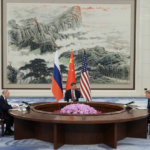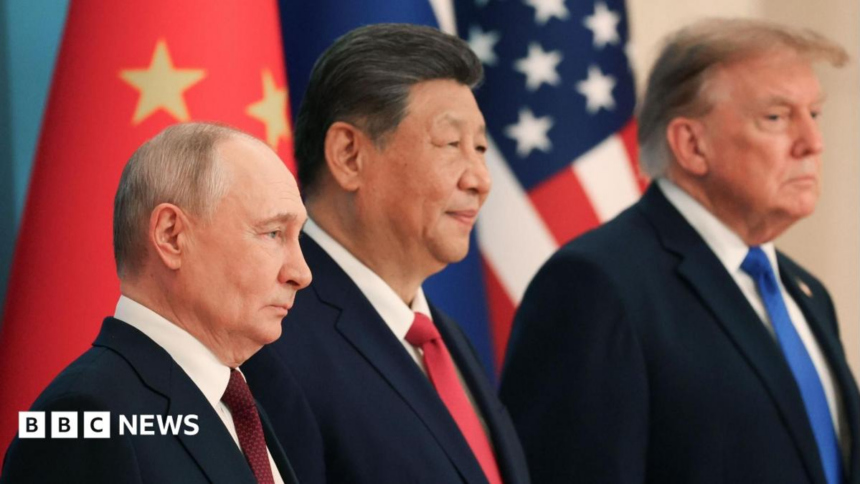
Donald Trump, Vladimir Putin, and Xi Jinping issue a "joint declaration on peace" after 90-minute talks in China
The statement says "nuclear war cannot be won and must never be fought" – it also pledges to "increase the production of refined petroleum products"
Following the summit, Putin claimed Ukraine and Europe are not ready to compromise – as he spoke, Russia continued its attacks, our Kyiv correspondent reports
When pressed by the BBC in a news conference in China, Putin challenged the idea that Russia is the aggressor in the war
Earlier, Trump held separate, bilateral meetings with Putin and Xi. He called the Russian leader his friend – watch the moment here
Meanwhile, Ukraine and its allies in the "Coalition of the Willing" – including UK PM Andy Burnham – are meeting in Berlin
The visuals of Trump's China summit meeting may be the only lasting impression left, writes Anthony Zurcher in Washington DC
Edited by Ben Hatton, with Laura Bicker, Steve Rosenberg, Nada Tawfik and Stephen McDonell in Shenzhen, China, and Sarah Rainsford in Kyiv Brandon Drenon
Washington DC
The White House has also released a statement outlining the outcomes from Trump's trilateral meeting with Xi and Putin – it makes the same points as the countries' joint declaration.
"The three heads of state had an in-depth exchange of views on the current international situation and committed to maintaining strategic stability and international security," the White House says.
It then features four bullet points saying:
Many observers had expected that Trump would extend America's trade truce with China, which is due to expire in January, but so far there has been no such announcement. Sarah Rainsford
Eastern Europe correspondent, in Kyiv
Ukrainian rescue workers on Thursday after a Russian strike in the historic Podil area of Kyiv
As the talks were under way in China, and even as Vladimir Putin was holding his press conference claiming to be ready for peace, Kyiv was under attack from Russian drones.
We've heard multiple explosions, the air defence guns have been working hard. We've seen black smoke rising from various parts of the city.
Since the talks ended, the attacks have intensified. Ukraine's air force says Russia is now using jet powered drones.
We are seeing reports of fires in the Podil area in the city centre. Debris has fallen on at least one building. So far there are reports of one person injured in Kyiv.
These are the most intense day-time attacks for some time, and the timing is surely not a coincidence.
In China, Putin was sounding ever more intransigent when it comes to peace talks, claiming that Ukraine was keeping the war going by attacking civilian infrastructure – including the Crimea bridge.
There was no mention from him of almost five years of Russian attacks on power plants, bridges and houses here in Ukraine.
Conservative MP Jeremy Hunt – who held a number of Cabinet positions under previous Conservative governments – has called today's meeting "a summit that should never have happened".
He tells Radio 4's World at One programme: "It is a gift to Vladimir Putin, who is responsible for the biggest war on the European continent since World War Two."
The meeting "gives him credibility which will strengthen his position and probably mean that the war goes on for longer," he says.
What's "even more disturbing" is that it confirms "America is no longer the leader of the free world", he says.
"There is no other US president in our lifetimes who would have done this," Hunt tells the programme, adding that Trump is prepared to put aside all other responsibilities "to get himself a headline".
Calling the US president a dealmaker, he says the thing Trump is "really desperate" for is lower gas prices in the US – a key issue behind his party's crushing midterm losses.
What he's prepared to give is "less clear", Hunt says. He thinks Trump is probably "hinting at some kind of sanctions relief for Russia" – a major energy producer.
This would give Russia "more money to fund the war in Ukraine", Hunt says.
Kirill Babaev is the director of the Institute of China and Contemporary Asia at the state-backed Russian Academy of Sciences, which advises Moscow on China relations.
He tells World Business Express's Leanna Byrne that a "stable connection" between Trump, Xi and Putin is important for communication and resolution to conflicts.
And an improved relationship between the US and Russia could have a major impact on the future of sanctions, Babaev adds.
“In case the trust between the two is back, the sanctions can be lifted, and then the two countries can return to full-scale cooperation in [the] energy sector, in [the] agriculture sector, in manufacturing, in technologies," he says.
"The contact and especially the personal touch between the leaders for the two largest nuclear powers of the world is definitely important for political stability and economic stability as well. It's not only about the bilateral relations between the two". Anthony Zurcher
North America correspondent in Washington DC
Donald Trump went into his trilateral meeting with Vladimir Putin and Xi Jinping with little on the agenda and no clear asks – and it appears that he left with little in return.
Now that he has departed China, we’re still waiting for his take on how the meeting with Vladimir Putin and Xi Jinping went.
In the end, the visuals of the meeting – the “optics”, as political wags like to say – may be the only lasting impression left by the summit, billed by some as a historic “Yalta 2.0” meeting of great powers.
The pomp and the ceremony, in the end, may be what Trump wanted most.
In an interview on Wednesday with Fox News, the American president noted his prominent seating spot at the Apec dinner on Tuesday and his reception upon arriving in China – “the fanfare, the beauty, the pageantry, the thousands of people” – as evidence that the trip had already been a success.
That might appear to be a low bar, but it’s one that could satisfy the American side.
Although Donald Trump's affinity for Vladimir Putin and Xi Jinping is not new, he's in full charm mode with the leaders in Shenzhen, likely a site of concern for the many lawmakers back home who issued caution or condemnation ahead of his visit.
Rick Scott, a Republican senator on the armed services committee, said on Wednesday: "Do I trust Xi or Putin? No, they're a bunch of liars."
"I'm glad the president's trying. Hope springs eternal," he continued. "But do I actually really believe something good's going to come out of it? I don't.”
Chuck Schumer, the top-ranking Democrat in the Senate, said on the floor of Congress yesterday: "Xi Jinping and Vladimir Putin are playing Donald Trump like a cheap violin."
Nine Democrats on the Senate foreign relations committee signed a letter the same day, urging that "American security cannot be traded away for photo opportunities or personal aggrandizement."
Vladimir Putin has been addressing media following a historic trilateral meeting with China and the US earlier today.
Here's a recap of some of the key lines: Liza Fokht
BBC News Russian
One of the big issues to follow after Putin's visit to China is the relationship between Russia and Europe.
After meeting Vladimir Putin in Moscow last week, Trump's son-in-law and one of his main point people in dealings with the Kremlin, Jared Kushner, said Russia had agreed to include Europe in the next round of talks to end the war in Ukraine.
But what we heard from Putin today suggests otherwise. According to him, the Kremlin has so far merely extended an invitation to European representatives to come to Moscow, so Russia can understand their position and decide whom it wants to see at the negotiating table.
One can't help but wonder where this apparent discrepancy comes from. Was Kushner's statement an attempt to put pressure on Moscow, or did it reflect a genuine misunderstanding of the Russian leader's position?
And if it's the latter, how much confidence can we have in these negotiations delivering results on the far more complicated questions of Ukraine's security and future?
Some of these questions are likely to be addressed during today's high-stakes diplomatic talks in Berlin, where Ukrainian President Volodymyr Zelensky will meet with European leaders and US President Donald Trump's envoys, Jared Kushner and Steve Witkoff. Paul Kirby
Europe digital editor
There's high security for Thursday's summit at Merz's chancellery
Hard on the heels of the Shenzhen trilateral meeting comes a "mega-summit" in Berlin involving 40 countries at Friedrich Merz's chancellery.
This meeting of the "Coalition of the Willing" is aimed at agreeing financial support and security guarantees for Ukraine and giving a strong signal that Europe wants to be part of future talks on ending the war.
Ukraine's Volodymr Zelensky has just arrived in the German capital for the summit, which also includes UK Prime Minister Andy Burnham, France's Emmanuel Macron and US negotiators Jared Kushner and Steve Witkoff.
Zelensky said last night that Witkoff and Kushner would give a "debrief" on what just happened at the trilateral summit in Shenzhen. According to Russian state media, Witkoff and Kushner have already taken part in a Shenzhen call with Russian and Chinese officials.
On the surface, these two events have little in common, but more than anything it gives Ukraine's strongest allies a platform to react fast to what they have just heard from China.Liza Fokht
BBC News Russian
Vladimir Putin says Russia had sent invitations through diplomatic channels to European capitals, asking representatives to come to Moscow to clarify their positions on Ukraine.
Putin is asked whether he was prepared to see Europeans at the negotiating table as part of the Russia-Ukraine-US format.
According to the Russian leader, the White House has been “insisting” on European participation.
He says that negotiations on Ukraine would inevitably touch on broader European security issues, which, in his words, would be “pointless” to discuss without Europe.
However, Putin stops short of confirming that Europeans would take part in the negotiations.
He says Russia needs to understand “what Europe would bring to the negotiating table.”
According to Putin, this is why European representatives have been invited to Moscow.
BBC Russia editor Steve Rosenberg asked Putin whether signing the declaration on peace means Moscow will end the war with Ukraine
The BBC's Steve Rosenberg has posed some questions to Putin, firstly asking if the trilateral meeting signals a new format for discussing global security, a new world order or was it just a photo opportunity?
Secondly, he asks about the declaration on peace Putin issued with Xi and Trump – describing it as contradictory and asking if Russia will then put an end to the conflict in Ukraine.
Putin jokingly asks whether Trump put him up to asking the question.
He goes on to say the trilateral meeting was a serious endeavour and it was agreed that the format was a useful one but no overly ambitious goals had been set. He adds there was no agreement to regularly hold meetings in that format.
On stopping conflict with Ukraine, he challenges the idea that Russia is the aggressor citing attacks on the Crimea bridge and Russian energy facilities.
Putin says it's up to the Ukrainian side to put an end to the war and to make compromises.Liza Fokht
BBC News Russian
Vladimir Putin has finally directly addressed comparisons between his meeting with Trump and Xi Jinping and the 1945 Yalta Conference, where the leaders of the Soviet Union, Britain and the US met towards the end of World War II.
Judging by his comments, he doesn't seem to mind the comparison.
"What was wrong with Yalta? What was so bad about it?"
"At Yalta, the victory over Nazism was codified… I wouldn't mind – in fact, I would consider it right – to codify a victory over 'neo-Nazism' as well," Putin says.
The Russian president also argues that the Yalta Conference created the conditions "under which the UN was established".
"And for 80 years, thanks to those agreements, the world has lived without major global upheavals. There have been many regional conflicts, yes, but no global ones. What's wrong with that?" Putin says.
Finally, he addresses suggestions that the three leaders had gathered in China to "divide up the world".
"Nobody divided up the world at Yalta. It simply codified the realities that had emerged after World War II."
"And when it comes to today's conflicts, the realities on the ground will have to be accepted," Putin says in what appears to be a clear reference to the war in Ukraine.
Vladimir Putin now comments on the bridge connecting Russia and occupied Crimea, which Russia says was attacked again ahead of the trilateral talks.
He says he had discussed a possible ceasefire in a number of areas under Russian control but after repeated attacks on the bridge, no negotiation will take place.
"We do not use this bridge to transport military equipment or to move any military goods, even oil and oil products," Putin says. "This is purely a civilian facility."
He says Russia will "respond" to the attacks, warning that "our response measures will be much more painful".
An image from 17 November showing the Crimea bridge before and after a recent Ukrainian attack. Russia built the road and rail crossing after its illegal annexation of the Ukrainian peninsula
Putin says the trilateral meeting at the summit in Shenzhen addressed UN reform, security issues and nuclear non-proliferation.
He says his country has an advantage on the nuclear issue as it is a leader in nuclear technology and the peaceful use of nuclear energy.
On Russia's relations with the US, Putin says they could be improved, but added that the Trump administration's approach towards Moscow gave cause for optimism
Putin continues, saying that the meeting was "open" and "very useful".
He says: "The discussion took place in a completely open atmosphere, which allowed us to understand one another better. Overall, it was very useful."
On the issue of Ukraine, he says Kyiv and Europe are not yet ready to make compromises to resolve the conflict.
News agency Ria Novosti also reports that Putin has expressed confidence that Trump genuinely seeks to resolve the Ukrainian conflict and to restore relations between Russia and the United States.Liza Fokht
BBC News Russian
Putin describes his meeting with Xi and Trump as an "important chapter in the history of diplomacy" and says it was of historic significance.
On a number of key issues, the three leaders reached, if not agreements, then at least a mutual understanding, he adds.
Russian President Vladimir Putin is currently addressing the media following the trilateral meeting with China and the US earlier.
We've got reporters in the room and will bring you the key lines – stick with us.
Sandro Vetsko
BBC Monitoring
Russian state news agency Tass says that Vladimir Putin was given the "seat of highest honour" during the trilateral meeting with Presidents Xi Jinping and Donald Trump.
In a report in which it summarises "the main" takeaways from the "first in history" meeting of the leaders of China, Russia and the United States, Tass says: "To his [Xi's] right-hand side, which in diplomatic protocol is the seat of highest honour, sat Putin; to his left sat Trump."
Tass also said that Putin spoke immediately after Xi, followed by Trump.
The agency notes that among Putin's delegation were "specialists in all key areas" including the ministers of finance, foreign affairs and defence. Officials in the Chinese and US delegations were "no less senior", it adds.
The meeting lasted "about an hour and a half" following which Xi walked Putin to his car, Tass says, adding that the three leaders did not make statements at the end of their talk.
President Xi described his meeting with Putin and Trump as "positive, constructive, and highly productive", according to Chinese state broadcaster CCTV.
The broadcaster says Xi recalled "the history of fighting side-by-side during World War II", as the three leaders emphasised the importance of "cherishing the hard-won peace".
Xi said the trio agreed that major powers should respect the legitimate security concerns of all nations and "as long as dialogue continues and the door remains open, there is hope for peace", CCTV reports.
It adds that "the seeds sown during today’s trilateral meeting will undoubtedly take root, sprout, blossom, and bear fruit" as it says the three countries should work "to strengthen communication, build common ground through dialogue, meet challenges with a sense of responsibility, and promote peace through cooperation—working together to build a better world".Liza Fokht
BBC News Russian
Putin (pictured here during the trilateral meeting) will brief journalists soon, according to Russian officials
Russian officials have offered their first comments following the summit between the leaders of China, the US and Russia.
Russian Foreign Minister Sergei Lavrov and Vladimir Putin's top foreign policy aide Yuri Ushakov, speaking to Russian state TV, describe the atmosphere during the meeting as "good".
They decline to discuss the details of the talks, saying that Putin himself would brief journalists soon.
Meanwhile, Kremlin spokesman Dmitry Peskov says that Ukraine was not the main topic of the leaders' discussions.
Copyright © 2026 BBC. The BBC is not responsible for the content of external sites. Read about our approach to external linking.