




Facebook Twitter Print Email
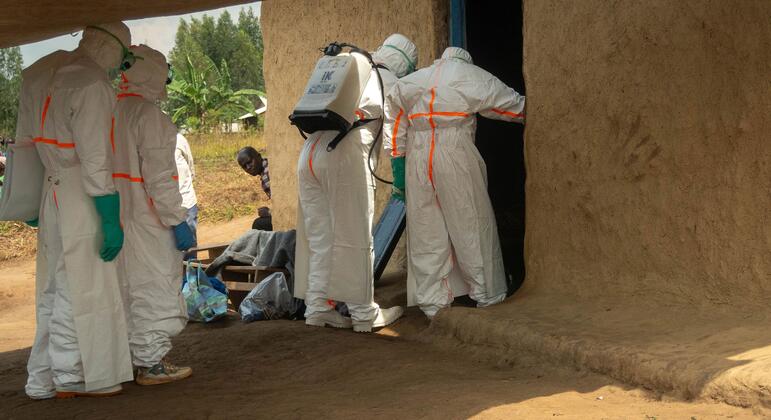
The Ebola outbreak in the Democratic Republic of the Congo (DRC) has more than doubled in three months, with more than 11,000 cases and 5,400 deaths now reported in 67 health zones across eight provinces, the head of the World Health Organization (WHO) said on Tuesday.
Opening the third meeting of WHO’s Emergency Committee on the Bundibugyo virus disease epidemic, Director-General Tedros Adhanom Ghebreyesus said children were “paying a terrible price”. They account for more than a quarter of confirmed cases and a third of deaths, and seven in ten children under five with confirmed Ebola have died.
“The risk beyond the DRC’s borders is not theoretical,” he said. Kenya has reported nine cases linked to an imported case, including two deaths, and Nigeria has reported one imported case.
He also expressed concern that some countries continue to apply blanket travel restrictions, which hinder the response and discourage countries from reporting outbreaks quickly.
Elaborating on the progress made, Dr Tedros said rapid transmission has been halted in most of the early epicentres, and the number of laboratories able to test for the virus has risen from two to more than two dozen. Two candidate vaccines developed specifically for Bundibugyo virus will be added to an ongoing vaccine trial in the coming weeks.
“But progress in some places is not control of the outbreak as a whole,” Dr. Tedros warned. Between 400 and 500 new cases are still reported every week, and two-thirds of confirmed deaths occur outside Ebola treatment centres, a sign that infections are being identified too late.
Exposure to endocrine-disrupting chemicals (EDCs) can begin before birth, with a broader range of effects on human and environmental health than previously understood, a new report released by the UN Enviornment Programme (UNEP) and WHO revealed on Tuesday.
The chemicals, which can interfere with the body’s hormones, have been detected in blood, breast milk and cord blood. Early exposure can have lasting effects on brain development, growth and reproductive health.
The State of the Science on Endocrine-Disrupting Chemicals 2026 is the first major global update since 2012. It finds stronger evidence linking EDCs to effects on fertility, brain development, thyroid and other hormone regulation, metabolism, immunity and cardiovascular health. In fish, birds, amphibians and mammals, exposure has been linked to impaired reproduction, development and behaviour.
“These effects can be long-lasting and, in some cases, irreversible,” said Sheila Aggarwal Khan, Director of UNEP’s Industry and Economy Division.
More than 350,000 chemicals and chemical mixtures are registered for production and use globally, yet only a small fraction have been evaluated for endocrine-disrupting properties. According to the study, the global cost of diseases associated with EDC exposure could amount to one per cent or more of global GDP.
“Protecting health means preventing harmful exposures before they occur,” said Bruce Gordon, acting Director of WHO’s Department of Environment, Climate Change, One Health and Migration.
The report was launched at the first International Conference of the Global Framework on Chemicals, which runs in Geneva until 20 November.
UN human rights chief Volker Türk has raised concern about the human rights risks of a proposal to transfer people from five European Union countries to Rwanda, “where they have no genuine connection and which has its own set of human rights challenges”.
Mr. Türk said his Office was not privy to the text of the proposal.
“The solution does not lie in single measures – often very costly – of finding countries far away to deal with one aspect of migration governance, or in externalising human rights obligations,” he said.
Instead, he called for the drivers of migration to be tackled head-on, including through investment that creates viable opportunities at home.
Those drivers include human rights challenges, huge inequalities, an inequitable economic and financial system that disadvantages many countries in the Global South, a surge in violent conflicts and heightened geopolitical tensions.
At the same time, societies in the Global North are rapidly ageing and grappling with labour shortages, Mr. Türk noted.
He called for a comprehensive approach to migration governance anchored in human rights, including expanded regular migration pathways.
Ending cholera as a public health threat by 2030 is within reach, as every cholera death can be prevented with tools that already exist, the World Health Organization (WHO) said on Tuesday.
The El Niño extreme weather pattern could cost the global economy up to $11 trillion and seriously impact food security, said the UN agency tackling rural poverty in developing countries on Monday.
Facebook Twitter Print Email
World News in Brief: Ebola cases double in DR Congo, chemical exposure starts before birth, Türk concern over EU-Rwanda transfer plan – UN News



Leave a Comment

