




Donald Trump is in the Philippines on the first leg of a high-profile trip to Asia – images show the US president meeting India's Narendra Modi, Australia's Anthony Albanese and Japan's Sanae Takaichi
"We have a great relationship with these people and these countries," Trump told reporters, adding Modi is a "very tough man" and Takaichi "may be even tougher"
Earlier, a red carpet was rolled out for Trump as he touched down at an airport in the Philippine capital, Manila
Trump walked down the steps of Air Force One and was greeted by a band playing YMCA, writes our South East Asia correspondent
Trump will fly to Shenzhen in China later today to attend a summit of Asia Pacific leaders – he will also meet Xi Jinping and Russia's Vladimir Putin for nuclear non-proliferation talks
Edited by Tiffanie Turnbull and Jessica Lamb, with reporting from Jonathan Head in Manila and Nada Tawfik travelling with President Trump Nada Tawfik
travelling with President Trump
Good morning from Manila, where President Donald Trump will get another welcome ceremony this morning, this time at the Malacanang Palace where he’ll have a meeting and lunch with the President of the Philippines.
Last night at the Asean dinner after the summit’s close, Ferdinand Marcos Jr called Trump his "honoured guest" and amped up the flattery.
Marcos Jr said knowing Trump’s desire for results, their staff had adopted principles and statements on tackling online scams. He isn’t the only leader here that’s been willing to offer the US president symbolic "wins", that critics will argue are devoid of real substance. It plays into the President’s desire to look like a deal maker.
Trump was happy to return the gesture, commenting that the Philipines President has "great genes" and that the US stands with partners in the region "always".
But this is a strategic pit stop, if you will, before President Trump’s main focus: his trip to Shenzhen where he’ll travel this afternoon. Jonathan Head
South East Asia correspondent, reporting from Manila
Coming right after the crushing mid-term election defeats for his Republican party, President Trump’s tour of Asia should offer him some relief.
His arrival on the last day of the Asean summit in Manila still dominates the agenda here. The Trump presidency has caused most South East Asian countries a lot of headaches, from the chaos of his on-again off-again tariffs, to the economic damage caused by his war on Iran, but that won’t stop them from giving him royal treatment.
US officials have scheduled a flurry of meetings for Trump over his short visit: a US-Asean summit, several bilateral meetings, and a meet-up for the so-called Quad with Australia, India and Japan on security.
Here in the Philippines, he will be in the most pro-American country in Asean, where they are looking for more US investment and stronger backing in their tussle with China over islands in the South China Sea.
But US ambitions to lock other Asian leaders into its so-called Pax Silica, a tech and AI ecosystem intended to rival China, are probably unrealistic. Few here will want to make any real long-term commitments to a president whose authority at home is diminishing. Joel Guinto
Live reporter
Welcome back to our live coverage of US President Donald Trump's visit to Asia. He is near the end of his 24-hour layover in the Philippine capital where last night, he met with South East Asian heads of state and the leaders of Australia, Japan, and India.
This morning Philippine President Ferdinand "Bongbong" Marcos will roll out the red carpet for Trump at the presidential palace, where a state luncheon will be held.
Afterwards, Trump will fly to Shenzhen in southern China for a separate summit of Asia Pacific leaders. He will also meet with Chinese leader Xi Jinping and Russian President Vladimir Putin.
It's 08:30 in Metro Manila and today has been declared a non-working holiday in the city of 15 million people, to give way to the country's hosting of world leaders. Freya Scott-Turner
Live reporter
Donald Trump has touched down in Manila, kicking off the first leg of his highly anticipated Asia trip.
On arrival to the Philippine capital, it was an all bells-and-whistles welcome for the US president, replete with a red carpet roll-out, music and a troupe of dancers.
Then, it was straight to business in the form of a meeting with members of the Quad – or Quadrilateral Security Dialogue – which consists of the US, Australia, Japan and India. Since its relaunch in 2017, the group's unstated goal is containing an increasingly assertive China – see our earlier post for more on this.
In a joint statement, the Quad said the alliance "is a force for good and a partnership of action, committed to peace, stability, and prosperity".
This flying visit to the Philippines is a short stop before Trump heads to China on Wednesday. There, he is expected to meet Chinese President Xi Jinping and Russia President Vladimir Putin on the sidelines of the Asia-Pacific Economic Cooperation (Apec) summit.
Trump also announced "a trade deal" with Thailand – though it's yet to be finalised and the Thai foreign ministry describes it as a "statement of progress".
And in comments to reporters before he headed into that Quad meeting, Trump left the door open for a one-to-one with Putin in China: "If it's available, I would." He added that North Korean leader Kim Jong Un had been hoping to attend, but "we'll see what happens".
For now, it's a cocktail reception and a dinner for the US contingent before it departs for China tomorrow. Nada Tawfik
North America correspondent, travelling with President Trump
At 20:24 local time (12:24 GMT), President Trump walked into the signing of a joint statement on reciprocal trade with Thailand’s Prime Minister Anutin Charnvirakul.
Trump called it "a great deal for both parties", saying they had been working on the deal for a long time, and that the deal would be finalised in the coming weeks.
The US president took a moment to tell the room he didn't get credit for the ceasefire deal between Thailand and Cambodia, before turning his attention back to the statement announcing there would be trade deal between the two countries – "we are just about there," he said, and added that a full agreement would be ready for them to sign soon.
Trump says the US and Thailand partnership extends beyond trade and investment, and shows what their two countries can accomplish together.
Applause rang out around the room as the two leaders shook hands, signed the document and held it up for everyone to see.
Trump was asked exactly what they had signed – he called it "a joint statement on reciprocal trade – very big trade deal".
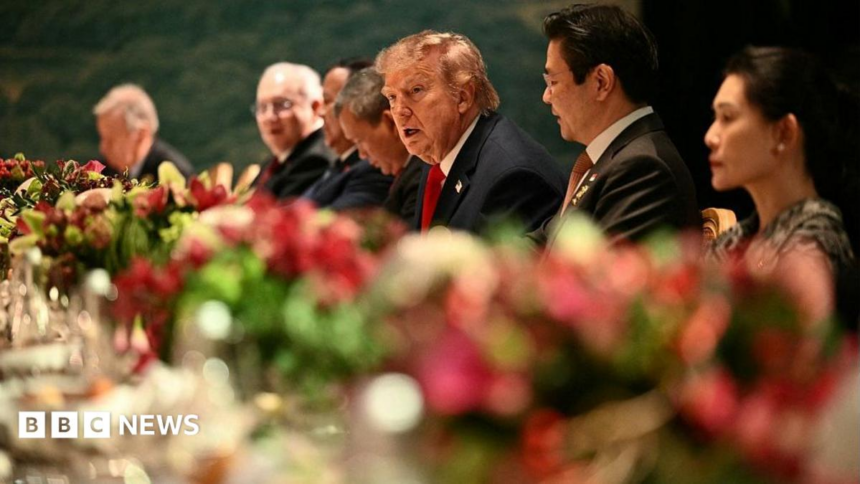
We have just arrived at the US-Asean dinner with President Trump in a fancy ballroom, with abstract lighting fixtures hanging from the ceiling, and blue and gold carpet.
A band has been playing soft music, and the table is set with flowers.Jonathan Head
South East Asia correspondent, reporting from Manila
Throughout the day, anti-Trump protesters in Manila have turned out in opposition to his visit to the Philippines.
More than 200 people are being held by police in the Philippines after they were arrested while protesting against the US-led AI Pax Silica initiative.
The Philippines and Singapore are the two Asean countries which have so far joined the US tech and AI ecosystem.
Under it there are plans for a big US investment-funded tech hub in New Clark City, north of Manila, but these are opposed by protesters suspicious of data centres and concerned about indigenous Aeta people being displaced to build it.Nada Tawfik
North America correspondent, travelling with President Trump
President Trump may be on foreign soil, hoping to put the focus on his role as diplomat in chief. But during his first appearance here, posing for a photo with the leaders of the Quad, he faced several questions on concerns back home.
He was asked about outages involving Chase bank most recently and prior to that the Federal Aviation Administration and Microsoft. President Trump downplayed the issues, saying it’s life.
"When you’re big and powerful and you have all the money, things like that happen. It’s fine," he said.
He was also asked about reports that Iran is planning to drop a dirty bomb on Washington. He said: "Well, if there is [an imminent threat], they will pay a price the likes of which no country has ever paid before."
Meanwhile, the leaders of the Quad stood there waiting and looking more than ready to move on. Later, at the start of the Quad meeting, the president was on message and on script, highlighting their close relationship.
He said his phone was always open to them.
Trump described the countries as the four corners of the free, open, stable, prosperous, Indo-Pacific. He spoke of their co-operation on AI, critical rare earth minerals and joint naval exercises.
Donald Trump has just announced an agreement with Thailand to remove all tariffs on US exports.
Speaking alongside the Prime Minister of Thailand Anutin Charnvirakul, Trump hails it as a "historic trade deal", telling reporters that "lays the foundation for a much stronger trading relationship" that would bring the two countries "closer than ever before".
Trump says the deal would see Thailand remove its tariffs on US exports and the removal of "substantial non-tariff barriers" (which are things like laws and regulations that restrict trade) on American vehicles, medical devices, pharmaceuticals and ethanol.
The US president adds that he is looking forward to "finalising the details of our formal agreement in the coming weeks".
The Thai premier says the deal should "open new opportunities", and notes that "there is still a little more to do" but he is "confident that the agreement will be ready for us to sign real soon". Jonathan Head
South East Asia correspondent
Another item on President Trump's agenda in Manila is a trade announcement with Thailand after a meeting with Prime Minister Anutin Charvirakul.
But what will the grandly-titled Agreement on Reciprocal Trade actually amount to?
Trade between Asean and the US has held up remarkably well through the chaos of constantly changing tariff regimes. In Thailand’s case, the tariffs started at 36%, then dropped to 19%, before reaching an arbitrary 10% when the US Supreme Court declared the original Liberation Day tariffs unlawful.
Now, these tariffs stand at 12.5% – which was the rate imposed on 60 countries because they supposedly failed to keep products of forced labour out of their exports.
In practice, Thailand is sticking to 19% as a ballpark figure and presumed eventual tariff rate (though this might end up changing in the end) just for some consistency – but there are still a number of US demands for better access for US agricultural products which Thailand will find difficult to accept.
Expect lots of warm words and little substance.
The Quad – or Quadrilateral Security Dialogue – members have been holding talks in a sit-down meeting.
These are India's Narendra Modi, Japan's Sanae Takaichi, Australia's, Anthony Albanese and US President Donald Trump.
Indian Prime Minister Narendra Modi
Japan's Prime Minister Sanae Takaichi
Australia's Prime Minister Anthony Albanese
US President Donald Trump and his Secretary of State Marco RubioJonathan Head
South East Asia correspondent, reporting from Manila
Whatever their concerns about Donald Trump’s presidency, countries in this region know how to flatter him, and it started right after he walked off Air Force One in Manila, with the band playing one of his favourite songs – YMCA.
He was whisked away quickly by helicopter to his hotel, where he’s having a series of meetings and a dinner with leaders attending the Asean summit.
Many of them run economies which have been hit hard by President Trump’s tariffs and his war on Iran, yet their exports to the US rose 30% last year, largely thanks to the AI boom for which South East Asia manufactures many of the components.
The US is hoping to draw more countries here into its Pax Silica tech and AI ecosystem, and away from China.
But China’s huge influence in this region cannot easily be challenged, and certainly not in the few hours Trump is in the Philippines.
Following those remarks to the media, US President Donald Trump has now joined the leaders of India, Australia and Japan for a multilateral meeting.
He praises how the nations "represent some of the most important partnerships in the entire world" and are among the most successful.
Trump adds that "in certain ways" they are also among the most powerful nations in the world.
He says his phone and the Oval Office are always open to the countries.
President Trump has also been asked about the possibility of a bilateral meeting with Russian President Vladimir Putin, to which he replies he doesn't know if that will happen.
"If it's available, I would," he adds.
The US president tells the assembled media that Putin is coming to China, and Trump too is "the guest of President Xi".
He is also asked if North Korean leader Kim Jong Un will be there, to which Trump replies by saying "he would like too, we'll see what happens".
Trump adds he will press President Xi Jinping and President Putin on the Iran war, "to get involved, to get it ended".
Cherylann Mollan
Reporting from Mumbai
In comments to reporters, Trump has just described Indian PM Narendra Modi as a "tough man".
While Modi is meeting Trump along with other leaders of the Quad – a separate bilateral meet looks unlikely.
It's the first time the pair have met since June when they briefly met on the sidelines of the G7 summit in Paris. The one today comes against the backdrop of prolonged negotiations over a US-India trade deal, but no updates around it are expected to come out of their meeting in Manila.
Analysts will also be closely watching the body language of the two leaders. Trump and Modi shared a warm relationship during the US president’s first term and even made joint appearances at massive rallies in Houston and Ahmedabad.
Modi was one of the first world leaders to visit Trump at the White House last year after he was sworn in. But since then, the relationship has soured, with Trump slapping high tariffs on India, and putting Delhi in a tight spot with comments he made on the country’s conflict with Pakistan.
The two leaders have spoken on the phone several times since then, and Indian ministers have indicated the trade deal negotiations are progressing. But it will be interesting to see whether they look as comfortable as they did earlier.
(L-R) Narendra Modi, Donald Trump and Anthony Albanese
Trump has also been taking questions during the photographs.
Asked about the plan for his meeting with the leaders of Japan, India and Australia, Donald Trump says: "We have a great relationship with these people and these countries."
"We have right from the beginning… they're friends of mine so that helps."
Gesturing at Indian Prime Minister Narendra Modi, Trump says "he's a very tough man, and she [Japanese Prime Minister Sanae Takaichi] may be even tougher".
Turning to Australian Prime Minister Anthony Albanese, Trump adds: "And we… we're okay".
It's been a quick turnaround for Donald Trump, who touched down in Manila a short while ago and has headed to meet the leaders of Australia, Japan, and India – known as the "Quad".
Following their photo together, Trump, Narendra Modi, Anthony Albanese and Sanae Takaichi will have a quadrilateral summit.
The Quad last met in 2024 when Joe Biden was US president. (L-R) Australian Prime Minister Anthony Albanese, Indian Prime Minister Narendra Modi, Joe Bidenm and former Japanese Prime Minister Fumio Kishida
Donald Trump is attending the first Quad meeting in two years. The group last gathered in 2024 in Delaware during the presidency Joe Biden. Here is what you need to know about the alliance.
Who is in the Quad? The Quadrilateral Security Dialogue brings together the US, Japan, Australia and India. It began as a loose grouping to provide aid following the 2004 Indian Ocean tsunami and was relaunched in 2017.
What are its aims? With its focus on the Indo-Pacific, the Quad says it backs the free and open, rules-based global order – its unstated goal is containing an increasingly assertive China in its backyard. Member nations' ties with China have deteriorated in recent years.
What's at stake? The US must persuade its allies – united by concern at China's rise but differing on other issues – that it's committed to a region seen as key to global security and prosperity. China says the region should beware what it calls the "Asian Nato".Jonathan Head
South East Asia correspondent, reporting from Manila
Foreign ministers from the Quad meet on the sidelines of the G20 foreign ministers' meeting in Atlanta in October
President Trump’s first meeting at the Asean summit will be with America's partners in the Quad – India, Japan and Australia.
But 19 years after it was first proposed by then Japanese Prime Minister Shinzo Abe, and then relaunched by none other than President Trump on his first visit as president to Asia in 2017, what has the Quad really achieved?
Intended as a strategic counterweight to China’s relentlessly rising influence in Asia, it risks being seen as little more than a talking shop and empty symbol of co-operation – very much the kind of criticism often levelled at Asean.Jonathan Head
South East Asia correspondent, reporting from Manila
Trump walked down the steps and was greeted by the band playing YMCA.
He was handed flags of the US and the Philippines – and waved them rhythmically to the song.
Now he's on the helicopter to his hotel.
We've just seen US President Donald Trump emerging from his plane, Air Force One.
It touched down on the tarmac in Manila moments ago.
Copyright © 2026 BBC. The BBC is not responsible for the content of external sites. Read about our approach to external linking.
Philippines rolls out red carpet for Trump on important Asia diplomatic trip – BBC


Leave a Comment

