Thank you for visiting nature.com. You are using a browser version with limited support for CSS. To obtain the best experience, we recommend you use a more up to date browser (or turn off compatibility mode in Internet Explorer). In the meantime, to ensure continued support, we are displaying the site without styles and JavaScript.
Advertisement
Communications Biology (2026)
We’re sharing this article early to provide faster access to peer-reviewed, accepted research. It is citable and carries a permanent DOI. This version is subject to further edits and will be replaced automatically by the final Version of Record. All legal disclaimers apply.
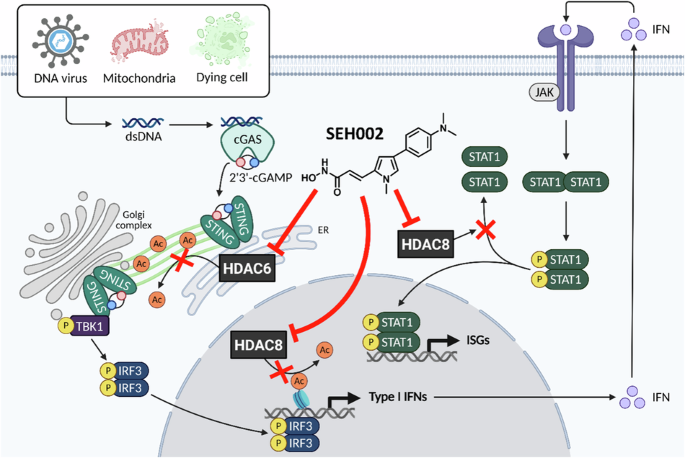
Despite the critical role of Stimulator of Interferon Genes (STING) in innate immune regulation, the isoform-specific epigenetic mechanisms that regulate its activation remain poorly understood because of the lack of suitable chemical tools. Here, we identify SEH002, a mechanistically informative dual HDAC6 and HDAC8 inhibitor that amplifies STING activation and reveals the complementary roles of HDAC6 and HDAC8 in innate immune signaling. STING-induced innate immunity proceeds through an intrinsic cell-autonomous phase, followed by a non-cell-autonomous paracrine phase. HDAC6 inhibition promotes the early cell-autonomous phase by increasing α-tubulin acetylation and facilitating endoplasmic reticulum-to-Golgi trafficking, thereby enhancing STING signaling. In contrast, HDAC8 inhibition sustains the later non-cell-autonomous phase by limiting STAT1 dephosphorylation and prolonging interferon signaling. These findings establish HDAC6 and HDAC8 as regulators of distinct phases of STING-mediated immune response. SEH002 provides an isoform-aware chemical handle to probe this cross-talk and suggests a general strategy for defining how epigenetic mechanisms orchestrate the magnitude and duration of STING-mediated innate immune responses.
This work was supported by the Basic Science Research Program (2023R1A2C1007899 to J.P., RS-2023-00211336 and RS-2021-NR060140 to J.K.) and the Priority Research Institute Program (RS-2023-00271205 to J.P.) through the National Research Foundation of Korea, funded by the Ministry of Science, ICT & Future Planning. This work was also supported by Korea Basic Science Institute (KBSI) National Research Facilities & Equipment Center (NFEC) grant (2019R1A6C1010006 to J.P.), Global-Learning & Academic research institution for Master’s·PhD students, and Postdocs (G-LAMP) program (RS-2023-00301850 to J.P., RS-2025-25441317 to J.K.) from the Ministry of Education, South Korea, Korea Institute of Science and Technology (KIST) Institutional Program (26E0143, 26V0140, 26V0200, and 26Z9082 to S.L.), Korea US Collaboration Research Fund (KUCRF) funded by the Ministry of Science and ICT and Ministry of Health & Welfare (RS-2024-00467483 to S.L.). Moreover, this study was supported by the Bio & Medical Technology Development Program of the National Research Foundation (NRF) funded by the Korean government (MSIT) (RS-2023-00254795, RS-2026-25538024, and RS-2026-25528645 to S.L.).
These authors contributed equally: Yeseul Kim, Junhyeong Yim, Yaeji Jang.
Medicinal Materials Research Center, Biomedical Research Division, Korea Institute of Science and Technology (KIST), Seoul, Republic of Korea
Yeseul Kim & Sanghee Lee
Department of Chemistry, Kangwon National University, Chuncheon, Republic of Korea
Junhyeong Yim & Jongmin Park
Multidimensional Genomics Research Center, Kangwon National University, Chuncheon, Republic of Korea
Junhyeong Yim & Jongmin Park
Division of Biological Sciences, Sookmyung Women’s University, Seoul, Republic of Korea
Junhyeong Yim
Department of Chemistry and AI-Bio Convergence Research Institute, Soongsil University, Seoul, Republic of Korea
Yaeji Jang, Sinhyeong Kim & Jonghoon Kim
Department of Green Chemistry and Materials Engineering, Soongsil University, Seoul, Republic of Korea
Minseok Lee & Jonghoon Kim
Department of Chemistry & Biochemistry, University of California at Los Angeles (UCLA), Los Angeles, CA, USA
Michael E. Jung
Institute for Molecular Science and Fusion Technology, Kangwon National University, Chuncheon, Republic of Korea
Jongmin Park
KHU-KIST Department of Converging Science and Technology, Kyung Hee University, Seoul, Republic of Korea
Sanghee Lee
PubMed Google Scholar
PubMed Google Scholar
PubMed Google Scholar
PubMed Google Scholar
PubMed Google Scholar
PubMed Google Scholar
PubMed Google Scholar
PubMed Google Scholar
PubMed Google Scholar
Correspondence to Jongmin Park, Jonghoon Kim or Sanghee Lee.
The authors declare no competing interests.
Publisher’s note Springer Nature remains neutral with regard to jurisdictional claims in published maps and institutional affiliations.
Open Access This article is licensed under a Creative Commons Attribution-NonCommercial-NoDerivatives 4.0 International License, which permits any non-commercial use, sharing, distribution and reproduction in any medium or format, as long as you give appropriate credit to the original author(s) and the source, provide a link to the Creative Commons licence, and indicate if you modified the licensed material. You do not have permission under this licence to share adapted material derived from this article or parts of it. The images or other third party material in this article are included in the article’s Creative Commons licence, unless indicated otherwise in a credit line to the material. If material is not included in the article’s Creative Commons licence and your intended use is not permitted by statutory regulation or exceeds the permitted use, you will need to obtain permission directly from the copyright holder. To view a copy of this licence, visit http://creativecommons.org/licenses/by-nc-nd/4.0/.
Reprints and permissions
Kim, Y., Yim, J., Jang, Y. et al. Dual HDAC6 and HDAC8 inhibition enhances STING mediated innate immune responses. Commun Biol (2026). https://doi.org/10.1038/s42003-026-11233-5
Download citation
Received:
Accepted:
Published:
DOI: https://doi.org/10.1038/s42003-026-11233-5
Anyone you share the following link with will be able to read this content:
Sorry, a shareable link is not currently available for this article.
Provided by the Springer Nature SharedIt content-sharing initiative
Advertisement
Communications Biology (Commun Biol)
ISSN 2399-3642 (online)
© 2026 Springer Nature Limited
Sign up for the Nature Briefing newsletter — what matters in science, free to your inbox daily.