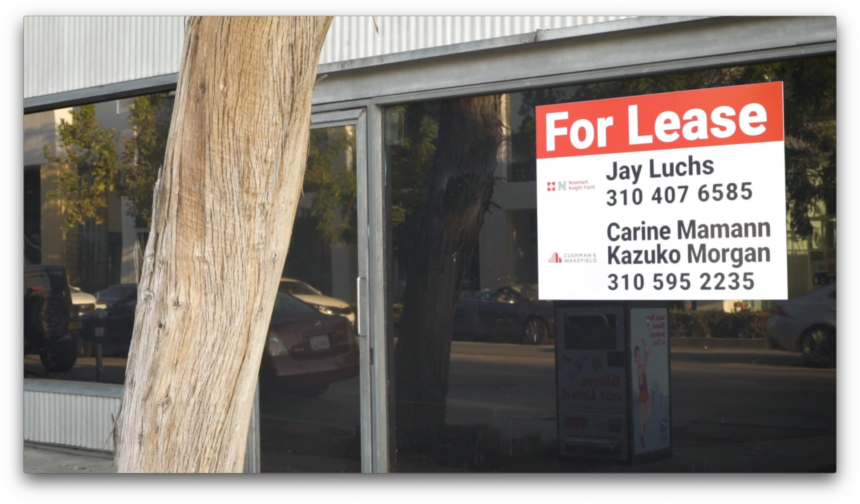
Councilmember Lauren Meister has spent nearly 12 years on the West Hollywood City Council, and she’s going out with one last push to try and get a handle on all those empty storefronts. You know, the ones that make WeHo look more busted than bougie.
At her final Council meeting Monday, Nov. 16, Meister is bringing forward a proposal to revisit commercial vacancies, including the possibility of taxing property owners who leave their properties empty for extended periods.
It’s an issue she’s been raising for years. And one the City has yet to figure out how to solve.
“I worry about the future of our City,” Meister told WEHOonline. “I’m concerned about commercial vacancies leading to more blight, as well as economic and public safety impacts.”

Take a walk down Santa Monica Boulevard, Sunset or Melrose and you see what she’s talking about. It’s as if we’re still in COVID. Some of these empty properties have been sitting that way for years. And while the landlords wait for tenants, the surrounding businesses are left dealing with fewer customers and activity.
Meister says there’s more at stake than just filling empty spaces. In a city where so much of daily life happens on foot, those storefronts are part of what makes the City special.
“West Hollywood is a walkable city, and vibrant commercial corridors are part of what makes our community special,” she said. “We can’t afford to accept long-term vacancies as the new normal.”
Some of the ideas she wants staff to look into include taxing landlords who leave storefronts empty for years, giving them financial reasons to find tenants, or trying something other cities have already put in place. For now, she’s asking City staff to come back with some options.
The City first looked into a commercial vacancy tax back in 2022. Meister and then-Mayor Sepi Shyne brought it back in 2023, hoping to get another round of voter polling and possibly put the question on the 2024 ballot. That didn’t happen.
Meister sees two problems behind the empty storefronts: the cost of doing business in West Hollywood and landlords unwilling to budge on rent.
“West Hollywood is an expensive place to do business, especially for small businesses. But I also believe some property owners would rather leave a storefront empty than lower their asking rents.”
“Property owners have a right to seek a fair return on their investment. But when storefronts sit empty for years, neighboring businesses, residents, and the City pay the price.”
There was actually considerable support for a vacancy tax when the City polled likely voters in 2022. Initially, 63% favored it. That rose to 73% once the proposal was explained in greater detail. Even after hearing arguments against it, 69% remained in favor.
“Clearly, this is an issue that resonates with residents,” Meister said.
Not everyone loves the idea. The idea has raised concerns among property owners and business advocates who argue that another tax could discourage investment or increase the costs of doing business.
Asked if she was concerned landlords might try to pass the cost of a vacancy tax onto new tenants somehow, Meister acknowledged the concern.
“The goal isn’t to raise revenue. It’s to encourage property owners to fill vacant storefronts rather than leave them sitting empty for years,” she said.
“A vacancy tax would target prolonged vacancies, not businesses that are operating. And we certainly need to evaluate potential unintended consequences, including costs being passed on to tenants.”
Her proposal doesn’t call for an immediate tax, nor does it contain any specific prohibition against passing those costs on to tenants. The goal is for staff to see what other cities have done and return with recommendations, including potential costs, staffing needs and the resources required to put new programs in place.
Any new initiatives requiring City funding would also have to be considered as part of the next budget and departmental work plan process.
San Francisco started taxing certain empty storefronts in 2022. If they’re vacant for more than 182 days a year, the owner may have to pay. Oakland’s tax is tougher in some ways. A property used fewer than 50 days a year can trigger a $3,000 to $6,000 annual tax, and it doesn’t just apply to storefronts. Residential properties can be taxed, too. Both cities have exemptions.
In September, the City’s Business Task Force delivered recommendations that included creating a public commercial vacancy registry, considering incentives and penalties to get properties leased, and exploring other financial assistance for local businesses. As WEHOonline reported, the task force stopped short of recommending a specific vacancy tax. It called for further examination of how to encourage property owners to fill their spaces.
The City has also brought in a consultant to examine commercial vacancies, why properties remain empty and what might be done to attract new tenants. Findings are expected in early 2027.
9.6% of West Hollywood’s retail space was vacant in the first quarter of 2026. But that also depends on where you look. On the Strip, the vacancy rate was 13.4%; on the Eastside, it was 6.4%.
Meister believes this is about accountability. “Property owners may own the buildings, but the consequences of long-term vacancies are shared by the entire community. We need to find a better balance between private property rights and the public good,” she said.
The three-term councilmember was talking about West Hollywood’s empty storefronts long before she was elected to the Council in 2015. Now, she’s giving the issue one more shot.
If the Council backs her proposal Monday, staff will do the research and bring back some options. By then, Meister will be gone, her term ending in December. Whether anything actually gets done about those empty storefronts will be up to the new Council.
This site uses Akismet to reduce spam. Learn how your comment data is processed.