




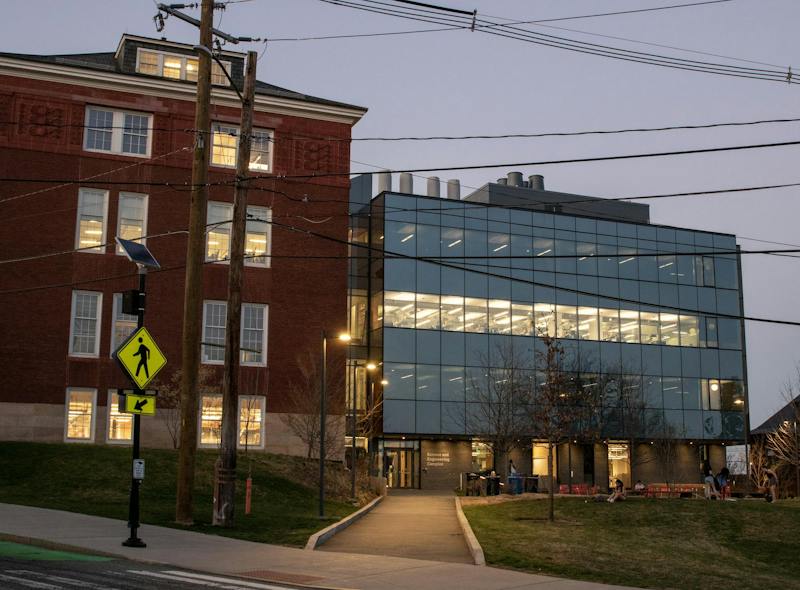
The Tsungming Tu Complex is pictured in November 2024.
As part of an initiative to incorporate more opportunities for experiential learning into the Tufts Graduate School of Arts and Sciences, the biology department has implemented a new graduate cooperative education program. Previously, co-op programs have not been offered within the GSAS, although the Tufts School of Engineering offers a graduate co-op program.
Within the GSAS, Dean Ayanna Thomas and Benny Belvin, director of professional development and alumni engagement, have been working to increase experiential learning at the school in a variety of ways.
The program, which is available to biology MS and BS/MS students, will allow students to be employed in relevant positions and engage in up to six months of full-time work at an external company. Co-ops will span two semesters, including the summer and either the adjacent spring or fall semester.
Interested students will be required to apply and be accepted into the co-op program prior to applying to outside positions. However, there is no limit on the number of students that can be accepted. Frank David, professor of the practice in biology, helped to create the program. He explained that this process is not meant to be prohibitive.
“We want people to be successful when they do co-ops, which involves some amount of basic professionalism training,” he said. David emphasized the myriad resources that students can utilize to prepare application materials such as cover letters and resumes.
The department also hopes that by instituting an application process for the program, it will ensure that candidates are representing the school well to employers. “Students who go out and do co-ops are, to a certain extent, ambassadors of our program,” David said.
Keeping with this sentiment, the department is also requiring interested applicants to complete Biology 197, Career Skills for Biologists. The course, taught by David, is open to both undergraduate and graduate students and provides an opportunity to build resumes, LinkedIn pages and explore the soft skills that are important for their future careers.
Originally, the biology department tried to encourage experiential learning in the form of internships. “But actually, companies … would much rather have people for slightly longer periods of time,” he added. “[Internships are] not long enough for them to really decide if they would want to hire you afterwards.” By contrast, co-op programs are longer term and allow participants to actually become productive in their roles at their companies.
When looking to implement a co-op program, David said he drew inspiration from the programs already in place in the School of Engineering. “I would say 80% to 90% of our program is based on the engineering school’s program,” he said. For example, engineering graduate students are also required to apply to the co-op program before applying to individual jobs.
Ultimately, David thinks the program will positively change the experience of biology MS and BS/MS students. “The problem with a master’s degree in biology is that it’s not inherently translatable into job opportunities,” he said. “So, the master’s in biology is inherently kind of what you make of it and how you spend your time.”
Students in the program have, as a whole, somewhat lacked relevant work experience when applying to jobs after completion of their MS. The co-op opportunity is a way for students to gain hands-on work experience to prepare them for the workforce.
David noted that, particularly when compared to other students in the Boston area, Tufts students previously were not “optimally competitive” in work experience. He hopes that the new program will help fill this gap, giving students all of the benefits of taking courses in the Tufts biology program while also gaining legitimate work experience: “We can now have the best of both worlds.”
Importantly, one requirement for co-ops is that students’ positions be “unrelated to academic research, grading, or teaching,” according to the program’s handbook. David explained that the value of the co-op lies in working for an external, non-academic organization: “If you want to work in an academic lab, you have plenty of opportunities to do that. I think we do a good job in biology of giving people lab research opportunities. So, for me, the real value … here is working [with] some other organization … some other non-academic setting.”
In the future, David hopes that more departments within the GSAS may move towards implementing their own co-op programs, learning from the biology department’s program as well as engineering programs. “I kind of think that every arts and sciences Master’s program should have a co-op program,” he said, adding, “it doesn’t have to look exactly like ours.”
Applications for the program have been open since this past summer. Students will begin applying for and working in co-op positions in the coming year.
Tufts Graduate School of Arts and Sciences implements new biology cooperative education program – The Tufts Daily



Leave a Comment

