




Editing: Megan Rowling and Joe Lo
Confusion reigned in Antalya on Wednesday morning as some delegates heeded the Turkish organisers’ warning to get to the COP31 venue before 7am today. Others saw a later UN clarification that this wasn’t necessary, and many more decided not to chance it and work from their hotel rooms.
Additional restrictions seem to have been put in place so that the 40 or so world leaders due to speak could be ferried from the airport to the venue and so that President Recep Tayyip Erdoğan could plant some symbolic olive trees without ordinary COP delegates ruining the photo op.
The list of world leaders speaking is considerably shorter than the (already short) list from just six days ago, with the leaders of Nigeria, Kenya, Egypt, the Netherlands and Sweden among those dropping out.
This story is exclusively available to paid subscribers. A free account gets you a selection of our reporting and our Climate Weekly newsletter. But a subscription gets you every story in full, our Bulletin emails from negotiations and conferences, two subscriber-only newsletters, and our monthly Editor’s column.
Confusion reigned in Antalya on Wednesday morning as some delegates heeded the Turkish organisers’ warning to get to the COP31 venue before 7am today. Others saw a later UN clarification that this wasn’t necessary, and many more decided not to chance it and work from their hotel rooms.
Additional restrictions seem to have been put in place so that the 40 or so world leaders due to speak could be ferried from the airport to the venue and so that President Recep Tayyip Erdoğan could plant some symbolic olive trees without ordinary COP delegates ruining the photo op.
The list of world leaders speaking is considerably shorter than the (already short) list from just six days ago, with the leaders of Nigeria, Kenya, Egypt, the Netherlands and Sweden among those dropping out.
Still on there are the co-hosts Erdoğan and Australia’s Albanese plus Brazil’s recently re-elected President Lula and the European Commission head Ursula Von der Leyen. The leader of rainforest-rich DR Congo and the vice president of clean energy and coal superpower China will also speak, as well Barbados’s Mia Mottley and Saudi Arabia’s energy minister Abdulaziz bin Salman.
International civil society groups singled out several European countries, Japan and Canada for the “Fossil of the Day” award over their absence at the Leaders Summit, which they said is being noticed by the world.
Despite their no-show, plenty of voices from the frontlines of climate change will be heard, including heads of government from desertifying Mauritania, water-stressed Iraq, the sinking Marshall Islands and drought-hit Somalia all speaking.
Wednesday is also “Zero Waste” Day, with First Lady Emine Erdoğan holding an afternoon roundtable on her pet topic. Before COP, Climate Home News visited a landfill and zero waste education centre in Ankara to find out how well – or otherwise – Türkiye is doing in its pursuit of waste reduction.
Türkiye pushes “zero waste” at COP31, but is it delivering at home?
We’re watching out for any news on the country’s single-use plastics ban, which has been introduced to parliament but not yet – after some lobbying from the plastics industry – got the president’s signature.
In his final speech to a climate COP as UN Secretary-General, Antonio Guterres floated one last idea to round off his widely respected thought leadership on tackling the climate crisis: a “climate justice compact”, based on “shared responsibility, shared security and shared benefits”.
The UN chief described climate justice as “the defining challenge of the next decade”.
“We cannot demand that countries transform their economies while denying them the means to do so,” he emphasised, adding that emerging and developing economies outside China receive less than one-fifth of global clean energy investment and face a far higher cost to borrow.
“If they cannot access affordable clean energy, fossil fuels will fill the gap – locking in emissions for decades,” Guterres warned. “And if vulnerable communities cannot adapt, instability will spread across borders.”
Wealthy countries, he insisted, should cut their emissions faster and deliver the finance and technology they have promised to developing nations.
While he didn’t say what form a compact might take, he set out four pillars: speeding up a just transition away from fossil fuels, starting with national plans; protecting all people through new adaptation plans and early warning systems; providing adequate, affordable and readily available climate finance; and cooperation between countries to drive implementation.
The UN boss, who has grown increasingly vocal on the need to cut down the world’s use of polluting coal, oil and gas, said the case for fossil fuels “is collapsing”.
Three-quarters of people live in countries that import fossil fuels, leaving them hostage to price shocks in international markets, he noted. “Recent conflicts make clear that this is a recipe for chronic insecurity and a cost-of-living meltdown,” he said. “It is time to accelerate a science-aligned, just, orderly and equitable transition to renewables.”
He received applause from the assembled leaders when he attacked the fossil fuel industry for distorting science and delaying climate policy, action and accountability, saying it was time to “end the fossil-fuel addiction” and “polluters must pay”.
Finishing with praise for the struggles of scientists, Indigenous peoples, civil society and small island developing states in standing up to “powerful monied special interests”, he promised to join them when he steps down from the UN “as an advocate and an ally” in the ongoing fight.
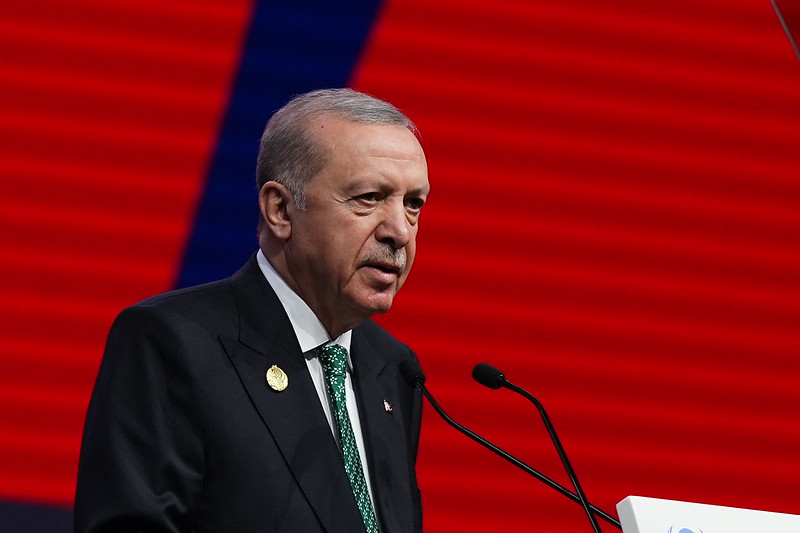
After starting the week boasting on social media about his country’s prospects for increased oil production in the Gabar mountains, President Recep Tayyip Erdoğan stuck to the green script in his speech at COP31, pointing to Türkiye’s tree-planting efforts on its day for afforestation.
Turkish culture “regards bread as a blessing, water as sacred, and trees as life. As such, this culture is the compass guiding our environmental and climate policies,” he said.
He also lamented the loss of “centuries-old olive trees” during the conflict in now-flooded Gaza, which he described as “ecocide”, and called on Israel to allow in more humanitarian aid.
The message from COP31, Erdoğan said, should be to “finally say enough to the greedy mindset that sacrifices ecology for the economy”, with the conference ensuring it sets “a strong example of consensus-building and of tangible, concrete progress”.
On how to move the energy transition forward in practice, he said that Türkiye wants “a fair policy that takes account of energy security and the different development needs” of countries. He also called for easier access to finance, technology and capacity-building opportunities for the poorest nations and small island states, saying “the countries that contribute least to climate change are often the ones that pay the heaviest price”.
Neither he nor Australia’s Prime Minister Anthony Albanese talked about the prospects for their own countries to transition away from fossil fuels. Türkiye is planning to add new oil production and both Türkiye and Australia are expanding coal mines even as both countries boost renewable power.
Speaking after the two COP host-nation leaders, Marshall Islands President Hilda Heine said the “discovery of new fossil fuel resources is not something to celebrate, but to fear”.
Adam Bandt, CEO of the Australian Conservation Foundation, slammed Albanese’s speech for ignoring the UN secretary-general’s plea for no new fossil fuels. ”At this summit, Australia is getting repeatedly called out for opening new coal and gas mines and the government can’t dodge it forever,” he said.
While the full list of countries backing Türkiye’s “35 by 35” electrification pledge is expected to remain under wraps until next week, around a dozen mostly smaller countries have come out publicly in support.
The pledge aims to raise electricity’s share of global final energy consumption to 35% by 2035, from 23% currently but does not specify how that electricity should be generated. As it stands, a country could meet it with its reliance on coal or gas power unchanged.
Besides fellow COP31 host Australia and COP32 president Ethiopia, the pledge’s public backers so far include Germany, Norway, Finland, Pakistan, Zimbabwe, Eswatini, Togo, Liechtenstein, and the small island states of Palau, Seychelles and the Solomon Islands.
Many are attaching caveats to their support. At a high-level roundtable on Wednesday, the low-lying Pacific island nation of Palau said it would sign on to the pledge. But it added that electrification “must not become a substitute or a distraction” from the chief goal of transitioning away from fossil fuels.
COP31 electrification pledge leaves out clean power commitment
Seychelles also endorsed the pledge but added that it must be connected with cleaner electricity. “Electrifying more activities while continuing to burn fossil fuels will not deliver the full economic or climate benefits,” the country’s representative told the roundtable.
The Marshall Islands said the focus on electrification was an “important contribution” but called the target “insufficient” if not directly linked with renewable energy. The Pacific island nation has not backed the pledge at this point.
The European Union and UK have also welcomed the focus on electrification but have not yet signed up to the pledge.
Australia’s climate and energy minister Chris Bowen, whose country is co-leading the pledge with Türkiye, has defended its design. “Electrification is almost always a good thing,” he told the Outrage and Optimism podcast recently. He argued that switching to an electric car cuts emissions by 60% even on a coal-fired grid, and by 90% when powered by solar.
Doug Arent, senior fellow at the WRI Polsky Center for the Global Energy Transition, said the most important thing “is that there is significant support for the concept of electrification”. He expects more countries to “recognise their pathway to be behind the 35 by 35” in the coming years.
Other developing countries backing the pledge have underlined the critical importance of access to finance. Pakistan’s Prime Minister Shehbaz Sharif showed off his country’s people-led boom in rooftop solar and growing rollout of electric vehicles. But he added that “momentum without finance cannot be sustained,” and said the burden of new technologies cannot fall on countries already in debt.
Zimbabwe backed the pledge but warned of the high capital costs and financial bottlenecks facing developing countries. Its representative proposed a global electrification investment facility that would provide first-loss guarantees for projects under Mission 300, an initiative to connect 300 million people in Sub-Saharan Africa to electricity by 2030.
The Solomon Islands, another supporter of the pledge, asked for a dedicated finance access window for small island nations and least developed countries (LDCs).
But not every country is on board. Saudi Arabia’s energy minister Prince Abdulaziz bin Salman told the leaders’ speech session that the objective of emissions reduction is “what unites us” and “not necessarily the track to achieving it”.
He added that “the expansion of electrification does not necessarily mean cutting emissions, so long as we do not consider the sources of its production, and we also must respect countries’ choices that are in line with their priorities and circumstances”.
Tuesday saw the launch of a global finance coalition backed by COP31 host Türkiye and COP32 host Ethiopia aimed at supporting clean electrification in developing countries.
Closing the roundtable, Türkiye’s energy minister Alparslan Bayraktar, who chaired the session, claimed the 35×35 pledge had found broad support worldwide. He called for a “smart” energy transition that draws on all available technologies, including carbon capture, use and storage.
The president of Ethiopia, which will host next year’s COP in Addis Ababa, used his opening speech to emphasise the importance of pre-arranged financing – money that goes quickly into peoples’ pockets when disaster strikes.
Abiy Ahmed said Ethiopia uses satellite data to give farmers early warning of extreme weather like droughts and floods, while the government’s digital ID programme helps support to reach families in need. “A warning is only effective if people have the means to act on it – funding should be agreed in advance,” he said, promising to put this at the “centre” of COP32.
As Ethiopia supplies the world with “the coffee many of you began your day with”, its climate and farmers matter beyond its borders, he said. According to the World Bank, prices for arabica and robusta varieties almost doubled between 2023 and 2025 as coffee-exporting countries like El Salvador, Brazil and Ethiopia heat up and their trees produce less beans.
Ethiopia has a credible claim to be a climate leader, as more than 90% of its electricity comes from hydropower – particularly the huge, new Grand Ethiopian Renaissance Dam. Wary of this reliance though, as climate-induced droughts reduce hydropower generation, Ethiopia is investing in wind, solar and geothermal. Ahmed also said it is “planning for nuclear”.
Ethiopia is an electrification poster child too, as it has banned imports of internal combustion engine vehicles and electric vehicles are booming in their place – although faster in urban than rural areas. Ahmed modestly described this boom as Ethiopia “doing its part” and called for “those with the greatest responsibility and the means to act” to cut emissions faster this decade.
He lamented the silos between climate, trade, development and finance and called out the interest payments developing countries face on their debt, limiting their capacity to invest in climate resilience. Every finance pledge should be met with three questions, he said: “How much? By when? On what terms?”
That call for finance was echoed by Australia’s Prime Minister Anthony Albanese. “The most vulnerable countries need capital. We must ensure they get it,” he said. He plugged the Pacific Resilience Facility, which will host a pledging event on Thursday, as “a promise to our Pacific family that they will not face the climate crisis alone”.
One of the most contentious issues dogging this COP is whether the next flagship scientific reports from the Intergovernmental Panel on Climate Change (IPCC) should be published in time to feed into the next Global Stocktake (GST) of climate action in late 2028.
Brazil’s President Lula da Silva appeared to weigh into that debate in his speech, saying on Wednesday that science and multilateralism are “under attack” by forces he did not name.
“It’s not by chance that the incorporation of the IPCC contributions to COP’s negotiating process is under check,” he said. “Nor is it a coincidence that climate agreements are the favourite targets of reactionary forces”.
Scientists and government officials at IPCC meetings have failed to reach agreement on this issue since 2024, which IPCC chair Jim Skea warned on Monday is causing “operational challenges and reputational risks” for the panel’s work.
If the seventh set of assessment reports are published before late 2028, they can feed into the agreed response to the second GST. At COP28, the first GST outcome included the landmark commitment to transition away from fossil fuels in energy systems.
Europe, small islands and the least developed countries, plus many Latin American and developed nations, want the IPCC to meet the deadline to inform the second GST. But around a dozen developing countries – led by India and Saudi Arabia – plus Russia have argued the reports should come later in order to allow for greater research input from the Global South.
Later, Palau’s President Surangel Whipps Jr said that “action without science is like a ship without a rudder” and called on the next IPCC report to be published by “2027 or early 2028 at the latest”.
Lula also warned that, while COPs are valuable because every nation takes part on an equal footing, their requirement for consensus “cannot become a hurdle for advancement in times of polarisation”.
He called for global roadmaps on transitioning away from fossil fuels, ending deforestation and mobilising $1.3 trillion a year of climate finance by 2035 – which have all been put together by Brazil’s COP30 presidency – to be incorporated into the next GST.
Incorporating the fossil fuel roadmap into the stocktake is likely to be opposed by countries like Saudi Arabia, which did not want them to be drawn up in the first place.
Lula lamented that climate change has dropped down the international agenda this year, particularly in meetings of the G7 and G20 groups of major-emitting countries.
“We started talking more about weapons and tariffs than the survival of future generations, but the planet cannot be at the mercy of hegemonic struggles,” he said. “Droughts, floods, fires and the rising sea level are already part of the reality. Millions of people, families lose their lives, houses, jobs and their livelihoods.”
One day after UN Secretary-General António Guterres urged all countries to deliver national roadmaps away from fossil fuels, Finland has announced its own domestic plan to wean its economy off coal, oil and gas.
The plan, which references this year’s Santa Marta conference on phasing out fossil fuels, aims for Finland to fully transition into low-carbon sources in electricity and district heating “by the 2030s”. The country already produces most of its electricity from low-carbon sources, with nuclear accounting for almost 40% of generation.
The country’s main challenges will be in phasing out fossil fuels used in transport, the roadmap says, in which the country mentioned it would follow the EU commitments of 90% reduction in the emissions of new passenger cars by 2040.
Big fossil-fuel countries back Brazil-led transition roadmap
At a plenary in Antalya yesterday, former US climate envoy John Kerry said the transition away from fossil fuels “is the prime discussion that we need to engage in” in the upcoming global stocktake of climate policies in 2028. Guterres said at the next stocktake “every country should be able to show what it has done to cut fossil fuel use or production, what it will do next, and how it will measure progress.”
France, Germany and the Netherlands are among the countries that have published domestic plans to end their reliance on fossil fuels. Brazil announced at last year’s COP30 that it would develop its own plan, but has yet to publish it.
Romain Ioualalen, global policy lead at climate NGO Oil Change International, said it is “positive” to see more countries publishing their national plans voluntarily, but that the COP31 co-presidencies Australia and Türkiye need to come up with “clear next steps” on this debate. He noted that neither of the two countries have published their own roadmaps and both have plans to expand coal, oil and gas.
In what UK foreign minister Ed Miliband called “President Lula’s COP victory party”, the Brazilian star turn gathered a group of leaders to reaffirm their support for one of his flagship initiatives – the Tropical Forest Forever Facility (TFFF).
Brazil launched the new rainforest fund at last year’s COP30 in Belém. The initiative seeks to channel private and public finance to reward efforts to keep forests standing by investing its capital in stock markets and paying countries from its returns.
Lula, whose speech was read out by environment minister João Paulo Capobianco due to a raspy throat, said that making the TFFF operational will allow countries to “turn forest commitments into results”.
“It’s not a donation. Public and private investments will receive financial returns. Countries that protect their forests will be able to count on a constant source of resources to strengthen national policies, respecting their national development priorities,” said Lula’s statement.
The fund pays countries that can demonstrate they have reduced forest loss, which can incentivise governments to strengthen their forest policies, said Bolivian president Rodrigo Paz. The country, which last year had the second-highest tropical deforestation rate in the world, has passed forest reforms to meet the threshold that would allow it to access TFFF funding, he added. “That’s action, not speech.”
Speaking at the event, Norwegian prime minister Jonas Gahr Støre said the TFFF “answers many major challenges” to protecting nature. His country pledged $3bn to the fund, conditional on other governments stepping in and mobilising $10bn by the end of this year.
“Making the TFFF a success is a top priority for my country. We have come a long way since last year. We are putting in place the rules for forest monitoring and results-based payments, and we are refining the financing model,” he added.
The fund has so far raised a total of around $7.9bn billion in pledges from governments and philanthropies, but remains short of its $10bn target in startup capital. This money will be used to help reduce risks for private investors and encourage them to contribute.
Rosalie Matondo, minister of forest economy for the Republic of Congo, told Climate Home News that Lula’s strong backing of the TFFF can help the push to attract more pledges and strengthen the fund’s credibility. Indonesia reaffirmed its $1bn pledge – originally announced as matching Brazil’s contribution – citing Lula’s recent re-election.
Dutch vice minister for international cooperation Steven Collet said private institutional investors and pension funds have expressed interest in investing in the TFFF, and pointed to a declaration launched in August backed by 12 major financial institutions.
At the event, a group of foundations – including the Children’s Investment Fund Foundation (CIFF), the Packard Foundation and the Moore Foundation – announced a joint additional contribution of US$72m to the fund, which CIFF CEO Kate Hampton said is a sign of “our confidence in the TFFF”. She added: “this results-based model has the potential to change how the world finances rainforest protection”.
However, by the end of the event, no governments announced new pledges to the fund, which is where the bulk of the starting capital is expected to come from.
Access to a selection of our in-depth coverage and analysis each week, comment and thought leadership by industry experts, invites to webinars and online events, and our Climate Weekly newsletter.
per year
Unlimited access to our expert coverage and everything published on our site, alongside our Climate Weekly newsletter, invites to webinars and online events, our Bulletin emails sent directly from the Conferences we cover, as well as two subscriber-only newsletters.
per quarter
Unlimited access to our expert coverage and everything published on our site, alongside our Climate Weekly newsletter, invites to webinars and online events, our Bulletin emails sent directly from the Conferences we cover, as well as two subscriber-only newsletters. You can upgrade to an annual subscription at any time.
Create a free account to join the community of readers — diplomats, negotiators, researchers, policy professionals and campaigners — who rely on Climate Home News.
Completely free. Takes 30 seconds.
Already have an account.
Forgot your password?



