


Researchers are exploring an Alzheimer’s disease treatment using nanoscale engineering that targets the brain.
Nov. 6, 2026 By ,
7 min. read
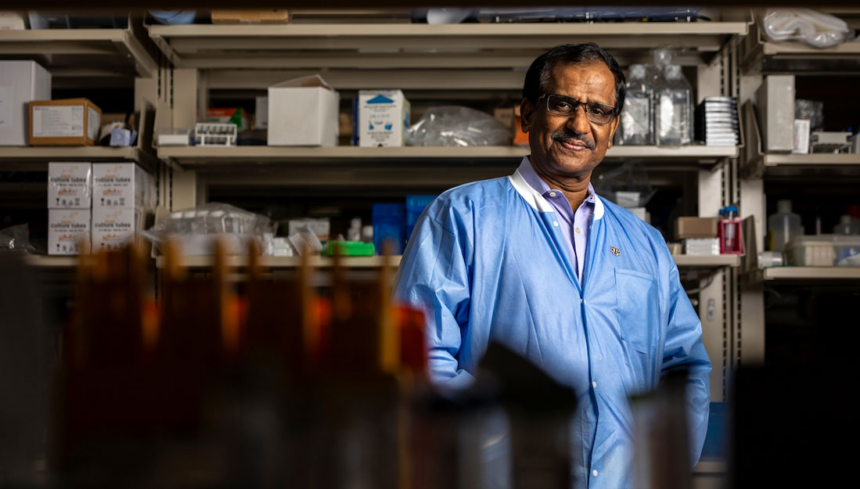
A research team led by neuroscientist Ashok Shetty, along with mechanical engineer Ya Wang, is exploring how nanorobots delivered through a nasal spray could penetrate the blood-brain barrier to slow the progression of Alzheimer’s disease.
Credit: Abbey Toronjo/Texas A&M University Division of Marketing and Communications
Could people adapt to outlive Alzheimer’s disease? Texas A&M University researchers are exploring whether treatment could one day offer a functional cure for the neurodegenerative disease — not by eliminating it, but by slowing it enough that people live out their natural lifespans before it takes a significant toll.
An interdisciplinary project led by Ashok K. Shetty, University Distinguished Professor in the Department of Cell Biology and Genetics at the Texas A&M University Naresh K. Vashisht College of Medicine, and Ya Wang, associate professor in the J. Mike Walker ’66 Department of Mechanical Engineering at the Texas A&M College of Engineering, is opening a new frontier in Alzheimer’s treatment research. The project pairs a promising Alzheimer’s drug with nanocarriers engineered to deliver the drug to the brain through the nose.
Most patients with Alzheimer’s disease are diagnosed in their late 70s or early 80s. As more Americans are living longer, more people may face the disease during their lifetime. For researchers, that makes slowing cognitive decline an important goal.
“Successfully slowing disease progression, even by 10 years, would have a massive impact on patients and their families,” Shetty said.
The project is one of 11 selected from 112 pre-proposals to receive an inaugural seedling grant from the Texas A&M Health Dementia and Alzheimer’s Research Initiative (DARI), which aims to accelerate progress in brain research by fostering multidisciplinary collaboration across the university.
Historically, much of Alzheimer’s drug development has centered on single-target interventions — most notably the clearance of amyloid-beta, a protein that can build up and form plaques in the spaces between nerve cells in the brain, making it difficult for signals to flow. These changes can contribute to dementia symptoms such as memory loss, difficulty communicating or completing familiar tasks, confusion about time and place, and changes in mood or social behavior.
Although amyloid plaques are a hallmark of Alzheimer’s disease, scientific consensus increasingly recognizes that the disease involves several distinct cellular failures, and effective long-term disease management requires multifaceted strategies.
“Our approach is distinct, because we are targeting multiple contributing factors to cognitive decline rather than just amyloid plaque accumulation,” Shetty said.
At the center of the team’s strategy is DDL-357, an experimental small-molecule drug that enhances levels of secreted clusterin, a protein involved in several protective processes in the brain. Clusterin works similarly to the way cooking oil prevents food residue from sticking to pans: The protein keeps plaques from adhering to brain cells. Previous studies correlated DDL-357, and its clusterin-enhancing properties, with less inflammation in the brain and a decrease in amyloid plaque buildup in Alzheimer’s animal models. Shetty’s lab is exploring how this compound may deliver an even broader biological impact across three key mechanisms.
“First is suppressing inflammation, second is triggering the production of new neurons, and third is promoting the formation of new synapses while protecting existing neurons to prevent synaptic loss,” Shetty said.
Simply put, the lab is seeking new ways to protect memory and promote cognitive function. But developing a potent drug is only half the battle — next, comes the delivery mechanism.
To deliver drugs effectively to the targeted brain region, Wang’s laboratory uses metal-organic frameworks (MOFs), a class of highly porous materials long studied in chemistry and increasingly investigated for medical applications. In 2025, UC Berkeley chemist Omar Yaghi shared the Nobel Prize in Chemistry with Susumu Kitagawa and Richard Robson for the development of MOFs. Wang, whose research spans nanomedicine and magnetic nanorobotics, received a 2025 Presidential Early Career Award for Scientists and Engineers (PECASE), the highest honor the U.S. government gives to early-career scientists and engineers. She said Texas A&M researchers are among the first to explore how MOF-based nanocarriers might be adapted for intranasal delivery of Alzheimer’s treatments.
MOFs consist of metal nodes connected by organic linkers, creating a porous structure. Their pores can hold drug molecules, while their composition can be engineered to influence release. Whether a given formulation reaches the brain—and how much reaches it — must be measured experimentally.
“If you can imagine, it’s just like a sponge, and these pores allow proteins or drugs to fit inside,” Wang said.
This collaboration builds on a prior study by the team, where MOF-74 nanocarriers infused with metformin (a drug for type 2 diabetes) were administered intranasally to mice. The results showed that about 9% of the dose reached the brain within eight hours — 82 times more than oral administration.
The current project will test a formulation loaded with DDL-357 designed, in theory, to safeguard the brain against plaque buildup. Researchers developed these nanocarriers using metals naturally present in the human body, designed to release the drug over time and then naturally biodegrade upon mission completion.
Even the most promising drugs face a persistent biological bottleneck known as the blood-brain barrier — a highly selective protective border of tightly packed blood vessels that separates circulating blood from the brain’s environment.
“The main challenge has been delivering enough of this drug into the brain because it does not efficiently cross that barrier,” Shetty said.
The blood-brain barrier prevents an estimated 98% of small-molecule drugs and virtually all large-molecule drugs from reaching the brain at effective levels. A drug that never reaches the brain can circulate to other organs, where it may cause unintended side effects.
“That is why we want to see how engineering can help with brain-targeted delivery,” Wang said. “The nose offers a shortcut: Drugs absorbed high in the nasal cavity can travel along the olfactory and trigeminal nerves into the brain, bypassing the blood-brain barrier.”
In this preclinical project, the team is studying intranasal administration of DDL-357-loaded nanorobots. If the approach proves sufficiently safe and effective, a nasal spray could be the future of Alzheimer’s disease treatment.
“In this study, we want to introduce these DDL-357-loaded nanorobots intranasally to determine whether the drug reaches different regions of the brain and is taken up by specific cell types,” Shetty said. “Intranasal administration reduces exposure to other organs, and we are evaluating dosage safety accordingly.”
The interdisciplinary team assembles leaders in regenerative neuroscience and nanomanufacturing to investigate how to deliver experimental therapies to specific brain regions and evaluate them in living systems. As data analysis continues, the researchers are focused on discerning feasibility.
“We are determining whether enough nanorobots reach the brain following intranasal delivery,” Shetty said. “We want to evaluate whether this approach is efficacious, whether the nanorobots successfully penetrate the brain, and whether they can slow Alzheimer’s disease pathogenesis.”
If successful, these preliminary findings will help the team pursue additional grants, including those offered by the National Institutes of Health (NIH). Further research could progress to human clinical trials, which would require extensive additional testing of safety, dosing, delivery and efficacy.
“I really appreciate the sponsors of this seed grant,” Wang said. “Given how challenging the overall funding situation is, this grant allowed our labs to work together and test whether this is a feasible and promising project for the future. It takes many years to translate nanomedicines into clinical practice, but this grant gives us hope and momentum.”
Ultimately, the drive behind this research stems from a commitment to people affected by cognitive decline. And the mission is personal.
“I have family and friends affected by Alzheimer’s, and patients and their families are constantly looking for a cure,” Wang said. “This grant has really helped push our research forward much faster.”
Laura Tolentino
Texas A&M Health
lauratol@tamu.edu
At the heart of the land-grant mission is the belief that higher education can transform lives by expanding opportunity, developing potential and preparing people to put what they learn to work in service to others.
The system filters and categorizes disaster, weather and humanitarian reports to help emergency professionals quickly find relevant information during emergency response.
A $1.94 million federal award will build on efforts to strengthen community-based healthy aging services.
Read articles, watch videos and discover how Texas A&M University is shaping an innovative, more secure future for the citizens of Texas and the world.
Could a nasal spray loaded with nanorobots buy Alzheimer’s patients an extra decade? – Texas A&M Stories



Leave a Comment