


Sign up to receive our email newsletter in your inbox.

In 2006, award-winning actor George Clooney worked to focus international attention on the violence and mass displacement facing civilians in Sudan’s Darfur region. He shined his celebrity spotlight on refugee camps, and he called for conversations about victims’ harsh living conditions.
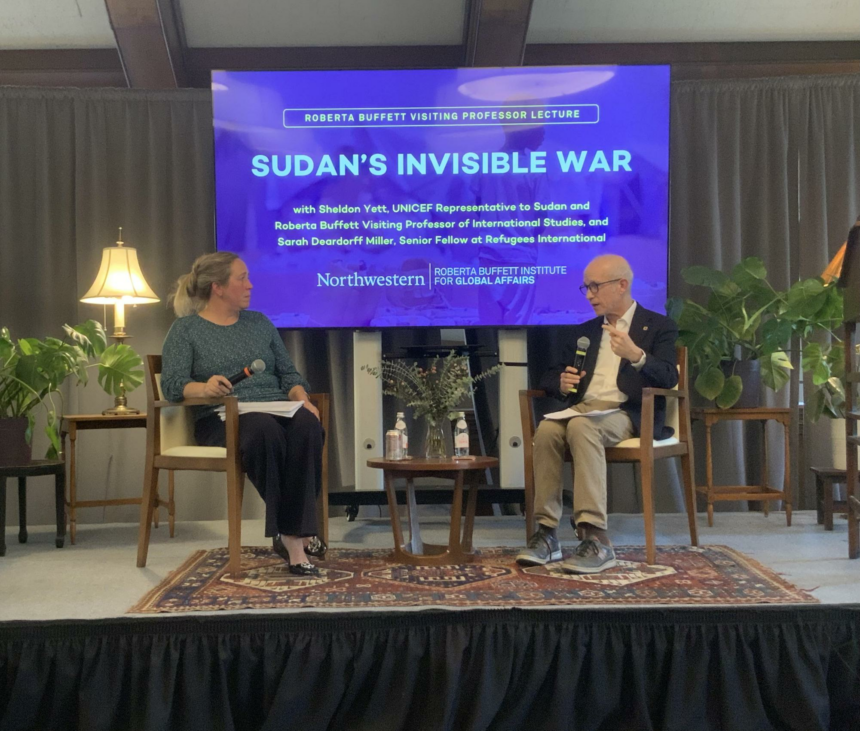
Twenty years later, visiting international studies Prof. Sheldon Yett said mainstream coverage about the chaos in Sudan remains scarce during an Oct. 27 conversation hosted by the Roberta Buffett Institute for Global Affairs.
Throughout the event, titled “Where’s George Clooney Now? Sudan’s Invisible War,” Yett conversed with Sarah Deardorff Miller, a senior fellow at humanitarian organization Refugees International.
“Gaza and Ukraine lead the news,” Yett said. “Sudan is on page 82, and that’s when it’s covered at all.”
Yett said audience members shouldn’t attribute this underrepresentation to Clooney. Drawing from his experience as UNICEF Representative to Sudan, he said the conflict’s complex narrative can hinder its global visibility.
Yett cited the U.N. Independent International Fact-Finding Mission, explaining the key sides of the catastrophe — the Sudanese Armed Forces and Rapid Support Forces. Both groups committed war crimes and abused global humanitarian law.
In 2019, the same commission described RSF actions against non-Arab ethnic communities in El Fasher as acts of genocide.
That same year, the SAF coordinated with the RSF to launch a coup against long-time dictator Omar Bashir. In 2023, the alliance crumbled and the groups openly warred. Since the start of the conflict, hundreds of thousands of civilians have been killed, and The World Health Organization has deemed it the world’s “worst humanitarian crisis.”
Throughout the event, Yett emphasized the importance of raising public awareness of the conflict’s impact on innocent individuals and communities within Sudan.
Attendee Butchuong Lulhok (Weinberg ’26) said he was a UNICEF beneficiary when growing up in Sudan. Lulhok said he appreciates Yett’s line of work.
“We need peace,” Lulhok said. “One of our activists in Sudan used to say that peace is when there’s food on the table, children go to school and conflict is managed in a mature manner that the violence is prevented.”
During the event, Deardorff Miller discussed the political powers impacting the global distribution of humanitarian assistance.
According to Yett, aid workers from the U.S. face unique challenges because the Trump administration has “slashed” resources for humanitarian aid and international development.
“The more money you take out, the worse the war gets, the less interest there is, and you just can’t get off the treadmill,” Yett said.
Yett said the international response spurred from high-profile individuals like Clooney may have been too incremental — with people debating how to act instead of acting directly. Still, he said, celebrities garnered attention.
Over 33 million people in Sudan require humanitarian assistance — a population greater than that of every person living in Illinois, Indiana and Wisconsin combined, according to the U.S. Census Bureau. More than half of those in need are children.
Evanston resident Jim La Rochelle said he believes the world has become a “global village.”
“I really believe very strongly that we, meaning the United States, should be responsive to needs throughout the world as much as we can,” La Rochelle said. “I think that’s part of being kind to our fellow man.”
As a UNICEF representative, Yett said he works wearing “a hat of all member states.” But as an American, Yett said he is aware of his country’s “soft power” in meetings with international leaders.
And while humanitarians can continue to restore infrastructure and supply communities with valuable resources, Yett said their short-term assistance is not a long-term solution.
“Humanitarian action can keep people alive, but humanitarian action cannot end this war,” Yett said.
After noting Clooney may no longer be actively rallying for Sudan, Yett said he still feels optimistic about the public’s interest based on the crowd that filled the Buffett Reading Room.
In the lecture’s final moment, Yett implored audience members to feel a sense of urgency.
“What happens beyond the shores here, beyond Chicago, beyond this country, in countries that people may or may not have heard about, actually really does matter and will impact them,” Yett said. “Continue to be involved. Talk to your friends, and hold us accountable as well.”
Email: [email protected]
X: @rawyahazin
Related Stories:
— BlackBoard and MENA spotlight Sudanese youth voices with ‘Sudan, Remember Us’ screening
— Students and faculty attend ‘Sudan and South Sudan in Context’ lecture
— Evanston Public Library, MENA host talk on war in Sudan
UNICEF representative talks conflict in Sudan during Buffett Institute lecture – The Daily Northwestern


Leave a Comment