


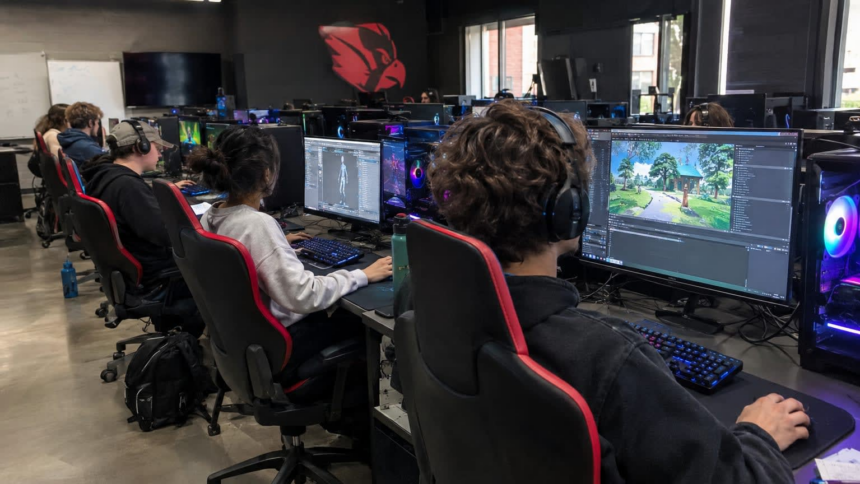
Corsair supplied Ball State University's Esports Center with 36 PCs, each with an Nvidia GeForce RTX 5070 Ti graphics card, 64 GB of memory and a 320 Hz display. The spec serves two kinds of users. Memory sized for Maya and Unreal Engine sits beside displays built for competitive play. Ball State says the upgrade gives students access to technology used in media production, animation and game development.
This story was produced through MarketScale. See how Education Technology teams put it to work with Executive Thought Leadership.
Explore related topics
Key takeaways
For a shared esports and media lab, let the heaviest course software set memory, and esports needs set the display and GPU.
Ball State expects its largest esports participation in 2026-27 since the program’s first year, and that count is the next test of demand.
Free workspace
Turn your Education Technology expertise into content.
Record interviews, organize footage, and write with AI on a free trial of the MarketScale platform for qualifying companies. No demo required, no credit card.
On this page
According to the university's Oct. 28 announcement, Corsair supplied 36 high-end gaming PCs to Ball State University's Esports Center, and each one is built for two very different users. Inside each machine, an NVIDIA GeForce RTX 5070 Ti graphics card runs alongside an AMD Ryzen 7 processor, backed by 64 GB of RAM. Every station has a 320 Hz display and its own keyboard, mouse and headset. Corsair also added 40 premium gaming chairs.
The release also lists the software the machines are meant to run: the Adobe Creative Cloud suite, Blender, Maya and Unreal Engine. That software list is the interesting part. Ball State presents the room as both a competitive gaming venue and an academic resource for media production, animation and game development, and the hardware it chose supports that pitch.
Jane Imbody covered the upgrade for The Star Press on Oct. 29, a day after the release.
Look at the spec sheet as a whole and it splits neatly in two. Shattered.io's Daniel Roth argued that the memory is the giveaway. Most competitive titles run comfortably on 16 or 32 GB, so 64 GB points to creative work, where Blender scenes, Unreal Engine projects and Maya rigs eat memory fast.
The display covers the other half. A higher refresh rate shortens the last step between a mouse click and a change on screen. That matters a great deal to a Valorant player. It matters very little to a student waiting on a render.
Each of the 36 stations carries two specs that answer to different masters: 64 GB of memory for Maya and Unreal Engine, and a 320 Hz panel for Rocket League and Valorant. A lab built for only one of those groups probably wouldn't pick both specs, so the setup looks like a deliberate dual-use build, not an off-the-shelf gaming rig.
Refresh rate is how many times per second a display can draw a new image. At 320 Hz the gap between frames is 3.125 milliseconds, but players only get that benefit if the graphics card can produce frames that fast. That's why the GPU and the monitor are chosen as a pair.
Universities deciding whether a gaming room can also handle a course load can use that split as a simple rule. The teams' needs set the minimum display and graphics card. The heaviest application on the course list sets the memory. Ball State's setup suggests the two can coexist in one box without compromising either group.
The machines sit in a space meant to do more than host practice. Ball State opens the facility for esports events aimed at its own campus community, at other colleges and universities, and at high schools. Programs also draw on the center, among them the STEM and Esports Camp run by the College of Communication, Information, and Media.
There are four more chairs than PCs. Roth reads the extra chairs as seating for spectators, coaches or staging, and he labels that a guess.
The control room also gives weight to how Dean Kristen McCauliff described the upgrade. She said it gives students access to elite technology they might not otherwise have, and prepares them for careers in media, live event production and animation. Running a multicamera stream of a match is live event production.
Demand looks strong. Ball State says the center has been full every day it has been open this semester, and the program expects its largest participation in 2026-27 since its first year. Dan Marino, the director of Esports, said students have been thrilled with the equipment and that turnout at weekly events has risen substantially.
The teams are winning, too. In 2026, the Rocket League team took the national championship of the National Association of Collegiate Esports. The Valorant team claimed the 2026 Esports Collegiate Conference championship, and League of Legends placed second. The release presents those results as context for the upgrade but does not attribute them to the new hardware.
The best argument against the dual-use reading is that the classroom half rests on capability and intent. The release says what the machines can run and what the dean expects, but it doesn't list courses scheduled into the room, and Marino's participation gain is measured in weekly events, not class enrollments.
Cost-per-seat comparisons aren't possible. Both Tech Insider and Shattered.io pointed out that the release gives no price, retail value, commercial terms or exact component models.
What the announcement does provide is a public reference setup: a named graphics card tier, a memory size and a refresh rate, all tied to a named software list. For a university writing specs for a shared esports and media lab, that's a real starting point to compare quotes against, especially when the same room has to pass review from both athletics-style programs and academic departments.
Before signing off on an esports refresh, ask which courses will be scheduled into the room. Size the memory for the heaviest creative application on that list, and the display and graphics card for the teams.
The next test is the 2026-27 participation count. Ball State expects its biggest turnout since the program's first year. If that happens, and class sections start showing up on the room's calendar, the 36 machines will have earned both halves of their spec sheet.
Sources
Featured companies
Your experts belong here
Every story in MarketScale Education Technology starts with a company putting its implementation leads, instructional designers, and district partners on the record. Buyers are already reading this topic. The only question is whose experts they find.
Procurement teams read long before they ever call, and your implementers get to answer their questions first.
About the author
The MarketScale Newsroom reports on the companies, technologies, and trends shaping 16 B2B industries. It turns primary sources and expert commentary into clear, useful coverage for the people doing the work.
Explore the publications, audience data and ways to participate in The MarketScale Network.
Your experts, this publication
MarketScale turns your implementation leads, instructional designers, and district partners into coverage like this.
MarketScale platform
Want to launch your own Education Technology podcast or show?
MarketScale gives Education Technology B2B marketing teams a full content studio: record, produce, and distribute your own channel. No agency, no crew, no guessing.
The week in Education Technology, and sixteen other industries, every Monday.
Ten stories, one-line takes, five minutes. Free.
Keep exploring
Put campus leaders on the record.
How B2B brands get cited by AI search.
education technology Events
Future of Education Technology Conference 2027
Jan 26, 2027 · Virtual
Learning Technologies Conference 2027
May 5, 2027 · Virtual
Become a Education Technology Voice
Share your Education Technology expertise with B2B marketing teams across MarketScale’s 1,250+ brand network.
The week in Education Technology, and sixteen other industries, every Monday.
Ten stories, one-line takes, five minutes. Free.
Education Technology: are you visible to AI?
Before they reach out, Education Technology buyers ask AI engines which vendors to trust. Explore how your experts, customers, and partners can become useful content for buyers and AI search.
Free Trial
This article was produced through MarketScale. The same platform turns your implementation leads, instructional designers, and district partners into the articles, video, and social content Education Technology buyers are searching for. Start a free trial and see it with your own people. For qualifying companies, no credit card, no demo required.
NPS +73 · 1,000+ creators · 38+ countries
What your free trial includes
More Education Technology Insights
More EdTech companies are changing hands, at lower prices
Edtech acquisitions reached 149 through August 2026, with four months of the year still to go. In Berkery Noyes’ data, the median disclosed revenue multiple fell from 2.3x to 1.3x, though deals above $160 million carried a median 5.9x in its historical sample.
Oct 30, 2026
A $4 billion repair backlog will now shape Louisiana's college building budgets
A Gordian assessment prepared for the Board of Regents puts the deferred maintenance backlog at Louisiana's public colleges at $4 billion. Buildings in the LSU and University of Louisiana systems average 64 years old, compared with 53 years for the community and technical colleges. Those findings now sit alongside a $1.25 billion capital request covering 73 projects.
Oct 29, 2026
Field of study drives community college certificate earnings test outcomes
Community college degrees almost all pass the new federal earnings test. Certificate results vary more: in Texas, construction trades certificates put students $48,000 ahead while IT certificates left them $21,000 behind.
Oct 27, 2026
Explore More Education Technology Insights
Read more expert perspectives from across Education Technology.
About the Expert
Editorial Team
MarketScale
The MarketScale Newsroom reports on the companies, technologies, and trends shaping 16 B2B industries. It turns primary sources and expert commentary into clear, useful coverage for the people doing the work.
For Education Technology teams
See how Education Technology teams use MarketScale →
Industry news, analysis, and expert perspectives
For B2B teams
Stories like this one run on content MarketScale captures from real practitioners. See how your team's expertise becomes coverage in Education Technology and beyond.
Or call us. No forms required. We pick up. 214-945-2512
© 2026 MarketScale, Inc.
Ball State's 36 new Corsair PCs are built for esports and creative software – MarketScale



Leave a Comment