


Now
62°
Sun
76°
Mon
77°
by Devyn Lyon
INOLA, Okla. – An agreement signed by Oklahoma Gov. Kevin Stitt and a company owned by government investment entities in the United Arab Emirates outlined hundreds of millions of dollars in proposed incentives for a $4 billion aluminum smelter in Inola nearly a month before lawmakers approved legislation creating a state incentive program.
The document, signed April 21, 2025, is marked confidential and details what Oklahoma was prepared to offer Emirates Global Aluminum (EGA) to attract the massive industrial project.
FOX23 reviewed the agreement, the legislation that followed and the timeline of its passage.
We also interviewed three state representatives – two Republicans who voted against the legislation and one Democrat who supported it.
Despite their different votes, all three raised concerns about how quickly the proposal moved through the Legislature.
The investigation raises questions about how major economic development agreements are negotiated, what information lawmakers receive before voting and how much influence local communities have over projects proposed in their backyards.
What was in the agreement?
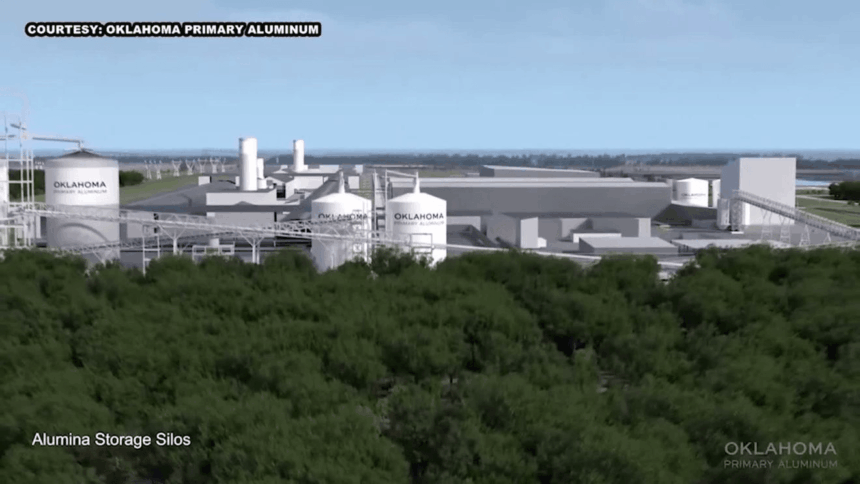
The memorandum of understanding between Gov. Stitt's office and EGA outlined a proposed arrangement intended to bring a multibillion-dollar aluminum production facility to northeastern Oklahoma.
Among the proposed financial terms were:
The agreement was nonbinding on the proposed commercial terms and anticipated additional negotiations and approvals. The figures represent proposals and estimates, not proof that the money has been paid to the developers.
Tax increment financing, commonly called TIF, generally redirects specified tax revenues within a designated area toward approved development costs. The proposed $545 million figure should not be confused with a direct payment of that amount from the state's general fund.
The agreement also outlined potential infrastructure investments benefiting the surrounding community.
The proposed facility would be one of the largest industrial investments in Oklahoma history.
Supporters say it could create approximately 1,000 permanent jobs, thousands of construction jobs and significantly expand domestic aluminum production.
But the financial terms outlined before the legislative vote are now drawing scrutiny from lawmakers who say they wanted more time to evaluate the proposal.
The timeline: Agreement first, legislation afterward
The sequence of events is central to FOX23's investigation.
April 21, 2025: Gov. Stitt signs the memorandum of understanding with EGA, outlining proposed financial and development terms.
May 15, 2025: The White House publicly announces the proposed Oklahoma smelter as part of a broader series of commercial agreements between the United States and the United Arab Emirates.
May 19, 2025: New legislative language establishing the Reindustrialize Oklahoma Act advances through House Bill 2781.
May 20, 2025: The Oklahoma House passes HB 2781 by a vote of 56-34.
May 22, 2025: The Oklahoma Senate passes the legislation.
May 28, 2025: Gov. Stitt signs the bill into law.
HB 2781 was already an existing bill before the agreement was signed. The legislation was subsequently revised to establish the Reindustrialize Oklahoma Act of 2025.
The law does not specifically name EGA, Oklahoma Primary Aluminum or the Town of Inola.
Instead, it creates an incentive program for qualifying manufacturers making at least $2 billion in capital investments and meeting employment requirements beginning at 700 jobs.
Those thresholds align with the scale of the proposed Inola project.
The timing raises questions about how the program was developed and how much information individual lawmakers had before the vote. However, the sequence alone does not establish that the agreement was improperly incorporated into legislation or that any laws were broken.
The Oklahoma House publicly identified the EGA smelter as a project supported by the legislation when it announced passage of HB 2781.
Lawmakers from both parties question the process
State Rep. Tom Gann, a Republican representing the Inola area, voted against HB 2781.
He told FOX23 he believes lawmakers were not given adequate information before the legislation reached the House floor.
"We didn't know about this, before the vote came up. It was rushed through, in a, very quick manner," Gann said.
Gann questioned the transparency of negotiations involving substantial public incentives.
He said large economic development proposals should receive more legislative scrutiny before lawmakers are asked to make decisions involving taxpayer money.
"We're not asking for trade secrets. We're not asking for possible, waste processes. We're just asking for transparency when they're getting taxpayer dollars. That's not unreasonable at all," Gann said.
Gann also supports giving local residents a greater voice in deciding whether major industrial developments should move forward in their communities.
Banning: Lawmakers needed more time
State Rep. Chris Banning, a Republican from Bixby, also voted against the legislation.
Banning told FOX23 he was not involved in the negotiations leading to the agreement and began reviewing the legislation shortly before it reached the House floor.
He described the process as unusually fast for a proposal involving such a significant amount of money.
"Without question. Yeah, this one was very quick," Banning said.
Banning also questioned whether the proposed incentives were appropriate given the foreign government ownership behind EGA.
He raised concerns about Oklahoma's restrictions on foreign land ownership and whether the project's ownership arrangement complies with state law.
Those concerns are questions raised by Banning, not an established legal finding. Oklahoma law includes exceptions to certain foreign ownership restrictions, and the project's specific legal status would require an authoritative determination.
The developer says Oklahoma Primary Aluminum will be a U.S. company subject to American laws and regulations.
Rosecrants voted yes — but wishes he had more information
State Rep. Jacob Rosecrants, a Democrat from Norman, offers a different perspective.
Unlike Gann and Banning, Rosecrants voted in favor of HB 2781.
He told FOX23 he supported the legislation because he believed the project could bring economic development and jobs to Oklahoma.
But he also expressed concerns about how quickly lawmakers were asked to consider the proposal.
"You would think there'd be slow deliberations on things that cost millions, hundreds of millions of dollars. That is not the way that that went down in 2025," Rosecrants said.
Rosecrants described learning details about the proposal shortly before the vote.
He said he felt pressure to make a decision on a major economic development opportunity without the time he would have preferred to examine it.
"I want the state to do well. Looking back on it now, I wish I would have had a lot more time to really go over everything," Rosecrants said.
Rosecrants has not said he would necessarily change his vote.
He emphasized that lawmakers approved an incentive program, rather than directly authorizing construction of the aluminum smelter.
Still, he believes the process should have involved more deliberation.
"We just need to take time on these things. We need to know about these things earlier," Rosecrants said.
He said that concern extends beyond either political party and applies to the entire Oklahoma Legislature.
Who owns the proposed smelter?
The project is being developed by Oklahoma Primary Aluminum, a joint venture involving EGA and Chicago-based Century Aluminum.
EGA holds a 60% controlling interest, while Century Aluminum holds the remaining 40%.
EGA is owned by investment entities controlled by governments in the United Arab Emirates.
The proposed facility would operate in Oklahoma, but its majority ownership would be held by the UAE-based company.
That arrangement has become one of the central issues in the debate surrounding the project.
Critics question foreign government control of a major industrial facility, particularly one involving public incentives and a material considered important to national security.
Supporters argue the investment would strengthen American manufacturing, reduce reliance on imported aluminum and create jobs in Oklahoma.
The Tulsa Port of Inola currently owns the industrial park where the facility is proposed.
Oklahoma Primary Aluminum says the plant and land would eventually be owned by the joint venture.
The ownership arrangement has also drawn scrutiny from Oklahoma Attorney General Gentner Drummond, who filed legal action seeking to stop the project over environmental concerns.
The existence of that litigation does not establish that the proposed ownership structure is unlawful.
The White House connection: A project promoted by President Trump
The proposed smelter is not simply an Oklahoma economic development project.
It has also received significant support from President Donald Trump's administration.
On May 15, 2025, the White House announced more than $200 billion in commercial agreements between the United States and the United Arab Emirates.
The administration specifically identified EGA's proposed $4 billion Oklahoma smelter as one of those projects.
The announcement came less than a month after Stitt signed the agreement with EGA and just days before Oklahoma lawmakers voted on HB 2781.
The White House described the smelter as a project that would strengthen American supply chains, create jobs and expand domestic aluminum production.
The administration also highlighted a separate partnership involving EGA, RTX and the UAE's Tawazun Council to develop gallium production capabilities.
Gallium is used in technologies including semiconductors and defense systems.
That partnership is distinct from the proposed Oklahoma smelter, but it illustrates EGA's broader involvement in U.S.–UAE industrial cooperation promoted by the White House.
The federal government has also supported the Oklahoma project through a $500 million Department of Energy award associated with the proposed development.
And in 2026, the U.S. Department of Justice filed a statement of interest supporting the smelter in litigation brought by Oklahoma's attorney general.
Federal officials argue that expanding domestic aluminum production is important to national defense and reducing dependence on foreign suppliers.
Those actions establish substantial federal support for the project. They do not, by themselves, establish improper influence over Oklahoma lawmakers or a personal financial interest by President Trump in the development.
The smelter and Oklahoma's governor's race
The project has also become a political issue in Oklahoma's race for governor.
Republican gubernatorial nominee Mike Mazzei has supported the development, while Democratic candidate Cyndi Munson has raised concerns about the environmental and financial impacts of major industrial projects.
During her campaign, Munson said:
"You're not going to pollute our air. You're not going to put those, costs on everyday working Oklahomans."
Attorney General Drummond, who unsuccessfully sought the Republican nomination, has opposed the smelter and pursued legal action against it.
President Trump endorsed Mazzei during the Republican primary, adding another national political dimension to the controversy.
But whether a new governor could actually stop the project is a separate question.
Banning doubts a new governor could stop the project
Banning told FOX23 he does not believe the outcome of the governor's race necessarily determines whether the smelter can move forward.
He said he has examined the state Constitution and spoken with legal experts about what authority a future governor might have to halt the development.
"I've talked to a lot of people, legal experts. I haven't found where a governor, the next governor, can come in and stop this," Banning said.
Banning acknowledged that he had not found a definitive answer establishing such authority.
His comments reflect his interpretation of the governor's legal powers, not a court ruling.
The project remains subject to applicable permitting, legal proceedings and other governmental decisions.
Other lawmakers believe the next administration's approach to the project could still matter.
But Banning argues the governor's race should not be viewed as a guaranteed way to determine the smelter's future.
Inola residents say they were left out of the process
While lawmakers debate what happened at the Capitol, residents in Inola say they have their own concerns about transparency.
Steven Flathers, an Inola-area resident who has previously spoken with FOX23 about the proposed smelter, said he believes the project was introduced without enough information being shared with the community.
"I would say it was kind of rushed in. There wasn't a lot of information shared upfront about the project," Flathers said.
Flathers said early descriptions of the proposed facility on local agendas did not adequately communicate the scale or nature of the development.
He recalled seeing references to a metal manufacturing facility or aluminum plant before residents understood the full proposal.
"Nobody ever indicated what it really was until they were pretty far in the process," Flathers said.
Flathers said learning that state lawmakers had similar concerns about the amount of information available before their votes only deepened his questions.
"It seems like state legislators may not have known what they were voting for when they voted for this. And, you know, I think it's worth diving into," he said.
Flathers also questions whether the proposed smelter is compatible with surrounding agricultural operations.
He has raised concerns about potential fluoride emissions and their possible effects on livestock, crops and nearby property.
Those concerns are not findings that the proposed facility will violate environmental standards. The project remains subject to environmental review and permitting requirements.
The developers say they are committed to meeting applicable environmental standards and operating responsibly.
Flathers also questioned whether government incentives are the best way to revive aluminum manufacturing in the United States.
He believes policymakers should examine the underlying energy costs that have made domestic aluminum production difficult.
Rather than relying primarily on subsidies, Flathers suggested investing in lower-cost energy infrastructure that could make American manufacturing more competitive.
He also questioned the project's majority foreign ownership, particularly when national security is cited as a reason for supporting domestic aluminum production.
"I think especially when one of the main reasons our leaders cite is that this is a national security concern. It makes a lot more sense to have it be a fully American owned company," Flathers said.
A local vote could help determine what happens next
Inola officials have moved toward allowing voters to decide whether aluminum production should be prohibited within town limits.
A local vote is scheduled for April 7, 2027.
The proposed ballot measure and its potential effects have become another point of contention between local officials and the project developers.
The developers have questioned the town's actions and argued that the project should be allowed to proceed through established legal and regulatory processes.
For Flathers, the principle is straightforward: The people living near the proposed facility should have a voice.
"I think the right thing to do is put this by the voters," Flathers said.
"They're the ones who will live with the impacts, whether they're good or bad. And I think they deserve a say."
What the developers and state officials say
Supporters of the project argue that the smelter represents an opportunity to rebuild an important American manufacturing industry.
In its May 2025 announcement, the Oklahoma Department of Commerce described the development as a historic investment that could bring approximately 1,000 permanent jobs and additional economic activity to northeastern Oklahoma.
Gov. Stitt said the project would help position Oklahoma as a leader in domestic critical-minerals production.
House Speaker Kyle Hilbert also defended the legislative process at the time, saying the Legislature's economic development committee had thoroughly vetted the project.
The Oklahoma House publicly described HB 2781 as legislation supporting the proposed EGA smelter.
The developers say the project would strengthen domestic aluminum production while bringing significant economic benefits to Oklahoma.
Oklahoma Primary Aluminum also says the proposed state support would not involve simply handing $255 million directly to the developers.
According to the company, the proposed funding structure would involve a state investment fund, with payments eventually used to offset qualifying electricity costs after the project becomes operational and meets applicable requirements.
Those descriptions explain the developers' position; they do not establish that every proposed incentive has been approved, funded or paid.
The questions that remain
The agreement between Stitt's office and EGA is publicly available, and the legislation establishing the incentive program is part of the public record.
Together, those documents establish that the state was negotiating substantial proposed incentives before the Legislature approved the program.
They also show that the agreement anticipated legislative action.
What remains less clear is precisely how much individual lawmakers knew about the agreement's financial terms, who helped develop the legislation and whether the amount of time available for review was sufficient.
The lawmakers interviewed by FOX23 do not agree on whether supporting the project was the right decision.
But they share a concern about the process.
Gann wants greater transparency when public money is involved.
Banning wants more scrutiny of major agreements and the legal questions surrounding foreign ownership.
Rosecrants, despite voting yes, believes lawmakers should receive more information before being asked to approve legislation involving hundreds of millions of dollars.
And residents such as Flathers say the people who would live alongside the development deserve a meaningful voice in its future.
As legal challenges and local decisions continue, the debate is no longer limited to whether Oklahoma should welcome a major aluminum manufacturer.
It is also about how the state makes those decisions — and who gets a say before they are made.
Read the documents
FOX23 reviewed the following public records and government announcements as part of this report:
The agreement: April 21, 2025, memorandum of understanding between EGA and Gov. Stitt's office
The legislation: HB 2781 — Reindustrialize Oklahoma Act of 2025
The legislative explanation: Oklahoma House announcement of HB 2781's passage
The White House connection: May 15, 2025, White House announcement of U.S.–UAE commercial agreements
The developers' position: Oklahoma Primary Aluminum's project information and answers
FOX23 will continue following the proposed smelter, the legal challenges surrounding it and the decisions that could determine its future.
2026 Sinclair, Inc.
Confidential Agreement Outlined Inola Smelter Incentives Before Legislative Vote – KTUL



Leave a Comment