


German diplomacy in Asia takes focus this week, as Chancellor Merz wraps up a three-country Asian business tour in South Korea. Meanwhile, President Steinmeier held talks with Xi Jinping in Beijing. DW has more.
Here are the leading headlines from and about Germany on Friday, October 30:
Ahead of talks with Chinese President Xi Jinping on Friday, German President Frank-Walter Steinmeier lauded China’s role as a global technological and economic power, while emphasizing the responsibility that comes along with it.
“We both bear responsibility for the international order and for the conditions under which states in this world maintain and shape their relations,” Steinmeier said.
President Xi praised what he called an “all-dimensional strategic partnership” between China and Germany, calling for new cooperation based on stability and mutual benefit.
“This new paradigm sends a positive signal to the world: we favour openness over closure, and cooperation over confrontation,” Xi said during opening remarks, emphasizing the start of a “new chapter” in Germany-China ties.
To view this video please enable JavaScript, and consider upgrading to a web browser that supports HTML5 video
On October 30, 1961, West Germany and Turkey signed an agreement allowing the temporary recruitment of workers. Sixty-five years on, many so-called “guest workers” cannot live from their pensions.
Learn more about how “guest workers” are struggling as they reach retirement age in this in depth report by Oliver Pieper.
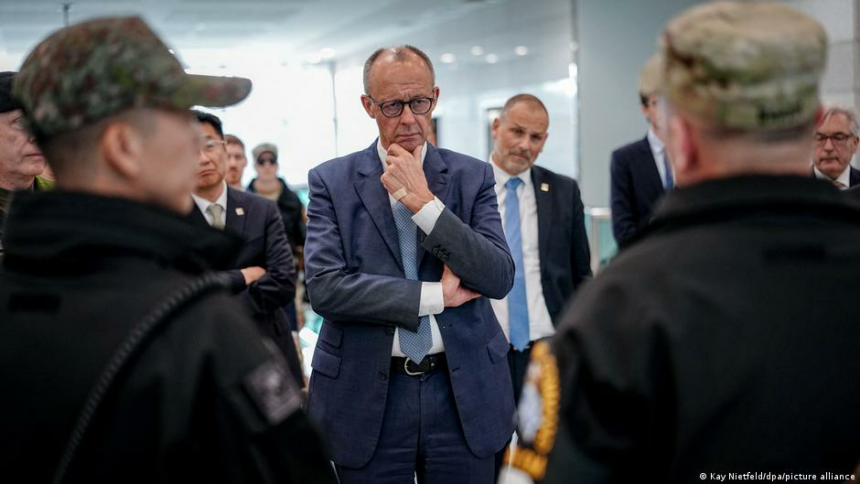
German Chancellor Friedrich Merz on Friday visited the Panmunjom truce village at the demilitarized zone (DMZ) separating North and South Korea, briefly standing on the North Korean side inside the barracks.
North and South Korea have been divided since the end of hostilities in the Korean War in 1953, with a border running across the peninsula.
In remarks to reporters, Merz recalled Germany’s reunification 36 years ago.
“Let us hope that Korea too gets the chance one day to regain state unity,” he said.
“You can also notice it here at this place, how much a country suffers from division and how strong the desire is for reunification, at least in this part of the Korean Peninsula,” he said, adding that he had been asked about Germany’s reunification experience while visiting Seoul.
North Korea, however, has backed away in recent years from diplomacy with the South, having officially removed language calling for reunification from its constitution while changing the South’s status to that of a “hostile state.”
While German Chancellor Friedrich Merz in South Korea on Friday called for a better rule-based trade order, President Frank-Walter Steinmeier was in the Chinese capital in a bid to smooth out trade disagreements.
In Beijing, Steinmeier called for preserving the “win-win principle” characterizing Sino-German relations, borrowing from the expression “win-win cooperation,” one of the most frequently used phrases in Chinese foreign policy statements.
Germany’s economic ties with China have gone through a shock in recent years, with Chinese manufacturing growing into sectors once dominated by German firms, and Chinese electric cars taking over market share.
At the start of a meeting with Chinese Premier Li Qiang, Steinmeier cited a recent deal limiting exports of Chinese hybrid cars to the EU in exchange for select tariff cuts on EU exports to China as an example of a “a way to find solutions.”
Steinmeier also brought up Germany’s growing trade deficit with China, which grew to nearly €90 billion ($100 billion) last year.
Germany has long resisted tougher action against China, fearing retaliation. But rising pressure on key industries has pushed Berlin to seek stronger EU trade-defense powers to protect its industrial base.
Steinmeier said Germany would work to solve trade problems with China. “We are coming with the intention of maintaining and strengthening the framework for good economic exchange between our two countries,” Steinmeier said.
Later in the day, the German president, who occupies a largely ceremonial role without policymaking power, was also recieved by an honor guard alongside Chinese President Xi Jinping.
During his final day of a whirlwind Asia tour this week, German Chancellor Friedrich Merz told the Asia-Pacific Conference of German Business in Seoul on Friday that Germany and Europe are ready to cooperate with Asian economies to foster a rules-based economic order.
Merz said the European Union is ready to take the lead in shaping a better deal for countries in Asia feeling the pressure of a destabilized rules-based trade order.
“Competition between the US and China is ramping up. Tariffs, technological decoupling strategies and a tough race for critical raw materials and new technologies are fundamentally changing the rules of our global economy,” Merz said.
“These conflicts and systemic shifts in power patterns concern us all. They particularly concern economically aspiring partners in the Indo-Pacific, as well as in Germany and in Europe.”
During stops in Singapore and Japan this week, Merz pushed for free trade partnerships and greater European cooperation with Asian economies.
In Singapore on Wednesday, Merz called for a free trade agreement between the EU and the Comprehensive and Progressive Agreement for Trans-Pacific Partnership (CPTPP), a sweeping multilateral free trade agreement connecting the Asia Pacific and the Americas.
The UK is the single European signatory, albeit outside of the EU bloc. The US pulled out during the first administration President Donald Trump in 2017, scuttling the original version, the Trans-Pacific Partnership (TPP).
“We want to offer opportunities beyond bilateral agreements,”he said in Seoul on Friday.
“We are resolutely joining forces against unilateralism, autocratic power politics and violations of international law,” Merz added.
“When supply chains become political pawns, when access to key technologies is obstructed or when efforts to secure raw materials resemble displays of power rather than fair partnerships, this jeopardizes growth, prosperity and ultimately the security of entire regions.”
Merz also tried to allay concerns about EU protectionism under the “Made in Europe” scheme intended to protect carmakers.
“There is a fear that we might be facing a new wave of European protectionism – that we are closing ourselves off from other nations,” Merz said.
“I take these concerns very seriously. I will carry them back not just to Berlin, but also to Brussels, and I will certainly raise the fact that these concerns were expressed to me quite forcefully here,” he added.
Citing Germany as an example, South Korean Prime Minister Han Seong Sook told the conference ”German companies are using Korea as a central hub to expand their presence in the Asia-Pacific region.”
Additional reporting by Nina Haase
The question of who should become Germany’s new president is becoming pressing.
Many want to see Germany’s first female head of state. Chancellor Friedrich Merz is keeping his cards close to his chest.
Read DW’s full report on who may be the next German president.
Good morning from the DW newsroom in Bonn.
Germany’s chancellor and president were both in Asia this week, with Chancellor Friedrich Merz calling for more robust trade ties with middle powers and President Frank-Walter Steinmeier focusing on diplomacy during a multi-day visit to China.
On Friday, Merz spoke at a German-South Korean business conference in Seoul, while Steinmeier is set to meet with Chinese President Xi Jinping.
Keep reading for the latest updates from Germany.
Germany news: Merz calls for global free trade alliance in Asia – DW.com


Leave a Comment