


JASON RANTZ OPINION
Jun 24, 2026, 5:05 AM
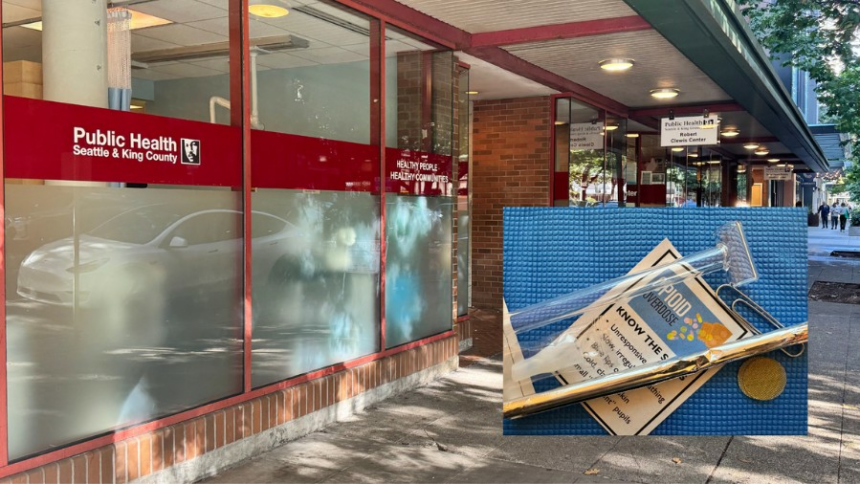
The main image shows a Public Health-Seattle and King County building in Seattle. The inset image shows a Seattle drug kit procured from Public Health Seattle. (Photos: Jason Rantz)
(Photos: Jason Rantz)
BY
Talk Show Host and Columnist at Seattle Red
The Washington State Department of Health has a message for the hundreds of thousands of soccer fans pouring into Seattle for the World Cup, and it is not “don’t use fentanyl.” It is a how-to guide for using it more carefully.
A substantial piece of the state’s official “Information for FIFA Visitors” page, between tips on staying hydrated and avoiding food poisoning, sits a section on opioids that never once tells a visitor to simply not buy street drugs. The guide concedes the danger in its own words. “Washington’s street drug supply is unpredictable, and fentanyl could be in any drug you buy on the street or online,” it reads. Then it explains how to proceed anyway.
That is not an oversight, but the entire philosophy, the same one baked into the overdose survival toolkit the state put out last winter.
The opioid section admits the stakes with brutal efficiency. “Each day about two people die of an opioid-related overdose in Washington,” the guide states. Fair enough. But a serious public health agency would follow that sentence with the obvious one, a plea not to gamble your life on a poisoned supply in a city you are visiting for three weeks.
Instead, the state offers this: “If you choose to use these substances, please take precautions to protect yourself, such as starting with a small dose, not using alone, and making sure that the people you are with have access to naloxone (Narcan), a medicine that can reverse an opioid overdose.”
Start with a small dose. Do not use alone. Keep Narcan within reach. That is the counsel Washington is handing a tourist from Belgium, Egypt, or Qatar, whose teams take the field at Lumen Field on June 24 and June 26 before the knockout matches on July 1 and July 6.
Read the entire section and notice what is missing.
The state links visitors to naloxone instructions, to a map for free naloxone, to the Good Samaritan law, and to a state-run overdose website. There is not one link to detox, to treatment, or to any path out of addiction. Every resource exists to keep a person using and breathing, never to help them stop. It is the same logic behind the taxpayer-funded kits the county hands out, which arrive with Narcan and a card encouraging users to get high in groups.
This is the harm reduction model working exactly as intended, the one that waits for the addict to ask for help rather than pushing anyone toward recovery. I traced how we got here in my book, “What’s Killing America.”
Harm reduction started as one tool among several, clean needles to slow the spread of disease and a professional on hand to reverse an overdose. Then activists and progressive officials kept pushing until it stopped being a bridge to treatment and became the only strategy anyone would fund. Pushing treatment, to the Radical Left, is “stigmatizing” to the drug addict.
So why won’t the state just tell people not to do it? Because in progressive public health circles, telling someone not to use drugs is treated as an act of stigma, and stigma has become the unforgivable sin. The National Harm Reduction Coalition insists that judgment makes addicts feel undeserving of dignity and scares them away from care. Warning people off a lethal supply, the reasoning goes, wounds them worse than the drug does.
It is a tidy theory, and it is false. Stigma is not what keeps an addict hooked. The endless river of cheap fentanyl keeps them hooked, along with a political class that asks nothing of them and expects nothing better. Addiction earns its stigma when the alternative is a visitor found dead in a hotel bathroom. I would rather make the behavior unwelcome than send someone off with a dosing tip and a Narcan hotline.
Washington Democrats have built a public health system that treats one sentence as too dangerous to print, the sentence that says there is no safe quantity of an unpredictable street drug and the only winning move is to not use at all.
Listen to The Jason Rantz Show on weekday afternoons from 3 p.m. – 7 p.m. on Seattle Red on 770 AM (HD Radio 97.3 FM HD-Channel 3). Subscribe to the podcast here. Follow Jason Rantz on X, Instagram, YouTube, and Facebook.
Follow @https://twitter.com/jasonrantz
Jason Rantz
Washington’s World Cup health guide coaches visitors on using street fentanyl more safely but never tells them to stop, and links to naloxone, not treatment.
5 minutes ago
Jason Rantz
For one Friday, World Cup Seattle was clean, safe, and electric. Rantz says the city could have that downtown daily. It just won’t do it for locals.
2 days ago
Jason Rantz
The Seattle Times turned a World Cup celebration into a Trump grievance session. Verified X users and even an Aussie fan dragged the paper for it.
3 days ago
Jason Rantz
World Cup concession prices at Seattle Stadium are absurd, from $11.99 cotton candy to a $13.49 pretzel. Jason Rantz on the one item that’s actually fair.
5 days ago
Jason Rantz
Seattle turned an Iran-Egypt World Cup match into a Pride crusade. Jason Rantz on why the Left’s favoritism, not gay rights, is driving it.
6 days ago
Jason Rantz
Seattle Times columnist Naomi Ishisaka recasts the convicted Spokane 3 as civil rights heroes while ignoring the federal jury that found all three guilty.
8 days ago
Washington's World Cup guide coaches tourists to take fentanyl – Seattle Red



Leave a Comment