


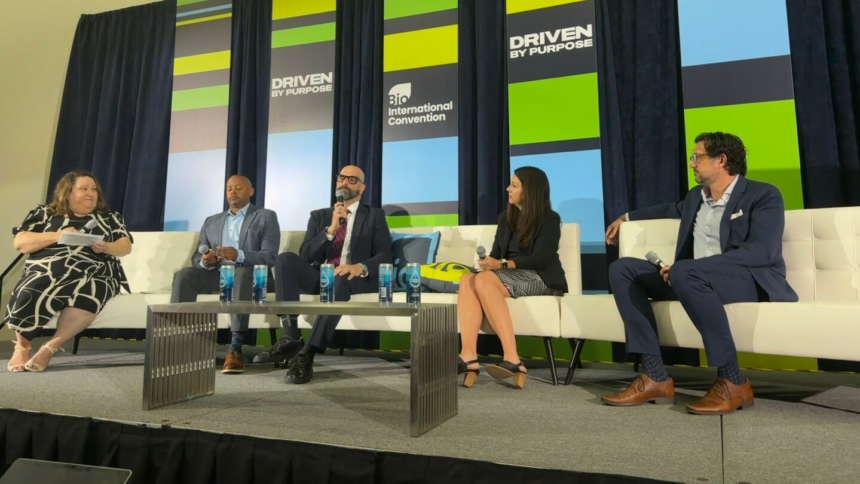
From left to right: Julie Tierney, former deputy director of the FDA’s Center for Biologics Evaluation and Research (CBER); Ian Simon, former lead of HHS’ Office of Long Covid; Demetre Daskalakis, former director of the CDC’s National Center for Immunization and Respiratory Diseases; Jennifer Eileen Towne, chief scientific officer at Vir Biotechnology; Jared Bauer, CEO and cofounder of Seek Labs.
Jef Akst
When the Department of Government Efficiency—nicknamed DOGE—started slashing jobs at the U.S. health department early last year, it was under the guise of a massive restructuring project. But Demetre Daskalakis, director of the CDC’s National Center for Immunization and Respiratory Diseases until October 2025, has a different view.
“When you think about a reorganization, you think about re-imagining a structure so it’s better fit to function,” Daskalakis, now chief medical officer at Callen-Lorde, said at a Monday panel during the BIO International Convention in San Diego. “This feels more like someone is deleting parts of an organization without thought. It’s moth-eaten, for lack of a better term.”
He gave the specific example of a branch within his CDC center that had the word equity in its name. “They actually had almost nothing to do with health equity,” he explained, but the division was wiped out nonetheless. “Certain things were deleted based on a search or certain terms, and then they just went away.”
In total, the Department of Health and Human Services (HHS) cut about 10,000 employees in the first half of 2025. Another 10,000 or so left as part of a program to incentivize voluntary departures such as early retirement.
Layer on the continued lack of steady leadership, with a majority of senior roles across the FDA, CDC and NIH being filled only in an acting capacity, and the department continues to survive in a state of flux.
“From the perspective of what the staff feels, they feel like the administration doesn’t actually value their work because they’re not giving them a permanent leader,” Daskalakis said specifically of the CDC.
When panel moderator Julie Tierney, former deputy director of the FDA’s Center for Biologics Evaluation and Research (CBER) under well-respected regulator Peter Marks, asked if the situation is recoverable, Daskalakis answered flatly: “No.”
But he and his fellow panelists maintained an optimistic tone. The U.S. may have transitioned from a golden age to a dark age in public health, but “the end of a dark age is always a renaissance,” Daskalakis remarked. “No one ever tries to go fix the Acropolis. . . . They try to build the Sistine Chapel.”
Jared Bauer, CEO and cofounder of Seek Labs, lauded the analogy, agreeing that “one of the things that happens when you tear down everything is you do have an opportunity to build something different.”
The panelists discussed the history of the public health system as it stood before the current turmoil, describing it as a patchwork of centers built in times of necessity. This time around, the country could theoretically build something better.
“The nice part of disruption is that there’s an opportunity to actually create something with intention,” Daskalakis said.
Stakeholders will have to act quickly to make that happen because infectious disease outbreaks like Ebola and hantavirus continue to become more common. And for now, the panelists agreed—the country is at risk.
“This sort of moth-eaten approach to dismantling government means that there is not a threshold of staff there that is adequate to make me feel confident to say that we are prepared to respond to a big event,” Daskalakis said.
The staff cuts and leadership turnover at HHS are problematic in obvious ways—such as a lack of experience with outbreak responses—and more subtle ways, said panelist Ian Simon, former lead of HHS’ Office of Long Covid, which was shut down last year.
“I saw firsthand during the COVID response when omicron first emerged in South Africa, the scientists in South Africa contacted NIH leadership almost immediately, days before they contacted their own ministry, because they had a decades-long trusted relationship with NIH leadership,” said Simon, now director of Biosecurity Policy and Partnerships at Flyttr. “It saved us days to a week . . . and it was built on this informal layer of information sharing that you lose when you ask senior leaders to go find a different line of work.”
Jennifer Eileen Towne, chief scientific officer at Vir Biotechnology, added that such government collaboration is important in industry as well, referring specifically to her company’s work with the NIH on Ebola. “It wasn’t just funding or speed; it was actually that we really partnered with them on it,” she explained. “So we actually got the patient samples from the NIH, from patients that had, or people that had survived Ebola.”
Banking on his eternal optimism, which he says is part and parcel of startup life, Bauer described a best-case scenario for moving forward. “I would love to see, over the course of the next five to ten years, more of a strategy that is going to protect us long term, built from the bottom up to protect us globally.”
His realism shone through, however, as he clarified that “there’s a difference between what I think and what I hope. What I think is that likely we’re going to create a similar mess to what we would do in the past. What I hope is we build the Sistine Chapel.”
Get daily news updates when you subscribe to GenePool!
© 1985 – 2026 BioSpace.com. All rights reserved.
BIO 2026: US public health as we know it is gone. Can we rebuild a better system? – BioSpace


Leave a Comment