


Thank you for visiting nature.com. You are using a browser version with limited support for CSS. To obtain the best experience, we recommend you use a more up to date browser (or turn off compatibility mode in Internet Explorer). In the meantime, to ensure continued support, we are displaying the site without styles and JavaScript.
Advertisement
Nature Food (2026)
Controlling agricultural ammonia (NH3) and nitrous oxide (N2O) emissions is vital for air quality and climate goals, yet policy synergies and trade-offs in mitigating these reactive nitrogen (Nr) remain unclear. Here, through an integrated framework combining high-resolution emission inventories with policy-specific scenario analysis, we evaluate China’s national agricultural policies for abating Nr emissions (2000–2022) and estimate synergies between NH3 and N2O abatements. China’s NH3 and N2O emissions peaked around 2015 and subsequently declined by 16% and 30% by 2022, respectively. Post-2015 synergistic achievements were driven mainly by fertilizer-reduction policies (~90% of abatements) with a sixfold increase in their synergetic level. Manure-management and straw-utilization policies showed limited overall effectiveness and trade-offs, though post-2015 synergies emerged in non-pastoral regions, highlighting spatial and sectoral heterogeneity. Optimized full-chain livestock management could reverse the overall trade-offs in this sector in the short term, achieving synergetic levels comparable to the fertilizer-reduction policies.
Agricultural systems are pivotal for achieving multiple United Nations Sustainable Development Goals (SDGs), including those related to zero hunger (SDG 2), human well-being (SDG 3) and the environment (SDGs 6, 14, 15)1,2,3. Nitrogen, an essential nutrient underpinning modern agriculture, is the dominant source of global anthropogenic emissions of reactive nitrogen (Nr) gases, accounting for 80–90% of NH3 and 60–70% of N2O emissions4,5,6. Critically, NH3 substantially drives the formation of fine particulate matter (PM2.5)7 and might offer superior cost effectiveness in air pollution mitigation compared to nitrogen oxides (NOx)8, whereas N2O, ranked as the third-largest anthropogenic greenhouse gas, not only has a 100-year global warming potential 273 times that of CO2 but also actively depletes stratospheric ozone9. In China, one of the world’s most populous countries and largest agricultural producers, Nr emissions have increased rapidly since 198010, threatening the ecological environment and human health. Notably, agricultural N2O alone contributes ~3.6% to China’s total greenhouse gas (GHG) emissions11. Therefore, identifying targeted agricultural strategies to simultaneously reduce NH3 and N2O emissions is urgently needed to concurrently advance environmental quality, climate mitigation and agricultural sustainability12.
Policy interventions that target nitrogen management could deliver coordinated abatements in Nr losses across multiple environmental pathways. Existing policies, such as Best Nutrient Management Practices in the USA and the EU’s Nitrate Directive, demonstrate co-benefits by simultaneously reducing multiple nitrogen pollutants such as NH3 volatilization, N2O emissions and nitrate leaching13,14. Similarly, China’s Soil Testing and Formulated Fertilization programme reduces fertilizer use while increasing grain yields and farmer incomes, achieving co-benefits across productivity, economy and the environment15.
However, due to the complex transformation pathways of Nr, neglecting these processes during policy-making may displace burdens from one system to another (for example, from the atmospheric system to the climate system), leading to environmental trade-offs rather than overall benefits. For example, meta-analysis based on field experiments showed that straw return reduces nitrogen leaching and runoff but simultaneously increases NH3 and N2O emissions into the air16. Meanwhile, some manure-management mitigation measures reduce one emission (for example, NH3 via injection or covers) but increase others (for example, N2O), highlighting trade-offs unless using integrated strategies17.
Whereas existing studies predominantly evaluate future technology-based mitigation potential18,19, effects of historic policies across the whole agricultural sector remain poorly understood. Though a recent study quantified that historic policies avoided considerable NH3 (~3.6 Tg) from cropland before 2017 in China18, evaluations targeting a single Nr species inevitably overlook pollution swapping and trade-off effects. Additionally, robust methodological frameworks to quantitatively assess policy-driven synergies and trade-offs across different Nr species remain underdeveloped, constraining policy effectiveness and complicating China’s evolving climate and pollution co-control goals.
To address these knowledge gaps, this study develops an integrated framework to systematically evaluate synergies and trade-offs between NH3 and N2O emissions resulting from China’s agricultural-management practices since 2000 (Extended Data Fig. 1). This framework first developed comprehensive city-level agricultural NH3 and N2O emission inventories from 2000 to 2022, covering 19 crop types and five livestock categories. Using machine learning-enhanced data integration with time-series environmental and meteorological datasets, we incorporated annually varying intermediate model parameters to better capture spatio-temporal heterogeneity and policy-driven trends in China. Subsequently, policy-specific scenario analyses quantify the different impacts of six major agricultural policy interventions on NH3 and N2O emissions across two distinct policy periods (Tables 1 and 2 show details). These policies include the Soil Testing and Formulated Fertilization programme (implemented in 2005) to improve nutrient balance during fertilization; the Straw Utilization policy (2008) to reduce resource waste and control open burning; the Large-scale Farming Standardization policy (2010) to enhance standardized livestock production; the Fertilizer Zero-Growth policy (2015) to cap nitrogen application; the Livestock Waste Utilization policy (2017) to promote manure use; and the Pig Production Stabilization policy (2019) to secure pork supply. Furthermore, we propose the Synergy Index, a composite metric enabling quantitative evaluation of policy-specific synergies and trade-offs across climate and environmental dimensions, thus moving beyond the limitations of single-gas-focused assessments. Policies achieving greater and balanced benefits across the two metrics are deemed to exhibit higher synergy. Finally, based on insights gained, the study proposes future governance strategies aimed at harmonizing NH3 and N2O mitigation efforts, with the Synergy Index serving as a quantitative benchmark for policy optimization. To directly address air quality and climate trade-offs driven by agricultural activities, this Article focuses on gaseous Nr emissions with nitrate leaching excluded. NOx emissions are also not considered, as agriculture contributes only 3–5% of China’s total anthropogenic NOx emissions20,21. Details of our analytic approach are described in Methods and Supplementary Information.
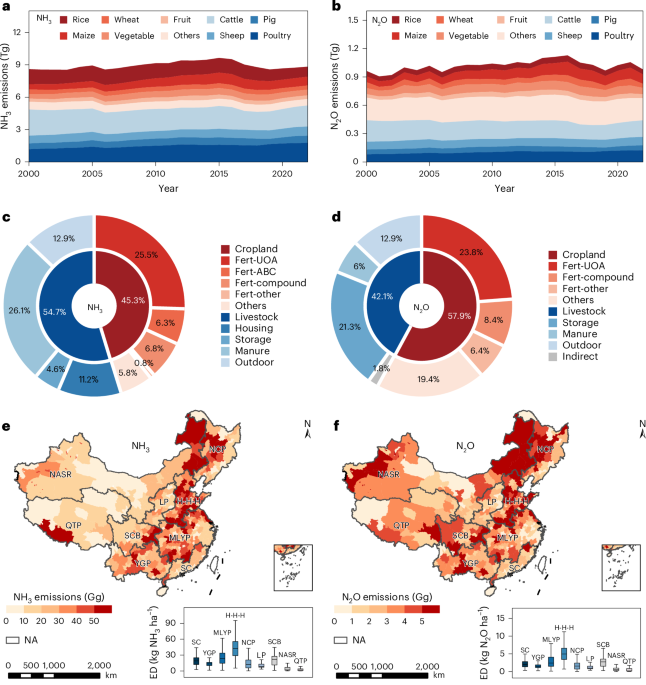
Figure 1 illustrates spatial, temporal and sectoral variations in major atmospheric Nr emissions from China’s agricultural system from 2000 to 2022. The estimated annual emissions of NH3 and N2O during this period fluctuated between 8.5 ~ 9.6 Tg and 0.9 ~ 1.1 Tg, respectively (Supplementary Tables 1 and 2 provide annual estimates and the estimated uncertainty range), which align well with those reported in previous studies (Extended Data Fig. 2 and Supplementary Discussion for the comparisons). Our estimates suggest that China contributed approximately 18% of global anthropogenic NH3 and 14% of N2O emissions annually, based on global totals from the Emissions Database for Global Atmospheric Research22,23. Nationally, the contribution of livestock and cropland systems to both Nr emissions is generally comparable over the 23 years, with livestock systems contributing 55% of total NH3 emissions and cropland systems contributing 54% of N2O emissions on average. Among fertilizers, urea represented approximately one-quarter of total Nr volatilization. Within livestock production, manure application was the largest source of NH3 emissions (26%), whereas excreta storage was the largest contributor to N2O emissions (21%).
a,b, Temporal trends in agricultural NH3 (a) and N2O (b) emissions in China from different crop and livestock categories. c,d, Proportion of NH3 (c) and N2O (d) emissions from various sources, including fertilizer types, manure-management stages and indirect emissions, averaged over 2000–2022. e,f, Spatial distribution of average annual NH3 (e) and N2O (f) emissions from 2000 to 2022. The insets at the lower right represent interannual variability in city-level NH3 and N2O emission density (emissions per unit area) using box plots. The statistics in these box plots are derived from n = 8,212 independent observations, where the unit of study is defined as an individual city-year pair (357 cities over 23 years). These data points are treated as independent replicates; no technical replicates were used. The precise sample sizes (n) for each geographical region are: H-H-H (n = 1,081), LP (n = 483), MLYP (n = 1,909), NASR (n = 1,058), NCP (n = 828), QTP (n = 345), SC (n = 1,104), SCB (n = 506) and YGP (n = 897). The centre line indicates the median, box limits indicate the 25th to 75th percentiles (interquartile range, IQR) and the whiskers show data within 1.5× IQR from the quartiles. Abbreviations in c and d include Fert-UOA: urea; Fert-ABC: ammonium bicarbonate; Fert-compound: compound fertilizer; Fert-other: other fertilizers such as diammonium phosphate and ammonium nitrate. In e and f, nine regions are outlined based on agricultural practices and environmental conditions. Region abbreviations in e and f include H-H-H, Huang-Huai-Hai Plain; LP, Loess Plateau; MLYP, Middle-Lower Yangtze Plain; NCP, Northeast China Plain; NASR, Northern Arid and Semiarid Region; QTP, Qinghai Tibet Plateau; SCB, Sichuan Basin and surrounding regions; SC, Southern China; and YGP, Yunnan-Guizhou Plateau. Provinces in each agricultural region and reference of the classification are summarized in Supplementary Table 3. Supplementary Tables 1 and 2 provide estimated annual NH3 and N2O emissions in China (as shown in a and b) and the uncertainty ranges. NA in the legend of e and f denotes missing values for Taiwan, Hong Kong and Macau, which were excluded from the analysis due to data unavailability. Basemaps in e and f from the National Platform for Common Geospatial Information Services (https://cloudcenter.tianditu.gov.cn/dataSource).
Source data
Temporally, national NH3 and N2O emissions exhibited significant increasing trends before 2015 (n = 16, two-sided Mann-Kendall test, P < 0.01), at annual growth rates of 0.76% and 0.95%, respectively. Sustained economic growth boosted household demand for agricultural products (Supplementary Fig. 1), intensifying farming practices and fertilizer use, thereby elevating Nr emissions. By 2015, emissions from intensive livestock system exceeded their 2000 levels by over 60% (Extended Data Fig. 3), and total nitrogen fertilizer application climbed to 1.2 times the 2000 baseline (Supplementary Fig. 2). However, between 2015 and 2022, national agricultural NH3 and N2O emissions declined by 16% and 30%, respectively, based on our estimates. Besides, NH3 and N2O emissions from urea and ammonium bicarbonate decreased by 30% and 20% in 2022 compared to 2015 levels, respectively (Extended Data Fig. 4). Despite the overall emissions decline, shifting dietary preferences, particularly increasing demand for poultry and vegetables, reshaped the Nr emission profile, elevating their combined contribution to total NH3 and N2O emissions from 18% and 15% in 2000 to 26% and 20% in 2022, respectively (Extended Data Figs. 3 and 4).
Spatially, emission hotspots of the two Nr species concentrate near the Hu Huanyong Line (that is, 400 mm precipitation line), which demarcates China’s densely populated eastern half from its sparsely populated western regions (Fig. 1e,f). Notably, both Nr species share similar regional patterns. The Huang-Huai-Hai Plain (H-H-H; Fig. 1e shows location), characterized by maize–wheat rotation systems and intensive poultry/swine farming, exhibits the highest annual average emission intensity (39 kg NH3 ha−1 and 4.6 kg N2O ha−1) among nine agricultural regions classified by the Chinese government. The Middle-Lower Yangtze Plain (MLYP) and Southern China (SC), China’s major rice production areas, also exhibit relatively high emission intensities (red blocks in Fig. 1e,f).
During the study period, the estimated spatial gravity centres (emission-weighted average locations; Supplementary Methods) of NH3 and N2O emissions both shifted northwestward, by 155 km and 122 km, respectively, as a result of spatially asynchronous emission trends (Fig. 2a,b). Overall, regions with the steepest emission increases were concentrated in northwest Xinjiang, northeastern China and Yunnan, driven by intensified agricultural activity (Fig. 2a and Supplementary Fig. 3), potentially threatening the ecological security of more nitrogen-sensitive ecosystems in northwestern China. Before 2015, shifts in the spatial gravity centres were primarily driven by the expansion of maize cultivation and rapid growth in poultry and sheep/goat farming in northern China. After 2015, the pronounced emission decline in southeastern China’s MLYP region, which was driven by a substantial decrease in nitrogen fertilizer application per unit area for rice (−32% from 2015 to 2022; Supplementary Fig. 4), further accelerated this northward shift. Together with the rice’s substantially higher NH3 emission factors compared to other crops (Supplementary Fig. 5), this targeted reduction played a decisive role in the northwestward migration of NH3 emission gravity centre.
a, Trends in NH3 (left) and N2O (right) emissions at the city level. b, Trajectories of the spatial gravity centres for NH3 (blue) and N2O (red) emission. c,d, Regional contributions to national emission changes for NH3 (c) and N2O (d); the inset at the upper left of c details the source-specific contributions of rice, beef and other emission sources to NH3 emission variations in the Middle-Lower Yangtze Plain from 2015 to 2022. The arrows and numbers on the x axis between years represent the percentage changes in emissions. In a, cold and hotspots indicate areas of statistically significant spatial clustering of increasing or decreasing emission trends, respectively. The emission trends are derived from the slope of a linear regression (least-squares method), representing absolute annual changes; confidence levels reflect the statistical significance of the clustering results of these trends, based on z-scores and P values generated by the Gi* statistic (Supplementary Methods provide details). Basemaps in a and b from the National Platform for Common Geospatial Information Services (https://cloudcenter.tianditu.gov.cn/dataSource).
Source data
The temporal trends in agricultural Nr emissions identify 2015 as a critical breakpoint (Fig. 1a,b). Therefore, we adopted this year as a demarcation to comparatively evaluate the impacts of agri-environmental policies implemented in two distinct periods: pre-2015 (2000–2014) and post-2015 periods (2015–2022). Nr emissions changes induced by policies were estimated for the years 2014 and 2022, respectively.
As shown in Fig. 3, while policies related to fertilizer reduction (navy bars), manure management (dark red bars) and straw utilization (cyan bars) all implemented during both periods, post-2015 interventions generated more pronounced emission abatements due to enhanced policy rigour and targeted directives (Supplementary Table 4 provides estimated policy-specific NH3 and N2O abatements and the uncertainty). These policies were estimated to reduce NH3 emissions by 48 Gg in 2014 (−0.50%; percentages in parentheses throughout this section represent the reduction achieved by the policy as a proportion of national total emissions in the corresponding year) and 1,176 Gg in 2022 (−13%), while N2O emissions transitioned from an increase of 23 Gg in 2014 (2.1%) to a reduction of 105 Gg in 2022 (−11%). Overall, fertilizer-reduction policies (first row in all panels in Fig. 3) emerged as the primary drivers for Nr emission reductions, whereas manure-management and straw-utilization policies showed complicated outcomes. In addition, the Pig Production Stabilization policy (orange bars in Fig. 3b,d), enacted in 2019 to counteract swine population decline caused by African swine fever, was estimated to increase emissions by 457 Gg NH3 (5.2%) and 43 Gg N2O (4.4%) in 2022, highlighting the potential tension between environmental conservation and safeguarding food security.
a,b, Absolute emission changes and relative contributions of individual policies to total mitigated reductions for NH3 (a) and N2O (b) emissions during 2000–2014. c,d, Absolute emission changes and relative contributions of individual policies to total mitigated reductions for NH3 (c) and N2O (d) emissions during 2015–2022. The emission changes shown in a–d are derived from policy-specific scenario simulations rather than observed emission trends (Methods provide details). The x axis quantifies the absolute magnitude of emission changes induced by each policy (positive for reductions, negative for increases). The y axis displays each policy’s proportional contribution to the total abatement achieved by all measures that resulted in mitigating effects in the respective period. Abbreviations include STFF, soil testing and formulated fertilization; FR, fertilization reduction; LFS, large-scale farming standardization; and LWU, livestock waste utilization.
Source data
Fertilizer-reduction policies (navy bars in Fig. 3) demonstrate superior and increasing efficacy in mitigating Nr emissions, reducing NH3 and N2O emissions by 1,217 Gg (14%) and 155 Gg (16%) in 2022, which account for 98% and 90% of NH3 and N2O emission reductions in the post-2015 period (Supplementary Table 4 provides details). Specifically, the Soil Testing and Formulated Fertilization policy (STFF) initiated in 2005, targeted resolving mismatches between crop nutrient demand and soil fertility supply through optimized fertilization protocols24. It substantially shifted fertilizer types from traditional inorganic fertilizers to compound fertilizers, with the share of the latter increasing from 12% in 2000 to 23% in 2014 (Supplementary Fig. 2). The Fertilizer Zero-Growth policy, launched in 2015, further advanced precision nutrient management, driving a 21% nationwide reduction in agricultural fertilizer use in the following 8 years.
Livestock manure-management policies consistently produced contrasting effects, reducing N2O emissions but increasing NH3 emissions in both periods (dark red bars in Fig. 3). In particular, the second-phase intensified policies yielded amplified N2O mitigation, from 6 Gg (0.54%) in 2014 to 17 Gg (1.7%) in 2022; and increased NH3 emissions from 47 Gg (0.50%) to 65 Gg (0.74%). Notably, the expansion of intensive farming rather than amplified nitrogen retention was the dominant driver, accounting for over 90% of the increase in NH3 emissions in both phases. Regarding the policy evolvement, whereas the first-phase policy primarily aimed to standardize the intensified farming systems, the second-phase policy strengthened the emphasis on nutrient recycling. The divergent impacts of these policies on NH3 and N2O emissions were driven by two main reasons. First, elevated intensive-farming practices enhance manure collection and nitrogen concentrations indoors, promoting NH3 volatilization while reducing outdoor N2O emissions due to higher temperature and anaerobic conditions25,26. Second, efficient excreta collection and treatment technologies enhanced nitrogen recycling efficiency but inadvertently intensified nitrogen retention, elevating emissions during manure application. Particularly in intensive-farming systems, although advanced technologies such as mechanical dry collection and anaerobic digesters have reduced indoor emissions intensity of both NH3 and N2O, elevated field emissions fully offset the initial NH3 mitigation but only about 10% of the N2O mitigation.
The straw-utilization policy (cyan bars in Fig. 3), which restricted open burning while promoting field incorporation of straw, yielded modest net reductions in NH3 emissions but concurrently increased N2O emissions. Specifically, it reduced NH3 emissions by ~0.3% of the annual totals both in 2014 and 2022, whereas increased N2O emissions nearly ten times those proportions. In the post-2015 period, the increase in N2O emissions moderated because the increase in the proportion of straw returned to the field slowed after 2015 (Supplementary Table 5 provides details). Notably, while straw burning restrictions directly reduce NH3 emissions (that is, ~1% in 2014 and 2022), the increased composting-related processes led to additional NH3 and N2O emissions through soil N transformation processes, highlighting a cross-media redistribution of nitrogen flows. Yet, the straw-utilization policy exhibits the highest uncertainty among all policies, stemming from multiple emission sources (for example, open burning and composting) and the large variability in combustion conditions and nitrogen content (Supplementary Discussion). Whereas the opposing effects of this policy on NH3 and N2O emissions are robust, the effect size remains poorly constrained, thus necessitating more accurate parameterization based on process-specific field observations.
Figure 4 compares the effectiveness of different policies in abating NH3 and N2O emissions, evaluating policy-specific synergies or trade-offs between air pollution control and greenhouse gas mitigation. A Synergy Index was developed to quantify their co-control effectiveness, with positive values indicating synergetic benefits (co-reductions in emissions) and negative values reflecting trade-offs. Overall, national agricultural abatement measures marked a pivotal shift from pre-2015 trade-offs (Synergy Index = −0.11) to post-2015 synergies (Synergy Index = 0.36). This shift primarily reflects improved outcomes from fertilizer-reduction policies, whereas manure-management policies consistently exhibited trade-offs in both periods. Spatially, policy outcomes largely resemble national-level trends, though regional variations occurred due to differing cropland distribution, intensive livestock production scales and sensitivity to control measures.
a,b, Impacts of fertilizer-reduction policies during 2000–2014 (a) and during 2015–2022 (b). c,d, Impacts of livestock manure-management policies during 2000–2014 (c) and during 2015–2022 (d). e,f, Impacts of the Straw Utilization policy during 2000–2014 (e) and 2015–2022 (f). g, Impacts of the Pig Production Stabilization policy during 2015–2022. In all panels, scatters in the first quadrant represent positive synergetic effects (co-reduction), where greater reductions and closer proximity to the y = x line indicate higher synergies; scatters in the third quadrant represent negative synergies (co-growth); scatters in the second and fourth quadrants highlight trade-offs between NH3 and N2O abatements. Abbreviations include SI, Synergy Index; STFF, soil testing and formulated fertilization; FR, fertilization reduction; LFS, large-scale farming standardization; LWU, livestock waste utilization.
Source data
Consistent with the national pattern, fertilizer-reduction policy showed a notable shift from limited regional synergies before 2015 to enhanced nationwide synergies afterward, with the estimated policy-specific national Synergy Index increased from 0.05 to 0.36 (Fig. 4a,b). From 2000 to 2014, NH3 emissions reduced across all regions due to fertilizer-reduction policies; yet, compound fertilizer promotion in certain regions led to a rise in N2O emissions (that is, 0.5–0.8% relative to 2000 levels in LP, NCP, QTP and SC regions), thereby resulting in partial trade-offs in the listed regions with the estimated Synergy Index ranges from −0.01 to −0.06. However, post-2015 policy interventions achieved nationwide synergies, primarily driven by reduced nitrogen inputs, which simultaneously lower NH3 and N2O emissions. Among crops, rice cultivation exhibited at least 13% higher synergy than others due to its most substantial fertilizer application reduction rate (Supplementary Fig. 6), elevating synergy in core regions such as the MLYP and SC (Supplementary Fig. 7) and promoting the northwest shift in the spatial gravity centres of Nr emissions.
Livestock manure-management policies maintained nationwide trade-offs across periods with comparable intensity (that is, Synergy Index changed from −0.08 to −0.10; Fig. 4c,d). Nevertheless, regional heterogeneity was pronounced: enhanced livestock management policies induced modest localized synergies in non-pastoral regions, such as H-H-H, Loess Plateau (LP), MLYP, SC and Yunnan-Guizhou Plateau (YGP), where centralized waste processing systems reduced NH3 emission intensity by 0.03–0.38% (that is, Synergy Index = 0.05 to 0.09). In particular, H-H-H—China’s predominant intensive poultry production base—showed the most notable shift from trade-off to synergy (Synergy Index increased from −0.07 to 0.09 between the two periods), driven by advanced manure-removal technologies that provided strong synergies in intensive poultry systems. More specifically, the Livestock Waste Utilization policy showed 37% stronger synergy in intensive systems compared to free-range systems, highlighting the benefits of centralized farming operations.
Similarly, the straw-utilization policy also exhibited national trade-offs across two periods, with the estimated Synergy Index remaining stable at −0.10 and −0.08, respectively (Fig. 4e,f). However, the synergetic performance reflected heterogeneous changes across regions. For example, in NCP, policy effects shifted from simultaneous Nr emissions growth before 2015—due to increased open-field straw burning (27–47% above baseline levels27)—to trade-offs post-2015, following stricter regulation and financial incentives that markedly reduced burning. In NCP, the pre-2015 growing burning resulted in additional NH3 and N2O emissions of 7.7 Gg and 4.4 Gg, whereas post-2015 air-protection-driven burning restriction reduced NH3 emissions by 28 Gg but increased N2O emissions by 7.0 Gg. Conversely, the H-H-H and the MLYP transitioned from trade-off to co-growth of Nr, as high existing straw-utilization rates limited NH3 abatement potential and increased straw incorporation into fields, thereby driving concurrent NH3 and N2O emissions rises.
The Pig Production Stabilization policy, initiated to secure pork supply, drove co-growth in NH3 and N2O emissions, especially pronounced in concentrated pork production regions such as SCB and YGP (Fig. 4g). With ongoing governmental promotion for relocating pork production northward28, it is important for northern regions, with limited prior experience, to upgrade breeding practices to reconcile emission control with food security.
Facing the limited mitigation efficacy of current manure-management and straw-utilization policies in reducing NH3 and N2O emissions, we explored potential short-term synergy gains achievable through livestock full-chain mitigation and optimized straw-utilization pathways. A strengthened policy scenario was developed, assuming early achievement of 2025 agricultural policy targets, with other socioeconomic and policy factors constant at 2022 levels (Methods). The results suggest substantial short-term Nr abatement potential.
Full-chain livestock management incorporating source control, storage management and manure application management could reverse the trade-offs to positive synergies regarding NH3 and N2O emission co-control. In this analysis, a 1% reduction in dietary crude protein content was assumed for source control following the official target and the application rate of integrated manure-management strategies that incorporated optimized manure-treatment systems during the storage stage and emission inhibitors usage during manure application were set at 25%. The strengthened policy scenario suggests that, with short-term efforts, livestock policies could shift from NH3 increasing to NH3 mitigating (−985 Gg, 10% of the 2022 total), along with an additional 94 Gg N2O (10%) abatements (Fig. 5c,d). Specifically, source control dominated the emission abatements (bar labelled with ‘Source’ in Fig. 5e,f), contributing 60% to total NH3 and N2O reductions by livestock full-chain management. Storage-phase interventions (bar labelled with ‘Storage’ in Fig. 5e,f) could also achieve substantial efficiency gains, removing around 8% and 5% of baseline NH3 and N2O emissions in the storage stage. Coupled with application-phase inhibitors and fertilizer substitution, the Synergy Index would reach 0.32 at 25% adoption, rising further to 0.37 at 50% adoption, comparable to existing cropland policies (0.36 during 2015–2022). Notably, a 100% technology adoption rate could increase the Synergy Index to 0.43, surpassing that of current cropland policies (Fig. 5g). Despite substantial overall gains, stage-specific synergy in ‘Storage’ and ‘Application’ remains modest due to uneven Nr mitigation (Fig. 5h). The imbalance arises as NH3 is dominated by the application stage versus N2O by the storage stage (49% and 54% of respective livestock emissions, 2022). Additionally, unmanaged outdoor excretion in non-intensive systems (for example, free-range and grazing) and inter-stage nitrogen displacement further dampen system-wide synergy.
a,b, Emission reduction of NH3 (a) and N2O (b) under current policy. c,d, Emission reduction of NH3 (c) and N2O (d) under the strengthened policy scenarios, including strengthened livestock policy (full-chain manure management) and straw policy (increasing the share of off-field utilization by 25% within comprehensive straw utilization). e,f, Stage-specific emission reductions of NH3 (e) and N2O (f) achieved by the strengthened livestock policy. g, Synergy Index at 25%, 50% and 100% adoption rates of full-chain livestock management. h, Stage-specific and overall Synergy Index changes through full-chain livestock management with 25%, 50% and 100% adoption rate.
Source data
For crop straw management, the comprehensive utilization rate in 2022 had already met the 2025 policy target but failed to achieve positive co-control synergies. Yet, promisingly, increasing the share of off-field utilization (for example, feed production, bioenergy generation and so on) by 25% within comprehensive straw utilization from the current 21–57% regional baseline, could substantially reshape policy outcomes, additionally reducing N2O emissions by 8 Gg and NH3 emissions by 77 Gg (green bars in Fig. 5c,d) compared to that of the baseline scenario (green bar in Fig. 5a,b). As a result, this strategic shift could transform the impacts of Straw Utilization policies from trade-offs to synergies, achieving a Synergy Index of 0.09.
The agricultural sector emerges as a strategic priority within the sustainable development framework, acting as a major source of both non-CO2 GHGs and nitrogen pollution and as a cornerstone of food security6,29. In detail, NH3 volatilization and NH4+ leaching from agricultural production threaten air quality, aquatic ecosystems and soil health12,30,31, underscoring the complexity of agricultural environmental footprint. Our results showed that N2O emissions have been reduced by 148 Gg (40.4 Mt CO2-equivalent) during 2015–2022, slightly offsetting GHG increments from the power and transportation sectors20,32. Although these policy-driven emission abatements exhibit relatively modest impacts compared with mitigation achieved in other sectors, such as 218 Mt CO2 from transport-sector policies during 2015–202033, these reductions are notable given the diffuse and biologically mediated nature of food-system emissions33,34. With the easy-to-abate GHG emissions sharply reduced in other sectors such as industry and energy35,36, food-system mitigation will play an increasingly important role in China’s carbon neutrality pathway37. Moreover, under future climate scenarios, the interaction of hydroclimatic extremes, northward shifts in crop distributions38,39 and policy-driven livestock relocation (such as the ‘south-to-north’ pig redistribution)28 may exacerbate food security risks. Therefore, integrated policies are essential for addressing pollution and climate change while sustaining food security.
Our results quantitatively demonstrated that China’s historical fertilizer management initiatives effectively reduced Nr emissions without compromising food production. Specifically, the Fertilizer Zero-Growth policy exemplifies this by achieving a 21% reduction in fertilizer use from 2015 to 2020 while maintaining yields, highlighting its strong co-benefit for pollution control and food security. By contrast, though livestock policies have promoted sectoral intensification and improved manure-management technologies, their overall effectiveness for Nr abatement has remained limited throughout the past two decades. Nevertheless, substantial potential for environmental improvements remains achievable. Our analysis confirms that full-chain livestock management, combined with recoupling livestock and crops, could unlock substantial potential for short-term synergetic reductions in NH3 and N2O emissions28,40,41, providing immediate pollution control and resource efficiency co-benefits. As China’s livestock sector continues intensifying—projected intensification rates reaching 70% by 2025 and 83% by 203042—thereby would help reduce cross-media Nr pollution caused by outdoor excretion43,44. In addition, this ongoing intensification would also facilitate the adoption of advanced mitigation technologies and integrated management practices. In contrast, the dominance of smallholder operations (98%) in China’s cropland sector exerts scalability challenges regarding technical adoption (US$26 ha−1 in China vs US$14 ha−1 globally)13,45,46,47,48. We therefore recommend prioritizing integrated strategies that link cropland and livestock under full-chain livestock management.
Notably, agricultural policies that focus on single objectives or isolated mitigation measures often overlook interactions among nitrogen pathways, resulting in unintended trade-offs. For example, our study demonstrated that the Livestock Waste Utilization policy promotes nutrient recycling by increasing the proportion of manure collected and applied to cropland, which can reduce N2O but raise NH3 emissions due to their different field emission factors49. Similarly, NH3 mitigation strategies can reduce PM2.5 levels and nitrogen deposition but may inadvertently elevate the risk of acid rain if not implemented in synergy with SO2 and NOx emission controls50. Long-term straw return, while increasing NH3 and N2O emissions, has been shown to enhance crop yields and soil organic carbon16,51. Furthermore, our study reveals that policy-driven increases in straw return under the straw burning ban introduce further trade-offs, reducing Nr emissions from burning but increasing Nr emissions from straw return. Moreover, the absence of comprehensive evaluation metrics can obscure the understanding of such trade-offs, complicating the prioritization of mitigation strategies under pronounced regional heterogeneity. These findings highlight the need for integrated frameworks that balance nitrogen use efficiency, crop productivity, climate impacts and cross-media pollution risks.
Considering cascading impacts spanning the entire agricultural production chain, system-wide integrated mitigation strategies are essential. At the source, we suggest a further increase in N use efficiency in the cropland system and a lower crude protein feed formulation in the livestock system. During the production process, coupled crop–livestock systems and full-chain management can help decouple agricultural intensification from pollution40. Notably, within livestock systems, NH3 dominates the application stage while N2O is concentrated in the storage stage, because the two gases favour different environmental conditions; given this heterogeneity, technological interventions that simultaneously target these distinct emission sources could maximize the overall mitigation synergy. Finally, selecting appropriate utilization pathways for agricultural residues is crucial for enhancing nutrient recycling and minimizing Nr losses. For example, prioritizing straw removal for bioenergy production over field incorporation not only reduces Nr losses from decomposition but also contributes to renewable energy generation.
Furthermore, to maintain and amplify synergies while addressing trade-offs, we suggest region-specific mitigation strategies. Though MYLP and H-H-H contributed most in policy-derived NH3 emissions mitigation (97% and 13% pre-2015; 37% and 20% post-2015, respectively), these regions remained the hotspots of cropland and intensive-farming Nr emissions in 2022. Our findings highlight that stringent total fertilizer input control, coupled with enhanced livestock waste utilization, underpins the synergistic reduction of Nr species in these regions. Building on this foundation, the adoption of enhanced-efficiency fertilizers, integrated water fertilizer and full-chain livestock management could further boost synergies across cropland-dominant and intensive-farming areas52. On the contrary, QTP and NASR experienced most policy-driven increases in NH3 emissions and considerable trade-offs due to livestock expansion and limited fertilizer-use reductions. Therefore, in these pastoral-dominated regions, targeted measures including urease inhibitors during manure application and rotational or deferred grazing are recommended. In addition, the observed northwestward shift of the emission gravity centre, compounded by the ecological fragility of northern China, underscores the urgency to formulate differentiated standards tailored to local environmental carrying capacities and ecological vulnerabilities.
From the institutional perspective, effective implementation of region- and sector-specific mitigation strategies requires robust top-down policy support. Firstly, strong national guidance is essential, such as through dedicated N2O reduction plans. Coupled with this, cross-sectoral coordination between agricultural and environmental authorities is essential to ensure coherent enforcement. Economic instruments, including targeted subsidies for enhanced-efficiency fertilizers and eco-friendly manure management, and carbon-based incentives, could enhance the financial attractiveness of sustainable practices and promote the adoption of advanced technologies. Finally, localized training and multi-stakeholder platforms are critical for building technical capacity and aligning interests across policy actors.
Whereas our findings highlight actionable opportunities, this study is subject to several uncertainties and limitations. First, emission factors of different agricultural processes used in this study were derived from machine learning models, which rely on existing observational data that could be collected from the literature. Expanding the availability of high-quality observational datasets would be essential to improve the precision of these models, which highlights the need for robust foundational research in agricultural emissions monitoring across the country. Second, though our analysis constructed full-chain emission inventories for livestock management and crop planting, future studies on life-cycle emission reduction potential from the perspective of food systems, including activities in fertilizer production, land-use change, supply chains and food waste management, would be informative for exploring future emission reduction pathways.
Furthermore, because the quantification of the synergies and trade-offs between air pollution and GHG control remains an emerging field, many research directions could be explored. For example, the Synergy Index analysis framework could be advanced by incorporating comprehensive CO2-equivalent GHG emissions alongside cross-media multi-pollutant indicators and by extending the evaluation framework beyond emission reduction metrics to monetized environmental and public health benefits. Crucially, future work could use the Synergy Index to identify emission sources to be prioritized, enabling the development of differentiated mitigation pathways tailored to local emission profiles. More fundamentally, transitioning from single-policy analysis to inter-policy interaction assessment, to examine how policy combinations and sequencing generate amplifying co-benefits or counteracting trade-offs, would be a critical advancement.
An integrated framework was developed to systematically evaluate synergies and trade-offs between NH3 and N2O emission mitigation resulting from China’s agricultural policies from 2000 to 2022 (Extended Data Fig. 1). This framework comprises four components. (1) Emission accounting that applies a machine learning-enhanced approach to compile China’s annual city-level agricultural NH3 and N2O emission inventories from 2000 to 2022. The approach generates high-resolution, spatiotemporally explicit baseline emission information that enabled subsequent policy impact attribution. (2) Policy-specific emission abatement estimates that quantify NH3 and N2O emission reductions by six major agricultural policies across two distinct policy periods. (3) Synergy analysis that applies a Synergy Index system to evaluate climate-environmental synergies beyond single-pollutant assessments and identify strategies delivering balanced mitigation benefits. (4) Strengthened scenario analysis that conducts systematic assessment of potential synergy improvements through optimized livestock and straw management, which effectively transforms the Synergy Index from a diagnostic tool into a prescriptive framework for policy optimization. Furthermore, we also evaluate the uncertainty of the estimated Nr emissions and policy efficacy and analyse the pattern of the estimated emissions to enrich the discussion.
We compiled a database for 357 municipal-level cities (2000–2022), integrating activity data, proportion parameters, emission factors and meteorological and soil data from multiple sources.
Among the activity level, the cultivated area, crop yield and livestock number were obtained from the China National Bureau of Statistics (NBSC). Application rates for each crop and fertilizer type were obtained from the China Agricultural Cost-Benefits Information Compilation. The straw-grain ratio was derived from data published by the National Development and Reform Commission (https://www.ndrc.gov.cn/xxgk/zcfb/tz/201512/W020190905506500681746.pdf). The nitrogen content of the straw of the main crops was derived from Technical Guidelines for the Integrated Compilation of Air Pollutant and Greenhouse Gas Emission Inventories (hereinafter referred to as Technical Guidelines)53 (Supplementary Table 6).
For proportion parameters, the ratio of base to topdressing fertilizer is referred to in the previous literature54,55,56 (Supplementary Table 7). The proportion of no-tillage was calculated as the ratio of no-tillage area to total cultivated area, with data from the China Agricultural Machinery Industry Yearbook (Supplementary Table 8). Proportion of straw utilization, straw burning and straw composting was derived from official provincial bulletins and previous literatures27,57 (Supplementary Table 5). Livestock intensification levels were obtained from https://doi.org/10.6084/m9.figshare.21779654.v1, with temporal changes aligned with policy targets. Shares and effects of manure-removal and treatment practices on NH3 and N2O emission factors during the livestock housing and storage stages were derived from previous studies25,58,59,60.
Emission factors of fertilizers across fertilizer types, crop species and application phases were algorithmically estimated through the machine learning model described in the next section. Data used to train the model are from literature published before September 2024. Detailed procedures for literature data collection are provided in Supplementary Methods, and further information on the dataset and variable definitions is available in Supplementary Table 9. All other emission factors of NH3 and N2O in this study, including those for the livestock sector and for non-fertilizer cropland sources, were derived from the Technical Guidelines53. The Technical Guidelines were prepared based on a rigorous synthesis of extensive and geographically diverse field measurements, ensuring that the adopted emission factors are both reliable and representative of real-world conditions.
Soil properties for each city were derived from the 1-km Harmonized World Soil Database (HWSDv2.0, https://www.fao.org/soils-portal/data-hub/soil-maps-and-databases/harmonized-world-soil-database-v20). Annual climate variables (temperature and precipitation) for each city (2000–2020) were obtained from the National Centers for Environmental Information (https://www.ncei.noaa.gov).
The NH3 and N2O inventories were developed using a bottom-up methodology including two major source categories (cropland and livestock) from 2000 to 2022 at the municipality level. Emissions were calculated as a product of the activity data, category proportion and condition-specific emission factors, according to the following equation (1):
where EM is the total emission in each municipality and year, A is the activity level and X is the proportion of the specific emission category and EF is the corresponding emission factor. Subscript n represents Nr species, including NH3 and N2O in this study; u represents emission sources, such as livestock or cropland; (g) represents emission category in specific emission source, such as fertilizer types in cropland emissions or livestock systems in livestock emissions.
Annual emissions from fertilizer in each municipality were aggregated from emissions from four fertilizer types, 19 crop types, two fertilizer placement methods and two soil tillage modes, which were calculated according to equation (2).
where EM represents accumulated emissions from cropland fertilizer in each municipality and year, Area represent the cultivated area of each crop, Nrate represents the total fertilizer amount applied per unit area of each crop, (theta) represents the proportion of each fertilizer type, α represents the proportion of each fertilizer placement, γ represents the proportion of each soil tillage modes and (mathrm{ef}) is the corresponding emission factor of fertilizers under specific conditions, which was estimated using machine learning models. The method for deriving the (mathrm{ef}) of fertilizer emissions is detailed in the following section: ‘Machine learning-based estimation of cropland fertilizer emission factors’. Subscript (n) represents Nr species, including NH3 and N2O in this study, (c) represents 19 crop types, (f) represents the four fertilizer types, (p) represents the two fertilizer placement methods and (t) represents two soil tillage modes. In equation (2), the (mathrm{Area}times mathrm{Nrate}) equals to the (A) in equation (1), the θ × α × γ equals to the X in equation (1) and the (mathrm{ef}) equals to the (mathrm{EF}) in equation (1).
Additional emissions, including those from agricultural soils, N-fixing plants, straw return and burning and indirect N2O emissions were estimated following established methods (Supplementary Methods provides details).
The emissions from livestock waste in each municipality were calculated using a process-based N mass flow approach. Three livestock farming systems were distinguished (intensive, free-range and grazing) with free-range and grazing further divided between outdoors and indoors. Excrement indoors undergoes the stages of housing, storage and application. Proportions of six manure-removal techniques (manual dry removal, mechanical dry removal, grass-based bedding, slatted-floor housing, water flushing, water submerging) at the housing stage, share of eight manure-treatment methods (oxidation pond, liquid storage, solid storage, natural drying, daily application, biogas digester, composting and others) at the storage stage and the manure-utilization ratio at the application stage are dynamic from 2000 to 2022 according to the comprehensive environmental statistical datasets. The total emissions from livestock are calculated as equation (3).
where (mathrm{EM}) represents accumulated emissions from livestock in each municipality and year, (L) represents total quantity of each livestock category, P represents the proportion of livestock system categories, R represents the proportion of each manure-removal techniques, (T) represents the proportion of each manure-treatment methods and ef represents emission per animal under specific conditions. Subscript (n) represents Nr species, including NH3 and N2O in this study, j represents 11 livestock categories, i represents three livestock farming systems, s represents the four emission stages, r represents six manure-removal techniques, t represents the eight manure-treatment methods. In equation (3), L equals to the A in equation (1), the P × R × T equals to the X in equation (1) and the ef equals to the (mathrm{EF}) in equation (1), which is calculated as shown in equations (4)–(7) for each livestock category (j), manure-removal techniques r and manure-treatment methods t:
where ({mathrm{ef}}_{1-4}) represents the emission factors of each livestock farming systems at the housing, storage, application and outdoors stages, respectively. ({N}_{mathrm{in}}) and ({N}_{mathrm{out}}) represents the N excretion of each livestock indoor and outdoor, respectively, and the excrement from intensive system is assumed to be all generated indoors. (mu) represents the impact of each manure-removal technique on ({v}_{1}), and ({v}_{1-4}) represents the volatilization rate of NH3 or N2O during the housing, storage, application and outdoors stages, respectively. (C) represents the collection coefficient of excrement in the housing stage, and we assume that the excrement that failed to be collected and stored ended up in the sewage system, thus falling outside our calculation boundaries. U represents the manure-utilization ratio each year. Subscript i still represents the three livestock farming systems, including intensive (i = 1), free-range (i = 2) and grazing (i = 3).
The machine learning model has been widely used in estimating the high-resolution emission factors under different fertilizer management practices, so this study followed the methods of previous studies61. Before fitting the machine learning models, we used ‘One-hot Encoding’ to convert classified variables into binary vectors so that the machine learning models can recognize them correctly. Then we allocated 80% of the dataset as the training set and the remaining 20% as the testing set. We chose Random Forest (RF) out of seven algorithms, including Linear Regression, Ridge Regression, Lasso Regression, Gradient Boosting, Support Vector Regression, K-Nearest Neighbours, Random Forest (RF) and XGBoost Regressor, due to its superior overall performance according to root mean square error and coefficient of determination (R2) (Supplementary Fig. 8). Moreover, RF is well suited for handling small sample sizes and high-dimensional feature spaces61. Subsequently, we tested the model’s performance based on the testing set, achieving an R2 of 0.78 for NH3 and an R2 of 0.68 for N2O (Supplementary Fig. 9). Finally, we combined the training and testing sets to re-train a final RF model, using the same set of hyperparameters determined in the tenfold cross validation. The model training was conducted in Python 3.11, with ‘sklearn’ package. Furthermore, to assess feature importance, we computed the Shapley additive explanation (SHAP) values for each observation to identify the contribution of features to the model output (Supplementary Fig. 10), which were calculated with ‘shap’ package in Python 3.11.
A policy-specific scenario analysis framework was developed to estimate Nr emission reductions attributable to China’s major agricultural policies, including the Soil Testing and Formulated Fertilization programme, the Straw Utilization policy, the Large-scale Farming Standardization policy, the Fertilizer Zero-Growth policy, the Livestock Waste Utilization policy and the Pig Production Stabilization policy. The description of the six policies was summarized in Table 1. The study period was divided into two phases using 2015 as the policy inflection point, aligned with the temporal trend of Nr emissions in our emission inventories.
For each policy, we modelled a no-control scenario by holding implementation levels at pre-policy values while allowing all other drivers (for example, livestock numbers, cultivated area, climate conditions those not affected by the given policy) to evolve historically. The policy impact at the pivot years (that is, 2014 and 2022) was then calculated as emissions in the no-control scenario minus estimated actual emissions with policy implemented, as equation (8) showed:
Where (Delta {text{Emis}}) is the calculated emission reduction under certain policy, ({A}^{{prime} }) is the estimated activity level under the no-control scenario, ({X}^{{prime} }) is the estimated proportion of a specific emission category under the no-control scenario, (mathrm{EF}{prime}) is the corresponding emission factor under the no-control scenario and (mathrm{EmisReal}) represents baseline emissions obtained from our Nr emission inventory in the calculated years (that is, 2014 and 2022). Subscript (m) represents the agricultural policies chosen in this study, (n) represents Nr species, (u) represents emission sources related to the policy (m), (g) represents emission categories in specific emission sources.
According to policy contents, parameters perturbed in the inventory model by major measures are listed in Table 2. In scenario Fertilizer1, ({X}^{{prime} }) was perturbed by changing fertilizer type proportions, whereas in Fertilizer2, ({A}^{{prime} }) was perturbed by changing fertilizer application per unit area of each crop. Similarly, in Manure1, ({X}^{{prime} }) was perturbed by changing the proportion of livestock system categories, manure-removal techniques and manure-treatment methods, whereas in Manure2, besides the ({X}^{{prime} }) impacted by the above proportions, ({mathrm{EF}}^{{prime} }) was further perturbed by changing the manure-utilization ratio. Regarding the straw-utilization policy, in Straw1 and Straw2, ({X}^{{prime} }) was perturbed by changing the proportion of straw burning and straw returning to field. Finally, in scenario Pig2, ({A}^{{prime} }) was perturbed by changing total pig numbers. Detailed scenario descriptions are provided in Supplementary Methods.
To assess the synergetic or trade-off effects of policies on reducing NH3 and N2O emissions, we developed a Synergy Index based on the Coupling Coordination Degree model62. This index quantifies interactions between NH3 and N2O reductions, leveraging the Coupling Coordination Degree framework’s effectiveness in analysing multi-system interactions. The Synergy Index uses relative changes in NH3 and N2O emissions as key metrics, calculated as the ratio of policy-specific reductions (for example, avoided NH3 or N2O emissions) to the total emissions from a baseline year (for example, 2000). Specifically, for each policy, the NH3 metric is the reduction in NH3 emissions relative to 2000 levels, and the N2O metric is the reduction in N2O emissions relative to 2000 levels. This approach ensures comparability across policies and time periods, enabling unified evaluation of policy impacts. The policy-specific Synergy Index can be estimated as equations (9)–(12):
where ({R}_{{rm{s}}}=frac{{Q}_{{rm{s}}}}{{E}_{{s}}}) and ({rm{s}}) refers to the gas species (NH3 or N2O). Here ({R}_{{rm{s}}}) represents the reduction rate of emissions; ({Q}_{{rm{s}}}) represents the reduction in emissions achieved under the specific policy; and ({E}_{{rm{s}}}) represents the baseline emissions for the species in year 2000 or 2015. C represents the coupling index, whereas (T) represents the coordination index. α and β are the weights of subsystems and α + β = 1. We considered NH3 and N2O as equivalent in this study, thus α and β are both assigned to 0.5. Di represents the direction vector for the Synergy Index. The synergy index Synergy Index captures both the total mitigation efficacy and the balance between reductions in NH3 and N2O, with higher positive values indicating greater synergy and negative values representing trade-offs.
To assess the mitigation potential and co-benefits of enhanced livestock management and straw utilization, we designed a Strengthened Policy scenario, incorporating full-chain livestock management and improved straw utilization. The scenario assumes that key 2025 policy targets are achieved ahead of schedule during phase two. We further apply tailored measures to livestock management and estimate mitigation potential under varying adoption rates (25%, 50%, 100%). In this scenario, emission inventories and the synergy index were calculated using the methods described above.
The full-chain livestock management incorporates interventions across the livestock chain, including source control and strategies at the storage and application stages—(1) source control: we assumed a 1% reduction in dietary crude protein content compared with current feeding standards for each livestock category. This adjustment is based on low-protein feeding strategies and does not compromise animal productivity (meat, egg or milk output)19. As a result, total nitrogen excretion was reduced by 12.6% for both intensive and free-range systems17. According to China’s Feed Soybean Meal Reduction Replacement Three-year Action Plan, which aims to reduce the proportion of soybean meal in feed from 14.5% in 2022 to below 13% by 2025, we assume full implementation of a 1% reduction in dietary crude protein. Therefore, we assume 100% implementation of this reduction. (2) Storage stage: the scenario assumes an increased share of manure undergoing anaerobic digestion, coupled with acidification during storage, leading to an 83% reduction in NH3 emission factors and a 28% reduction in N2O emission factors17. (3) Application stage: for manure from free-range and grazing systems, the livestock waste-utilization rate was increased to 80% according to the goal of the 14th Five-Year Plan. During land application, NH3 and N2O emissions were mitigated by implementing soil incorporation and nitrification inhibitors, which can reduce NH3 emission factors by 75% and N2O emission factors by 55% (refs. 17,63,64). Additionally, integrated crop–livestock systems were assumed to replace 5% of basal chemical fertilizer with organic manure according to the Action Plan for Fertilizer Reduction by 2025.
Regarding enhanced straw collection and utilization, we simulated improved straw removal rates based on national circular economy targets. According to the ‘14th Five-Year Plan for Circular Economy Development’, China aims to achieve a crop straw comprehensive utilization rate above 86% by 2025. Given that provincial-level targets had already been achieved by 2022, we assumed a 5% increase in the proportion of each of the five major off-field straw-utilization pathways.
The additional mitigation effects of strengthened measures on NH3 and N2O emissions were quantified relative to current policies (2022 baseline), with detailed formulations and parameter settings provided in Supplementary Methods.
To analyse the extent of uncertainty inherent, we used the widely applied Monte Carlo ensemble simulation to quantify the variability of the Nr emissions and policy efficacy19,65,66,67.
Uncertainties in the emission inventory stem from activity data, emission factors and intermediate parameters. Statistical distributions and coefficients of variation (CVs) for each emission source were obtained from previous studies19,65,67,68. Activity data such as fertilization rates and livestock numbers are generally reliable, with CVs of 5–10% (refs. 65,67). In contrast, emission factors exhibit substantially greater variability across processes. For fertilizer emission factors derived from machine learning modelling, uncertainty was quantified using a bootstrapping approach, in which 100 bootstrap datasets were generated with replacement from the full sample, and an RF model was trained on each using the original optimal hyperparameters61. For all other emission factors, we assumed coefficients of variation around 50% (ref. 65). For intermediate parameters (for example, nitrogen content, combustion efficiency), CVs of 25% were adopted based on established literature67. All CVs were assumed to follow lognormal distributions. Cities across China share the same distributional characteristics for each emission source, whereas different emission sources were assigned distinct error distributions.
Uncertainties in annual total Nr emissions and the emission reductions achieved under each policy-specific scenario were quantified through 1,000 Monte Carlo iterations, with all parameters sampled from their respective lognormal uncertainty distributions. Specifically, for fertilizer emission factors, in each Monte Carlo iteration, one RF model was randomly selected from the ensemble of 100 bootstrap-derived models and used to predict the emission factor for the activity level sampled in that iteration. A summary of the resulting uncertainty ranges of Nr emission inventories and policy-specific reductions is provided in Supplementary Information (Supplementary Text 3 and Supplementary Tables 1, 2 and 4).
The full dataset and list of references for publications used in our machine learning model (Supplementary Table 9) and the long-term city-level agricultural NH3 and N2O emission inventory of China are available via Zenodo at https://doi.org/10.5281/zenodo.19841031 (ref. 69). Source data are provided with this paper.
The source code used in this research is accessible under the GNU General Public License v3.0 via GitHub at https://github.com/COMPASSagri/Policy-synergies-outweigh-trade-offs-for-NH3-and-N2O-co-control-in-China. GNU (which stands for “GNU’s Not Unix”) is a free software operating system project.
Sutton, M. A. et al. Nitrogen Opportunities for Agriculture, Food & Environment. UNECE Guidance Document on Integrated Sustainable Nitrogen Management (UK Centre for Ecology & Hydrology, 2022).
Ladha, J. K. et al. in Advances in Agronomy (ed. Sparks, D. L.) Ch. 2 (Academic, 2020).
Zhang, C. et al. The role of nitrogen management in achieving global sustainable development goals. Resour. Conserv. Recycl. 201, 107304 (2024).
Article CAS Google Scholar
Tian, H. et al. Global nitrous oxide budget (1980–2020). Earth Syst. Sci. Data. 16, 2543–2604 (2024).
Article ADS CAS Google Scholar
Abeed, R. et al. A roadmap to estimating agricultural ammonia volatilization over Europe using satellite observations and simulation data. Atmos. Chem. Phys. 23, 12505–12523 (2023).
Article ADS CAS Google Scholar
Zhang, L. et al. Agricultural ammonia emissions in China: reconciling bottom-up and top-down estimates. Atmos. Chem. Phys. 18, 339–355 (2018).
Article ADS CAS Google Scholar
Cheng, Y. et al. Reactive nitrogen chemistry in aerosol water as a source of sulfate during haze events in China. Sci. Adv. 2, e1601530 (2016).
Article ADS PubMed PubMed Central Google Scholar
Gu, B. et al. Abating ammonia is more cost-effective than nitrogen oxides for mitigating PM2.5 air pollution. Science. 374, 758–762 (2021).
Article ADS CAS PubMed Google Scholar
Forster, P. et al. in Climate Change 2021: The Physical Science Basis (eds Masson-Delmotte, V. et al.) 923–1054 (Cambridge Univ. Press, 2021).
Liu, L. et al. Temporal characteristics of atmospheric ammonia and nitrogen dioxide over China based on emission data, satellite observations and atmospheric transport modeling since 1980. Atmos. Chem. Phys. 17, 9365–9378 (2017).
Article ADS CAS Google Scholar
Yuan, W. et al. China’s greenhouse gas budget during 2000–2023. Natl Sci. Rev. 12, nwaf069 (2025).
Article CAS PubMed PubMed Central Google Scholar
Zhang, X. et al. Managing nitrogen for sustainable development. Nature 528, 51–59 (2015).
Article ADS CAS PubMed Google Scholar
Gu, B. et al. Cost-effective mitigation of nitrogen pollution from global croplands. Nature 613, 77–84 (2023).
Article ADS CAS PubMed PubMed Central Google Scholar
The nitrates directive. European Commission https://knowledge4policy.ec.europa.eu/water/topic/nitrates-directive_en (1991).
Soil testing and formula fertilization was commended by the Food and Agriculture Organization of the United Nations. National Agro-Tech Extension and Service Center https://www.natesc.org.cn/news/des?id=5b5fbcb3-cfe0-4785-8d1f-be98651cc1b7&CategoryId=7757f7de-6226-474a-958f-d082e10df1c1 (2025).
Xia, L. et al. Trade-offs between soil carbon sequestration and reactive nitrogen losses under straw return in global agroecosystems. Glob. Change Biol. 24, 5919–5932 (2018).
Article ADS Google Scholar
Hou, Y., Velthof, G. L. & Oenema, O. Mitigation of ammonia, nitrous oxide and methane emissions from manure management chains: a meta-analysis and integrated assessment. Glob. Change Biol. 21, 1293–1312 (2015).
Article ADS Google Scholar
Adalibieke, W. et al. Decoupling between ammonia emission and crop production in China due to policy interventions. Glob. Change Biol. 27, 5877–5888 (2021).
Article ADS CAS Google Scholar
Xu, P. et al. Policy-enabled stabilization of nitrous oxide emissions from livestock production in China over 1978–2017. Nat. Food. 3, 356–366 (2022).
Article CAS PubMed Google Scholar
Li, M. et al. Anthropogenic emission inventories in China: a review. Natl Sci. Rev. 4, 834–866 (2017).
Article CAS Google Scholar
Zhao, Y. et al. Rising importance of agricultural nitrogen oxide emissions in China’s future PM2.5 pollution mitigation. npj Clim. Atmos. Sci. 8, 93 (2025).
Article CAS Google Scholar
Global Air Pollutant Emissions v8.1. European Commission https://edgar.jrc.ec.europa.eu/dataset_ap81 (2024).
Global Greenhouse Gas Emissions v8.0. European Commission https://edgar.jrc.ec.europa.eu/dataset_ghg80 (2023).
Yang, X. et al. Progress and prospects for the project of formula fertilization by soil testing in the last 15 years. Soil Fert. Sci. China 59, 236–244 (2023).
Google Scholar
Sommer, S. G., Clough, T. J., Chadwick, D. & Petersen, S. O. in Greenhouse Gas Emissions from Animal Manures and Technologies for Their Reduction 177–194 (Wiley, 2013).
Çinar, G. et al. Effects of environmental and housing system factors on ammonia and greenhouse gas emissions from cattle barns: a meta-analysis of a global data collation. Waste Manage. 172, 60–70 (2023).
Article Google Scholar
Peng, L., Zhang, Q. & He, K. Emission inventory of atmospheric pollutants from open burning of crop residues in China based on a national questionnaire. Res. Environ. Sci. 29, 1109–1118 (2016).
CAS Google Scholar
Bai, Z. et al. Relocate 10 billion livestock to reduce harmful nitrogen pollution exposure for 90% of China’s population. Nat. Food. 3, 152–160 (2022).
Article CAS PubMed Google Scholar
Reay, D. S. et al. Global agriculture and nitrous oxide emissions. Nat. Clim. Change 2, 410–416 (2012).
Article ADS CAS Google Scholar
Schulte-Uebbing, L. F., Beusen, A., Bouwman, A. F. & de Vries, W. From planetary to regional boundaries for agricultural nitrogen pollution. Nature 610, 507–512 (2022).
Article ADS CAS PubMed Google Scholar
Pretty, J. et al. Global assessment of agricultural system redesign for sustainable intensification. Nat. Sustain. 1, 441–446 (2018).
Article Google Scholar
Qi, Z. et al. Co-drivers of air pollutant and CO2 emissions from on-road transportation in China 2010–2020. Environ. Sci. Technol. 57, 20992–21004 (2023).
Article ADS CAS PubMed Google Scholar
Malahayati, M. & Masui, T. Challenges in implementing emission mitigation technologies in Indonesia agricultural sector: criticizing the available mitigation technologies. Open Agric. 3, 46–56 (2018).
Article Google Scholar
Kazimierczuk, K., Barrows, S. E., Olarte, M. V. & Qafoku, N. P. Decarbonization of agriculture: the greenhouse gas impacts and economics of existing and emerging climate-smart practices. ACS Eng Au 3, 426–442 (2023).
Article CAS PubMed PubMed Central Google Scholar
Zhuo, Z. et al. Cost increase in the electricity supply to achieve carbon neutrality in China. Nat. Commun. 13, 3172 (2022).
Article ADS CAS PubMed PubMed Central Google Scholar
Wan, T. et al. Assessment of decarbonization pathway for Chinese road transport sector based on transportation-energy integration systems framework. Energy 317, 134727 (2025).
Article CAS Google Scholar
Crippa, M. et al. Food systems are responsible for a third of global anthropogenic GHG emissions. Nat. Food 2, 198–209 (2021).
Article CAS PubMed Google Scholar
Gao, Y. et al. Cost-effective adaptations increase rice production while reducing pollution under climate change. Nat. Food 6, 260–272 (2025).
Article CAS PubMed Google Scholar
Piao, S. et al. The impacts of climate change on water resources and agriculture in China. Nature 467, 43–51 (2010).
Article ADS CAS PubMed Google Scholar
Gu, B. Recoupling livestock and crops. Nat. Food 3, 102–103 (2022).
Article PubMed Google Scholar
Cheng, L., Zhang, X., Wang, C., Deng, O. & Gu, B. Whole-chain intensification of pig and chicken farming could lower emissions with economic and food production benefits. Nat. Food 5, 939–950 (2024).
Article CAS PubMed Google Scholar
National Plan for the Construction of Modern Facility Agriculture (2023–2030). Ministry of Agriculture and Rural Affairs of the People’s Republic of China https://www.gov.cn/zhengce/zhengceku/202306/content_6887551.html (2023).
Oenema, O. Nitrogen budgets and losses in livestock systems. Int. Congress Series 1293, 262–271 (2006).
Article Google Scholar
Bailoni, L. et al. Effect of a daily outdoor access on the urination and defecation behaviors and nitrogen excretion by lactating cows. Front. Vet. Sci. 12, 1429638 (2025).
Article PubMed PubMed Central Google Scholar
Bulletin of the Main Data of the Third National Agricultural Census (No. 1). National Bureau of Statistics https://www.stats.gov.cn/sj/tjgb/nypcgb/qgnypcgb/202302/t20230206_1902101.html (2017).
Yu, Y., Hu, Y., Gu, B., Reis, S. & Yang, L. Reforming smallholder farms to mitigate agricultural pollution. Environ. Sci. Pollut. Res. 29, 13869–13880 (2022).
Article Google Scholar
Ren, C. et al. The impact of farm size on agricultural sustainability. J. Cleaner Prod. 220, 357–367 (2019).
Article Google Scholar
Zhang, W. et al. Closing yield gaps in China by empowering smallholder farmers. Nature 537, 671–674 (2016).
Article ADS CAS PubMed Google Scholar
Lin, H., Jiao, H., Lin, H. & Xu, X. The evolution of policies for the resource utilization of livestock manure in China. Agriculture 15, 153 (2025).
Article CAS Google Scholar
Dong, Z. et al. An acid rain–friendly NH3 control strategy to maximize benefits toward human health and nitrogen deposition. Sci. Total Environ. 859, 160116 (2023).
Article CAS PubMed Google Scholar
Berhane, M. et al. Effects of long-term straw return on soil organic carbon storage and sequestration rate in North China upland crops: a meta-analysis. Glob. Change Biol. 26, 2686–2701 (2020).
Article ADS Google Scholar
You, L., Ros, G. H., Chen, Y., Zhang, F. & de Vries, W. Optimized agricultural management reduces global cropland nitrogen losses to air and water. Nat. Food 5, 995–1004 (2024).
Article CAS PubMed Google Scholar
Technical Guidelines for the Integrated Compilation of Air Pollutant and Greenhouse Gas Emission Inventories (Trial) (Chinese Academy for Environmental Planning, T.U.C.R., 2024).
Wang, C. et al. An empirical model to estimate ammonia emission from cropland fertilization in China. Environ. Pollut. 288, 117982 (2021).
Article CAS PubMed Google Scholar
Kang, Y. et al. High-resolution ammonia emissions inventories in China from 1980 to 2012. Atmos. Chem. Phys. 16, 2043–2058 (2016).
Article ADS CAS Google Scholar
Huang, X. et al. A high-resolution ammonia emission inventory in China. Glob. Biogeochem. Cycles 26, GB1030 (2012).
Article ADS Google Scholar
Cong, H. et al. Distribution of crop straw resources and its industrial system and utilization path in China. Trans. Chinese Soc. Agric. Eng 35, 132–140 (2019).
Google Scholar
Christensen, M. L., Christensen, K. V. & Sommer, S. G. in Animal Manure Recycling (eds Sommer, S. G. et al.). 105–130 (Wiley, 2013).
Feilberg, A. & Sommer, S. G. in Animal Manure Recycling (eds Sommer, S. G. et al.) 153–175 (Wiley, 2013).
Sommer, S. G. & Feilberg, A. in Animal Manure Recycling (eds Sommer, S. G. et al.) 131–151 (Wiley, 2013).
Xu, P. et al. Fertilizer management for global ammonia emission reduction. Nature 626, 792–798 (2024).
Article ADS CAS PubMed Google Scholar
Li, Y., Li, Y., Zhou, Y., Shi, Y. & Zhu, X. Investigation of a coupling model of coordination between urbanization and the environment. J. Environ. Manage. 98, 127–133 (2012).
Article PubMed Google Scholar
Maffia, J. et al. Application of nitrification inhibitor on soil to reduce NH3 and N2O emission after slurry spreading. In 2020 IEEE International Workshop on Metrology for Agriculture and Forestry (MetroAgriFor) 58–62 (IEEE, 2020).
Zhang, C. et al. Using nitrification inhibitors and deep placement to tackle the trade-offs between NH3 and N2O emissions in global croplands. Glob. Change Biol. 28, 4409–4422 (2022).
Article ADS CAS Google Scholar
Chen, B., Zhang, X. & Gu, B. Managing nitrogen to achieve sustainable food-energy-water nexus in China. Nat. Commun. 16, 4804 (2025).
Article ADS CAS PubMed PubMed Central Google Scholar
Zhu, X., Hoffman, M. J. & Rochman, C. M. A city-wide emissions inventory of plastic pollution. Environ. Sci. Technol. 58, 3375–3385 (2024).
CAS Google Scholar
Zhang, X., Ren, C., Gu, B. & Chen, D. Uncertainty of nitrogen budget in China. Environ. Pollut. 286, 117216 (2021).
Article CAS PubMed Google Scholar
Zhou, F. et al. A new high-resolution N2O emission inventory for China in 2008. Environ. Sci. Technol. 48, 8538–8547 (2014).
Article ADS CAS PubMed Google Scholar
Jiang, F. et al. Policy synergies outweigh trade-offs for NH3 and N2O co-control in China: high-resolution agricultural NH3 and N2O emissions in China from 2000 to 2022. Zenodo https://doi.org/10.5281/zenodo.19841031 (2026).
Soil Testing Formula Fertilization Spring Action Plan. Ministry of Agriculture and Rural Affairs of the People’s Republic of China https://www.moa.gov.cn/ztzl/15jssh/200504/t20050412_354027.html (2005)
Opinions on accelerating the comprehensive utilization of crop straw. General Office of the State Council of the People’s Republic of China https://www.gd.gov.cn/gkmlpt/content/0/136/post_136500.html#7 (2007).
Opinions of the Ministry of Agriculture on accelerating the standardization of large-scale livestock and poultry breeding. Ministry of Agriculture and Rural Affairs of the People’s Republic of China https://www.moa.gov.cn/gk/tzgg_1/tz/201003/t20100329_1456886.htm (2010).
Action Plan for Zero Growth in Fertilizer Use by 2020 (Ministry of Agriculture and Rural Affairs of the People’s Republic of China, 2015); http://www.croplifechina.org/upload/11_20150914_nylzz_ch.pdf
Opinions of the general office of the state council on accelerating the resource utilization of livestock and poultry breeding wastes. General Office of the State Council of the People’s Repubic of China https://www.gov.cn/zhengce/content/2017-06/12/content_5201790.htm (2017).
Opinions of the general office of the state council on stabilizing pig production and promoting transformation and upgrading. General Office of the State Council of the People’s Repubic of China https://www.gov.cn/zhengce/content/2019-09/10/content_5428819.htm (2019).
Hoesly, R. M. et al. Historical (1750–2014) anthropogenic emissions of reactive gases and aerosols from the Community Emissions Data System (CEDS). Geosci. Model Dev. 11, 369–408 (2018).
Article ADS CAS Google Scholar
Fu, H., Luo, Z. & Hu, S. A temporal-spatial analysis and future trends of ammonia emissions in China. Sci. Total Environ. 731, 138897 (2020).
Article CAS PubMed Google Scholar
Kurokawa, J. & Ohara, T. Long-term historical trends in air pollutant emissions in Asia: regional emission inventory in Asia (REAS) version 3. Atmos. Chem. Phys. 20, 12761–12793 (2020).
Article ADS CAS Google Scholar
Streets, D. G. et al. An inventory of gaseous and primary aerosol emissions in Asia in the year 2000. J. Geophys. Res. 108, 8809 (2003).
Google Scholar
Wang, C. et al. A high-resolution ammonia emission inventory for cropland and livestock production in China. Chinese J. Eco-Agric. 29, 1973–1980 (2021).
Google Scholar
Xu, P. et al. An inventory of the emission of ammonia from agricultural fertilizer application in China for 2010 and its high-resolution spatial distribution. Atmos. Environ. 115, 141–148 (2015).
Article ADS CAS Google Scholar
Zhang, X. et al. Ammonia emissions may be substantially underestimated in China. Environ. Sci. Technol. 51, 12089–12096 (2017).
Article ADS CAS PubMed Google Scholar
Emissions-agriculture. FAOSTAT https://www.fao.org/faostat/zh/#country/351 (2024).
Li, N., Shang, L., Yu, Z. & Jiang, Y. Estimation of agricultural greenhouse gases emission in interprovincial regions of China during 1996–2014. Nat. Hazards 100, 1037–1058 (2020).
Article Google Scholar
Luo, Z., Lam, S. K., Fu, H., Hu, S. & Chen, D. Temporal and spatial evolution of nitrous oxide emissions in China: assessment, strategy and recommendation. J. Cleaner Prod. 223, 360–367 (2019).
Article CAS Google Scholar
Maraseni, T. N. & Qu, J. An international comparison of agricultural nitrous oxide emissions. J. Cleaner Prod. 135, 1256–1266 (2016).
Article CAS Google Scholar
Wang, G., Liu, P., Hu, J. & Zhang, F. Agriculture-induced N2O emissions and reduction strategies in China. Int. J. Environ. Res. Public Health 19, 12193 (2022).
Article CAS PubMed PubMed Central Google Scholar
Download references
Y.Z. discloses support for the research of this work from National Natural Science Foundation of China (grant number 42375191). Z.W. discloses support for the research of this work from National Natural Science Foundation of China (grant number 42407157) and Young Elite Scientists Sponsorship Program by China Association for Science and Technology (CAST). J.D. discloses support for the research of this work from National Natural Science Foundation of China (grant number 22376179). Z.W. discloses support for publication of this work from Young Elite Scientists Sponsorship Program by CAST. The other authors declares no relevant funding.
These authors contributed equally: Fangming Jiang, Zhang Wen.
State Key Laboratory of Soil Pollution Control and Safety, Zhejiang University, Hangzhou, China
Fangming Jiang, Zhulin Qi, Wu Yang & Jinsong Deng
Key Laboratory of Environmental Pollution and Greenhouse Gases Co-control, Ministry of Ecology and Environment, Chinese Academy of Environmental Planning, Beijing, China
Fangming Jiang, Zhang Wen, Yixuan Zheng, Zhulin Qi, Wenxin Cao, Yuxi Liu, Chuchu Chen, Yueyi Feng, Xuying Wang, Chenglin Yun, Jinyu He, Wei Liu, Yamei Sun, Zechen Zhang, Jinnan Wang & Yu Lei
College of Environmental and Resource Sciences, Zhejiang University, Hangzhou, China
Fangming Jiang, Zhulin Qi, Wu Yang & Jinsong Deng
PubMed Google Scholar
PubMed Google Scholar
PubMed Google Scholar
PubMed Google Scholar
PubMed Google Scholar
PubMed Google Scholar
PubMed Google Scholar
PubMed Google Scholar
PubMed Google Scholar
PubMed Google Scholar
PubMed Google Scholar
PubMed Google Scholar
PubMed Google Scholar
PubMed Google Scholar
PubMed Google Scholar
PubMed Google Scholar
PubMed Google Scholar
PubMed Google Scholar
Y.Z., Y. Lei and J.W. conceived the study. Y.Z., Z.W. and F.J. designed the analysis. F.J. and Z.W. constructed emission inventories. F.J., Z.W., Z.Q., W.C., Y. Liu, C.C., Y.F., X.W., C.Y., J.H., W.L., Y.S., Z.Z., J.D. and W.Y. contributed to the scenario simulations and synergy index evaluations. F.J., Z.W., Y.Z., Y. Lei and J.W. interpreted the results. F.J., Z.W., Y.Z. and Y. Lei prepared the draft with contributions from all coauthors.
Correspondence to Yixuan Zheng, Wu Yang or Yu Lei.
The authors declare no competing interest.
Nature Food thanks the anonymous reviewer(s) for their contribution to the peer review of this work. Peer reviewer reports are available.
Publisher’s note Springer Nature remains neutral with regard to jurisdictional claims in published maps and institutional affiliations.
In Step 1, EM is the total emission in each municipality and year, A is the activity level, and X is the proportion of the specific emission category, and EF is the corresponding emission factor. Subscript n represents Nr species; u represents emission sources; ({boldsymbol{g}}) represents emission category in specific emission source. In Step 2, ∆Emis is the calculated emission reduction under certain policy, A′ is the estimated activity level under the no-control scenario, X′ is the estimated proportion of a specific emission category under the no-control scenario, EF′ is the corresponding emission factor under the no-control scenario, and EmisReal represents baseline emissions obtained from our Nr emission inventory in the calculated years (that is, 2014 and 2022). m represents the agricultural policies chosen in this study, n represents Nr species, u represents emission sources related to the policy ({boldsymbol{m}}), ({boldsymbol{g}}) represents emission categories in specific emission sources. In Step 3, Synergy Index represents the index constructed to captures both the total mitigation efficacy and the balance between reductions in NH3 and N2O, Di represents the direction vector for the Synergy Index, C represents the coupling index, and T represents the coordination index. In Step 4, ∆Emis is the calculated emission mitigation under the Strengthened Policy scenario, A′ is the estimated activity level under the no-control scenario, X′ is the estimated proportion of a specific emission category under the strengthened scenario, EF′ is the corresponding emission factor under the strengthened scenario, and Emiscurrent represents actual emissions under current policies obtained from our Nr emission inventory in 2022. Subscript n represents Nr species, u represents emission sources related to the strengthened measure, g represents emission categories in specific emission sources.
a, Trends in agricultural NH3 emissions in China. Inventories: CEDS76, EDGAR22, Fu et al.77, Kang et al.55, MEIC20, REAS78, Streets et al.79, Wang et al.80, Xu et al.81, Zhang et al.82. b, Trends in agricultural N2O emissions in China. Inventories: EDGAR23, FAO83, Li et al.84, Luo et al.85, Maraseni et al.86, Wang et al.87. The solid black line indicates the mean values of the emissions estimated in this study via Monte Carlo simulation (n = 1000 iterations). The grey shaded area represents the 95% confidence interval, defined as the range between the 2.5th and 97.5th percentiles of the simulation results.
Source data
a-b, Temporal trends in NH3 (a) and N2O (b) emissions from 11 livestock categories from 2000 to 2022. c-d, Temporal trends in NH3 (c) and N2O (d) emissions from 3 livestock breeding systems: intensive system, free-range system, and grazing system. Livestock abbreviations include Beef_B, beef cattle (>1 yr); Beef_S, beef cattle (≤1 yr); Dairy_B, dairy cattle (>1 yr); Dairy_S, dairy cattle (≤1 yr); Hog, finishing hogs (>75 d); Piggy, nursery pigs (≤75 d); Sow, breeding sows; Poultry_E, layer poultry (egg production); Poultry_M, meat poultry (broiler type); SG_B, sheep/goats (>1 yr); SG_S, sheep/goats (≤1 yr).
Source data
a-b, Temporal trends in NH3 (a) and N2O (b) emissions from 19 crop categories. c-d, Temporal trends in NH3 (c) and N2O (d) emissions from three fertilizer categories. Fertilizer abbreviations include UOA: urea fertilizer; Compound: compound fertilizer; Others: other fertilizer types.
Source data
Supplementary Methods, Discussion, Tables 1–9 and Figs. 1–12.
Statistical source data.
Statistical source data.
Statistical source data.
Statistical source data.
Statistical source data.
Statistical source data.
Statistical source data.
Statistical source data.
Open Access This article is licensed under a Creative Commons Attribution-NonCommercial-NoDerivatives 4.0 International License, which permits any non-commercial use, sharing, distribution and reproduction in any medium or format, as long as you give appropriate credit to the original author(s) and the source, provide a link to the Creative Commons licence, and indicate if you modified the licensed material. You do not have permission under this licence to share adapted material derived from this article or parts of it. The images or other third party material in this article are included in the article’s Creative Commons licence, unless indicated otherwise in a credit line to the material. If material is not included in the article’s Creative Commons licence and your intended use is not permitted by statutory regulation or exceeds the permitted use, you will need to obtain permission directly from the copyright holder. To view a copy of this licence, visit http://creativecommons.org/licenses/by-nc-nd/4.0/.
Reprints and permissions
Jiang, F., Wen, Z., Zheng, Y. et al. Policy synergies outweigh trade-offs for NH3 and N2O co-control in China. Nat Food (2026). https://doi.org/10.1038/s43016-026-01368-3
Download citation
Received:
Accepted:
Published:
Version of record:
DOI: https://doi.org/10.1038/s43016-026-01368-3
Anyone you share the following link with will be able to read this content:
Sorry, a shareable link is not currently available for this article.
Provided by the Springer Nature SharedIt content-sharing initiative
Advertisement
Nature Food (Nat Food)
ISSN 2662-1355 (online)
© 2026 Springer Nature Limited
Sign up for the Nature Briefing: Anthropocene newsletter — what matters in anthropocene research, free to your inbox weekly.