


The work may also offer clues about what early life looked like on Earth
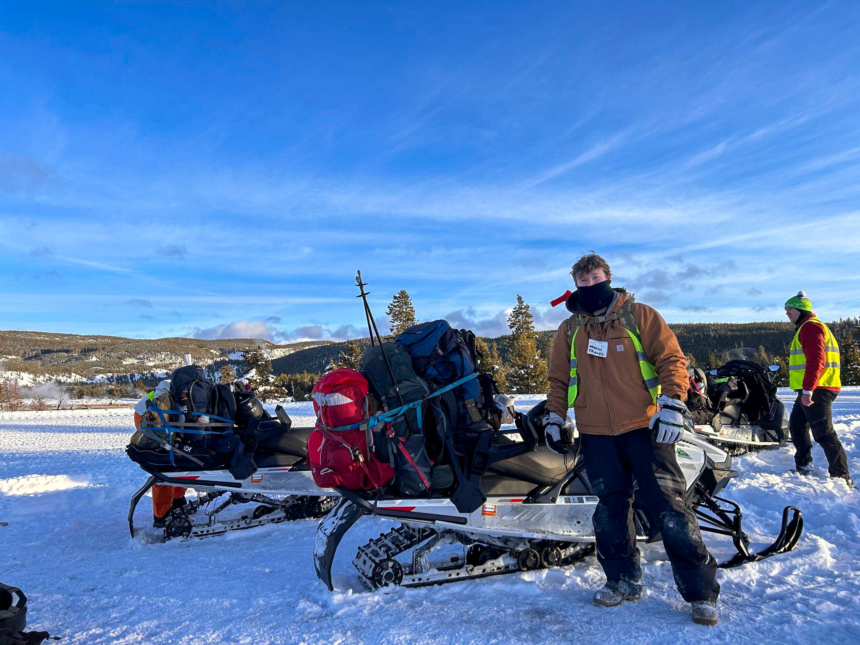
Doctoral candidate Tanner Barnes traveled deep into Yellowstone National Park to collect water samples for experiments examining life in extreme environments. Courtesy photo
Arizona State University doctoral candidates Tanner Barnes and Vince Debes both enjoy a good hike.
But when they set out on trails in places like Yellowstone National Park, they are not just taking in the sights — they are collecting samples that could answer some of science’s biggest questions: how life survives in extreme environments, how planets become habitable and what signs of life scientists should look for beyond Earth.
Barnes and Debes work with ASU Professor Everett Shock in the Group Exploring Organic Processes in Geochemistry, or GEOPIG Lab. The lab, which studies “life as a planetary process,” examines how geology, chemistry and biology interact to make planets habitable.
Barnes, who is in the School of Molecular Sciences, and Debes, who is in the School of Earth and Space Exploration, have made many visits to the hot springs in Yellowstone National Park to collect samples for their research, which advances GEOPIG’s goals.
While the samples they are studying come from the same source, they are individually working to answer different questions with the help of specialized instruments and staff support at the Metals, Environmental and Terrestrial Analytical Laboratory, or METAL Core, one of the Core Research Facilities.
Barnes’ fascination with science started when he was still in high school, with courses that made him see the natural world differently. This new perspective sparked a curiosity in astrobiology, the study of life’s potential beyond Earth.
“What drew me in was a fundamental question: How does life survive and even thrive in environments that seem impossibly hostile?” he says.
Barnes is helping scientists recognize signs of life using chemistry by focusing on carbon. Using METAL Core tools that measure carbon and isotopes, he can study whether carbon in Yellowstone samples came from outside the hot spring or was produced by the microbes living in it.
Think of separating these two kinds of carbon like studying water in a swimming pool during a rainstorm — which droplets came from the hose that filled the pool, and which came from the clouds?
Being able to identify the sources of carbon present in a sample is important when looking at rocks in other extreme environments, from Earth to other planets, to determine whether the carbon is there by chance or was left behind by life.
“Hiking through one of the most geologically dynamic landscapes on Earth to collect samples and observe these systems up close is a reminder of why I got into this work in the first place,” Barnes says. “Ultimately, the chemistry we uncover in places like Yellowstone will serve as a critical reference point as we begin returning samples from Mars and searching for signs of life on other worlds.”
Debes’ work looks not at what life leaves behind, but at how life might thrive without sunlight or organic matter as an energy source. He studies how microbes can survive on energy released by chemical reactions.
With the METAL Core equipment, Debes can analyze what chemicals are in the water, where that water came from and what forms of energy may be available to microbes.
Imagine, instead of using photosynthesis or digestion as a source of energy, you could tap into the chemical change that happens as metal rusts. In hot springs, microbes can take advantage of similar reactions involving iron and other chemicals in the water.
Understanding this process can show scientists where to look for life in places like Europa’s ocean, geological formations on Mars or other worlds with water-rock reactions.
Debes has been fascinated by hot springs since he was young, but his path to researching them took many twists and turns.
His early studies at ASU focused on chemical engineering. He soon realized that his desire to “engineer new chemicals” was not part of the degree path he was on and what he really wanted to do was biochemical research.
When he made that switch, he looked for labs doing interesting work to volunteer in and, when he saw Shock’s GEOPIG work dealt with hot springs, he knew he found his new home.
“The field aspect of research is probably my favorite part of my research career because you get to hike around and see the beautiful hot springs in their natural setting,” he says.
Looked at individually, their work seems highly specialized. When the results of their experiments are brought together, their joint efforts offer insight into big questions: How does life survive in extreme environments? How do geology and biology shape each other?
The answers to these questions will offer insight into how life may have started on Earth, and could guide other researchers as they look for signs of it on other planets.
“Field trips (with Shock and GEOPIG) are often where you get inspiration for future research projects as well. Sitting around the campfire after a day of fieldwork and talking about everyone’s observations really gets the creativity flowing and helps everyone frame the scientific questions they are working on,” Debes says.
Long before artificial intelligence became a fixture in workplaces, Nancy Cooke was exploring how humans and intelligent machines could work together effectively.A professor of human systems…
A new facility on Arizona State University’s Tempe campus will provide researchers and corporate partners with access to an extensive suite of advanced materials and manufacturing tools. The…
Artificial intelligence, or AI, is rapidly transforming nearly every industry, creating a growing need for students to add key technical skills to their major. To help meet that demand, the…
Contact ASU News
Manage subscriptions
Student research in Yellowstone could help scientists understand life on other planets – ASU News



Leave a Comment