


Personalise the news and
stay in the know
Emergency
Backstory
Newsletters
中文新闻
BERITA BAHASA INDONESIA
TOK PISIN
Topic:Surveillance
Fri 19 Jun 2026 at 1:54pm
Col Blanch says WA people will be safer with the use of live facial recognition technology. (ABC News: Callum Liddelow)
A marked police van will be used outside major events or in crowded areas to live scan the faces of people walking past, in an Australian first.
The faces of people will be matched against a database of people with outstanding arrest warrants and registered child sex offenders, as well as missing persons.
While the trial only includes one marked van, the police commissioner is not ruling out further covert technology being used in the future, including at protests.
Western Australia will become the first place in the country where police will trial real-time facial recognition cameras, scanning crowds for people wanted by police, registered child sex offenders and missing persons.
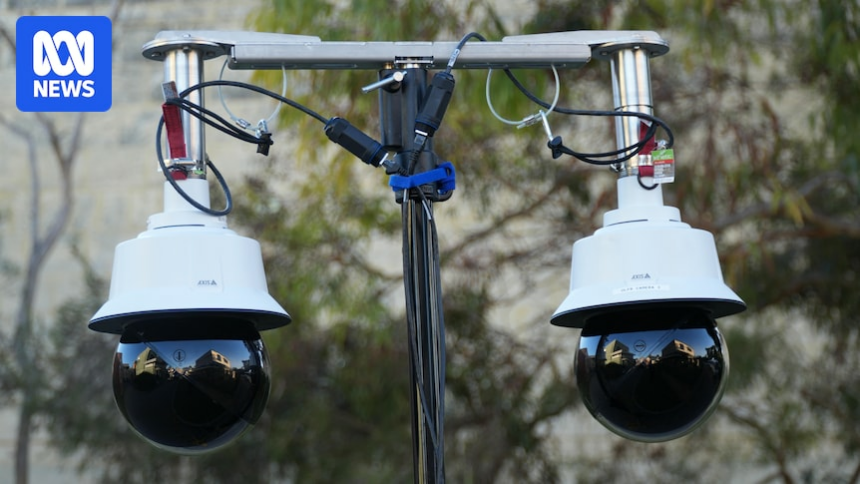
The cameras, which will be deployed in a marked police van outside major events or in crowded areas, will scan faces to be cross referenced with a database of targets.
Police Commissioner Col Blanch said that database will contain about 4,000 people with outstanding arrest warrants and thousands of registered child sex offenders, as well as people reported missing.
Live facial recognition cameras are set to be used at major events in WA or in crowded areas. (ABC News: Callum Liddelow)
The commissioner said signs alerting the public to the cameras would be clearly visible.
"This is about specifying those in our community who are wanted by police."
The cameras could be deployed in entertainment zones like Northbridge and at events at Perth Stadium. (ABC News: Keane Bourke)
If the technology detects a match, the image will be retained and an alert sent to nearby officers to confirm the person's identity.
Commissioner Blanch said while his force had used facial recognition technology on already obtained footage for more than a decade, it was the first time in Australia police had used live feeds for almost-instant facial detection.
A marked police van will be used in the trial, with standalone cameras able to be deployed from the van. (ABC News: Callum Liddelow)
He sought to quell concerns about potential breaches of privacy.
"CCTV cameras are everywhere. They are owned by private businesses, local councils, they are around the world … and who are they owned by, no-one would know," he said.
"They capture information of everyone, they store pictures of everyone — for how long, I don't know.
Police say images of people not on the database will be deleted almost immediately and will appear pixelated, even for officers monitoring the technology. (ABC News: Callum Liddelow)
"This technology here pixelates those who are not on the list, does not store information, deletes it immediately.
Bunnings was reasonably entitled to use the technology to combat crime and staff abuse, the Administrative Review Tribunal finds.
While this trial only includes one marked van, he did not rule out covert technology being used in the future, pointing to the force’s existing use of facial recognition systems.
"We already use facial recognition in a capacity that is not overt. We already do that," the commissioner said.
He said he wanted to the community to feel comfortable with the technology.
"We want the conversation and that debate to continue," the commissioner said.
The van will be fitted with clear signs which the Commissioner expects could deter people who would be recognised. (ABC News: Callum Liddelow)
"This is how we intend to keep our community safe. Let's have that conversation first before we decide to go any further."
Commissioner Blanch said private companies were already using live facial recognition.
Elsewhere in Australia, the national privacy commissioner found Bunnings had in 2024 breached the privacy of potentially hundreds of thousands of Australians through the use of facial recognition cameras to scan every customer on entry in an effort to reduce theft.
However, the ruling was later overturned, potentially paving the way for other major retailers to embrace the technology.
The privacy commissioner also found Kmart had breached Australians’ privacy by collecting their personal and sensitive information through a facial recognition technology system designed to tackle refund fraud.
Kmart was found not to have notified shoppers or sought their consent to use the technology to collect their biometric information.
Commission Blanch said it was not his "intent" for the technology to be used at protests "except if we have intelligence that there is a significant risk of someone seeking to do harm".
But he said that could be the case at the upcoming Land Forces defence expo, which Perth will host in October, if police had intelligence of a threat to that event.
If the technology detects a match, an alert will sent to nearby police officers to confirm the person's identity. (ABC News: Callum Liddelow)
The event attracted ugly protests in Melbourne two years ago, with police saying they were pelted with rocks, cans and horse manure.
Defence Industries Minister Paul Papalia said he expected the defence expo to attract around 20,000 attendees, including senior military officials from around the world.
Protesters accused police of using excessive force, including capsicum spray and stun grenades.
The state government yesterday introduced a bill into parliament to empower police to search people and vehicles without the need to suspect an offence was being, or was about to be, committed within an area around the event.
The police commissioner would also be empowered to create a list of people who would be banned from the area, although they would not be notified of that fact in advance.
"We hope we get through Land Forces without any problems whatsoever and not using a single power in that act, because ordinarily everyone in Western Australia has been extremely well behaved when we have these protests," Commissioner Blanch said.
"What we don't want is people coming from other jurisdictions thinking that they can behave the way they have over in Victoria."
The commissioner said police had intelligence that interstate protesters were planning to attend.
He said he was unable to say how much the live facial recognition technology would cost, or which company was involved, because it was only being trialled.
The cameras could assist police in monitoring alleged perpetrators in crowded public spaces. (ABC News: Kenith Png)
In November 2025, the commissioner also revealed police had access to private cameras recording the number plates of vehicles entering the car parks at a Westfield shopping centre in Perth's south.
Greens MP Brad Pettitt described the extra police powers and the real-time facial recognition cameras as "overreach" and a "deeply concerning development from the most authoritarian Labor government we have ever seen."
Asked about the cameras, opposition leader Basil Zempilas said he supported police having more tools to do their job.
“I’ve always had the view if you haven’t done anything wrong, you haven’t got anything to worry about, and I’m not sure it’s any different when it applies to this,” he said.
University of Western Australia law lecturer Anna Zenz said she had several concerns about the technology, including its level of accuracy and biases in the software.
"Even the most sort of state-of-the-art tools only are 90 per cent accurate, which might sound high," she said.
"But in a context of law enforcement that may lead to devastating outcomes if there is a false positive or a false negative, which these technologies still show quite a lot."
Anna Zenz has says the technology can have faults. (Supplied)
Ms Zenz also said "algorithmic bias" was a major concern.
"The datasets on which AI-enabled facial recognition technologies are trained have inherent biases, racial biases, gender biases… which obviously can lead to discriminatory outcomes."
Additionally, she raised the issue of "function creep", where a technology ends up being used beyond its initial stated purpose.
"Facial recognition technology in the public space, its usage is an indiscriminatory subjection of the public to mass surveillance," she said.
"A lot of the data that's collected through facial recognition technology is biometric data, which is some of the most sensitive and personal information that there is."
Topic:Indigenous Culture
Topic:Indigenous Culture
Topic:Photography
Topic:Feel Good
Topic:Indigenous Australians
Fri 19 Jun 2026 at 1:54pm
Fri 19 Jun 2026 at 9:05pm
LIVE
Analysis by Laura Tingle
Topic:Explainer
Topic:One Nation
Analysis by Jacob Greber
Topic:AI
Topic:Crime
Perth
Police
Surveillance
Technology
LIVE
Analysis by Laura Tingle
Topic:Explainer
Topic:One Nation
Analysis by Jacob Greber
Topic:Multiculturalism
Sat 20 Jun 2026 at 5:17am
Analysis by Jacob Greber
Sat 20 Jun 2026 at 5:16am
Topic:AI
Sat 20 Jun 2026 at 5:05am
Analysis by Laura Tingle
Sat 20 Jun 2026 at 5:26am
Your home of Australian stories, conversations and events that shape our nation.
This service may include material from Agence France-Presse (AFP), APTN, Reuters, AAP, CNN and the BBC World Service which is copyright and cannot be reproduced.
We acknowledge Aboriginal and Torres Strait Islander peoples as the First Australians and Traditional Custodians of the lands where we live, learn, and work.
Sign up to get the latest on your favourite topics from the ABC
'Not about mass surveillance': WA Police first in country to use live facial recognition – Australian Broadcasting Corporation



Leave a Comment