Thank you for visiting nature.com. You are using a browser version with limited support for CSS. To obtain the best experience, we recommend you use a more up to date browser (or turn off compatibility mode in Internet Explorer). In the meantime, to ensure continued support, we are displaying the site without styles and JavaScript.
Advertisement
Communications Biology (2026)
We are providing an unedited version of this manuscript to give early access to its findings. Before final publication, the manuscript will undergo further editing. Please note there may be errors present which affect the content, and all legal disclaimers apply.
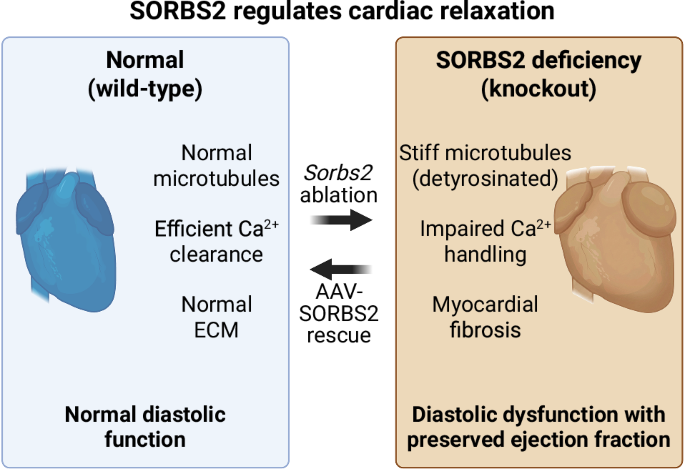
Diastolic dysfunction, defined by impaired relaxation and increased ventricular stiffness, is central to heart failure with preserved ejection fraction, yet cardiomyocyte-intrinsic mechanisms remain incompletely understood. Here, we show that SORBS2 is a vital component of murine cardiomyocyte adhesion complexes. Its genetic ablation in mice causes progressive diastolic dysfunction with preserved systolic function, accompanied by atrial enlargement and reduced survival. Postnatal cardiomyocyte-directed re-expression of SORBS2 restores diastolic indices and significantly improves longevity. Mechanistically, SORBS2 functions as an integrative scaffold linking adhesome integrity, cytoskeletal remodeling, and calcium homeostasis. SORBS2 deficiency increases microtubule detyrosination, reduces SERCA2 abundance, disrupts dyad-associated organization, which collectively impair active cardiomyocyte relaxation. Concurrently, this deficiency promotes extracellular matrix remodeling and myocardial fibrosis, driving passive ventricular stiffness. Pharmacological inhibition of microtubule detyrosination partially rescues relaxation defects. These findings establish SORBS2 as a key regulator of diastolic function and define a structural axis governing myocardial mechanics, offering potential therapeutic targets.
WTP was supported by NIH R01HL163937 and charitable donations to the Boston Children’s Hospital Department of Cardiology. F.L. was supported by an AHA postdoctoral fellowship.
Fujian Lu
Present address: Institutes of Biomedical Sciences, Department of Cardiology, Zhongshan Hospital, Shanghai Institute of Cardiovascular Diseases, Fudan University, Shanghai, China
Department of Cardiology, Boston Children’s Hospital, Boston, MA, USA
Zexuan Wu, Camille Blandin, Jiehui Chen, Jiajin Li, Li He, Qing Ma, Anna Ponek, Dogacan Yucel, Fujian Lu & William T. Pu
Disease Biophysics Group, John A. Paulson School of Engineering and Applied Sciences, Harvard University, Boston, MA, USA
Michael M. Peters & Kevin Kit Parker
Harvard Stem Cell Institute, Cambridge, MA, USA
William T. Pu
PubMed Google Scholar
PubMed Google Scholar
PubMed Google Scholar
PubMed Google Scholar
PubMed Google Scholar
PubMed Google Scholar
PubMed Google Scholar
PubMed Google Scholar
PubMed Google Scholar
PubMed Google Scholar
PubMed Google Scholar
PubMed Google Scholar
Correspondence to Fujian Lu or William T. Pu.
The authors declare no competing interests.
Publisher’s note Springer Nature remains neutral with regard to jurisdictional claims in published maps and institutional affiliations.
Open Access This article is licensed under a Creative Commons Attribution 4.0 International License, which permits use, sharing, adaptation, distribution and reproduction in any medium or format, as long as you give appropriate credit to the original author(s) and the source, provide a link to the Creative Commons licence, and indicate if changes were made. The images or other third party material in this article are included in the article’s Creative Commons licence, unless indicated otherwise in a credit line to the material. If material is not included in the article’s Creative Commons licence and your intended use is not permitted by statutory regulation or exceeds the permitted use, you will need to obtain permission directly from the copyright holder. To view a copy of this licence, visit http://creativecommons.org/licenses/by/4.0/.
Reprints and permissions
Wu, Z., Blandin, C., Chen, J. et al. SORBS2 regulates diastolic function through cytoskeletal networks and calcium handling. Commun Biol (2026). https://doi.org/10.1038/s42003-026-10503-6
Download citation
Received:
Accepted:
Published:
DOI: https://doi.org/10.1038/s42003-026-10503-6
Anyone you share the following link with will be able to read this content:
Sorry, a shareable link is not currently available for this article.
Provided by the Springer Nature SharedIt content-sharing initiative
Advertisement
Communications Biology (Commun Biol)
ISSN 2399-3642 (online)
© 2026 Springer Nature Limited
Sign up for the Nature Briefing newsletter — what matters in science, free to your inbox daily.