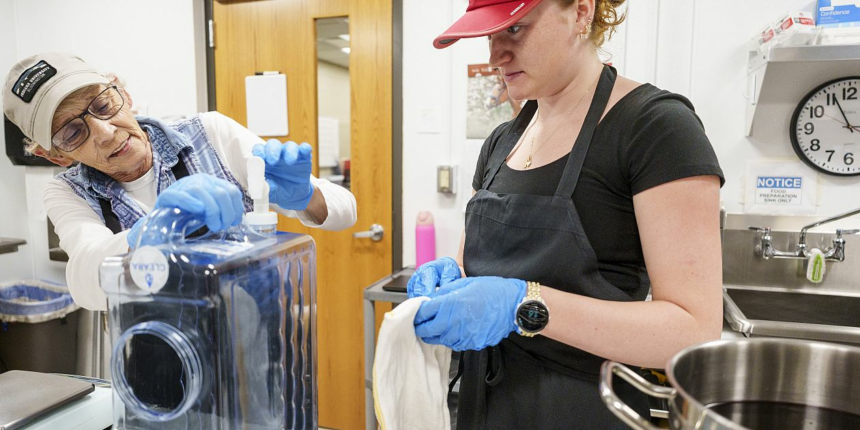

Since its completion in 2023, the metabolic kitchen in the Indiana University School of Public Health-Bloomington’s Nutrition and Metabolic Research Lab has been buzzing with cutting-edge studies on the health value of beef versus plant proteins, the palatability of Mediterranean versus Midwestern diets, and the effects of ketone supplements on people who consume high amounts of sodium.
The lab is part of the school’s Nutrition and Exercise Research Center, which serves scientists conducting diet-related research. It includes a clinical suite for on-site screening of study participants, a biospecimen processing laboratory and the metabolic kitchen.
The science of nutrition is a relatively young field; researchers began identifying the nutrients essential for human health only about 100 years ago. Important questions remain about which nutrients can help prevent, manage or treat specific conditions.
“The strongest evidence linking nutrition and health comes from randomized clinical trials, where participants consume carefully designed test meals under controlled conditions,” said Nana Gletsu Miller, an associate professor in the school’s Department of Applied Health Science who spearheaded the creation of the metabolic kitchen. “Through the research kitchen, IU Bloomington has the unique capacity to conduct these cutting-edge studies, providing a critical resource that distinguishes the university from many other research institutions.”
Before the construction of the metabolic kitchen, researchers conducted diet-related research in individual labs. Centralizing the research is optimal though because every study requires a dietitian to create the menus, student research assistants to produce the study foods and a kitchen manager like Corinne Nicholson to ensure food safety and oversee production.
Nicholson’s 40 years working in IU’s kitchens and dining halls makes her an ideal person to manage the metabolic kitchen. She’s cultivated skills in almost every area of the culinary arts and specialized in creating individualized meals for students, staff and faculty who have allergies and food sensitivities. She now brings that expertise to bear in her current role overseeing the metabolic kitchen, which creates meals, capsules and supplement formulations for controlled nutrition studies.
Certified at the highest level of food hygiene, Nicholson ensures that the metabolic kitchen maintains maximal sanitation.
“We needed a facility where food safety and accuracy are paramount, and Corinne’s qualifications make that possible,” Gletsu Miller said.
Lisa Spence is the metabolic kitchen’s research dietitian. With each researcher, she develops a controlled set of diets to study nutrients, ingredients and dietary patterns.
She recently designed menus for a study that compared a Mediterranean diet to a Midwestern diet to assess whether one appealed to study participants more than the other. She created meal plans for each dietary pattern that contained equivalent macronutrients (carbohydrates, fats and proteins) and micronutrients (vitamins and minerals). She then individualized each meal to the participant’s unique caloric needs.
“The reason we have this metabolic kitchen is to ensure accuracy,” Spence said. “We’re developing each study diet with precision in order to test the effects on clinical endpoints. Every single element of the diet is controlled.”
Nicholson plans and creates each meal using the exact measurements and ingredients laid out by Spence. In addition to ensuring accuracy, consistency and food safety, Nicholson also makes the meals appealing to participants.
“If it doesn’t look good, who’s going to want it?” Nicholson said. “It’s really important to me that it looks good so that participants have the best experience possible and tell their friends.”
“The kitchen also serves the teaching mission for the School of Public Health-Bloomington and IU,” Gletsu Miller said. “We look at this as a training opportunity for students to learn how to support a research study. They come out of the work with insights into the research process and gain professional skills from an undergraduate research assistantship.”

Delaney Wigand, who recently graduated with a degree in dietetics, and Grace Tyson, who is an incoming senior majoring in exercise science and minoring in nutrition, worked in the kitchen as undergraduate research assistants in the spring.
They both said they appreciated the job as the perfect training opportunity for their future careers as dietitians and exercise scientists. Plus, it was fun: “It’s just great coming in and making pancakes for work,” Wigand said.
Tyson and Wigand also said they enjoyed making salt capsules for a study conducted by Austin Robinson, an associate professor in the Department of Kinesiology. His research centers on dietary sodium and how it impacts cardiovascular and kidney health.
With funding from the National Institutes of Health, he is currently studying whether a liquid ketone supplement could mitigate the effects of excess sodium on kidney health. Robinson said that even in younger adults, a diet high in salty foods can create kidney stress and blood vessel dysfunction.
“Working with the Nutrition and Exercise Research Center has been critical for this study, because it’s really difficult to create salt capsules outside of a clean and controlled environment like the metabolic research kitchen,” Robinson said. “They’re able to individualize the capsules and the ketone drinks, and we just don’t have to think about that part, allowing us to focus on collecting data and analyzing the results.”
Robinson said that having access to the Nutrition and Exercise Research Center has allowed him to apply for larger grants because he can run controlled feeding studies through the metabolic kitchen.
Like Gletsu Miller, Robinson said he appreciates the fact that the School of Public Health-Bloomington can also engage students in the scientific process via the metabolic kitchen.
“It’s really cool to think that we’re doing important research that has a real impact on people, but we’re also training the next generation of dietitians and healthcare providers,” Robinson said.