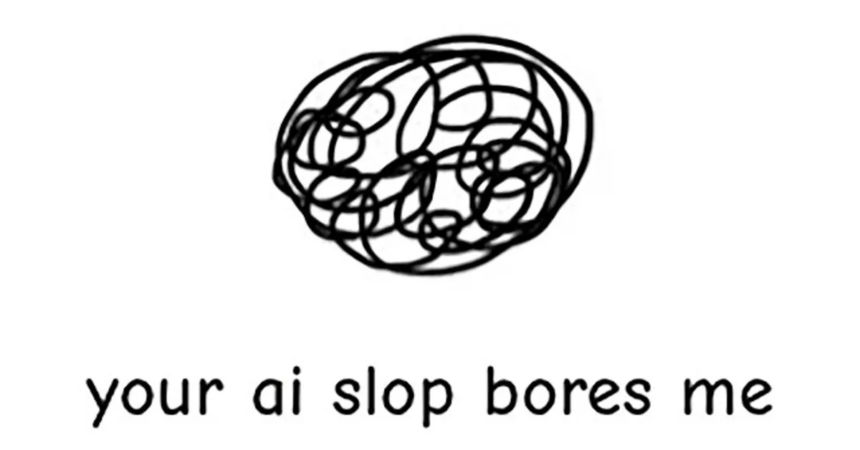
Your ai slop bores me is a wesbite that blurs the lines between viewer and creator. A parody of large language models, the page brings people together through nostalgia for a simpler internet and mockery of generative AI. The goal is to foster creativity and connection, as it is a place to let go of online hostility and the surrealism of a web flooded with non-human content.
This work is licensed under a Creative Commons Attribution-NonCommercial 4.0 International License.
No AI was used in the creation of this content. More info: https://creativecommons.org/ai-and-the-commons/
Your ai slop bores me (youraislopbores.me) is a website designed by programmer Mihir Maroju that was launched on March 2, 2026. The project, often shortened to “YASBM”, was designed to be a parody of large language models (LLMs) like the ones that are used by generative AI chatbot ChatGPT. The presence of “AI slop” — low quality content generated with AI tools — is a factor that is interpreted as hindering the spread of human creativity and connection on the Internet. This website, mocking AI tools and chatbots, relies on mutual understandings of how these AI tools work and the desire to get answers to questions people wouldn’t ask anywhere.
The website has a charming aesthetic designed to evoke nostalgia for the simpler times of the early internet. It contains a couple buttons, simple color scheme and Comic Sans font. The user experience of the website is similar to that of an LLM: directing prompts and getting answers to questions, except every response comes from a real person (Caswell, 2026). When logging on for the first time, users are given two free credits to write a prompt that another user, who is acting as the AI, answers with text or drawing. Users can earn further credits by “larping” as an AI by replying to the prompts of others with a 75-second countdown timer. The prompt-writers and “AI machines” are matched randomly and anonymously for only one round at a time. Once their credits run out, users can no longer write prompts until they have earned new credits by “larping” as the AI; however, the maximum amount that they can accumulate is 10. After the credits fill up, they have to switch to performing as humans again and create more prompts (Snelling, 2026). This ensures a balance between participants and the smooth run of the process, while forcing people to take an active role in the creative process.
With the recent rise of art installations being participatory, the ‘rules’ regarding the medium and form an art installation should have appear to become less rigid. Moments of life, human connection and understanding can now be understood as art, in which collaboration between humans can often play a significant role (Finkelpearl, 2014). YASBM facilitates human relationships by connecting two people without the weight and awkwardness of a first meeting. The mutual knowledge and experience of how botched and incorrect information given by LLMs can be frees people from the pressure of having to be correct when answering questions and allows for playfulness. The anonymity of the two people performing in the interaction releases the pressure that comes with sharing an opinion online, which might be associated with the fear of being called out, bullied or cancelled. People can get as silly or pretentious as they like: the more out of pocket the answers are, the more they remind the asker of the flawed nature of LLMs, which makes YASBM entertaining to participate in.
Participatory art pieces differ from traditional ones in how they should be considered by the audience. Without active participation, YASBM would be an empty textbox on a hidden corner of the internet. The users generate every part of the content: the prompts, the responses, the feedback on the answers. Mihir Maroju is the creator of YASBM but is not taking active part on the frontlines of its working. The audience is not only involved with the artwork but also responsible for its integrity: keeping the messages clean and enjoyable for anyone as well as continuing to participate to keep the project alive (Groys, 2008, p. 19). In this sense, it could be argued that the website is more of a medium to create art than a participatory art piece in itself. The real art is not the code or the server it runs on, it are the moments of interaction and social connection (Finkelpearl, 2014).
Your ai slop bores me is a piece of participatory art that blurs the lines between audience and creator, and artwork and medium. People from all over the world can take part in the joy of creation and protest against the growing use of generative AI. With a foundation that indexes nostalgia for the ‘old’ Internet and a distaste for the soulless, flawed output of generative AI chatbots like ChatGPT, it fosters human connection and creates a space to be playful on an otherwise hostile web.
Caswell, A. (2026, March 11). Quitting ChatGPT? I tried the viral “anti-slop” website everyone’s talking about — and it’s actually quite useful. Tom’s Guide. https://www.tomsguide.com/ai/i-tried-the-viral-website-where-humans-pretend-to-be-chatgpt-and-its-surprisingly-fun
Finkelpearl, T. (2014). Participatory art. In Encyclopedia of Aesthetics, M. Kelly (Ed.). New York: Oxford University Press.
Groys, ‘A Genealogy of Participatory Art’ (in The Art of Participation: 1950 To Now, edited by Rudolf Frieling et al., Norton, 2008)
Snelling, G. (2026, March 9). “Your AI slop bores me”: The viral website that lets humans answer your questions like ChatGPT. Fast Company. https://www.fastcompany.com/91505685/your-ai-slop-bores-me-website-game-makes-humans-larp-chatgpt
Second year Digital Culture and Society student at Tilburg University.
No AI was used in the creation of this content. More info: https://creativecommons.org/ai-and-the-commons/
Get your weekly dose of insights! Our newsletter arrives every Monday with fresh reviews, thought-provoking articles, and engaging videos. Enter your email address to subscribe.
© Diggit Magazine – 2026