




Massive stars produce light and heat through nuclear fusion, a process that releases enormous amounts of energy from their cores. Eventually, however, the largest stars run out of fuel. Once that happens, the outward pressure generated by radiation is no longer strong enough to resist gravity. The star begins collapsing under its own weight, theoretically continuing until all of its mass is compressed into a single point known as a singularity.
Although black holes are widely accepted by physicists, they still raise profound questions. How can a mass equal to billions of Suns be squeezed into an infinitely small point? How can spacetime become infinitely curved at a singularity?
At this extreme limit, the known laws of physics cease to provide reliable answers. Scientists cannot accurately describe what happens under such conditions. Black holes also present another challenge because they hide everything beyond their event horizons. Any matter, radiation, or information that crosses this boundary, including light itself, can no longer be observed.
Gravastars and the Role of Dark Energy
Because of these unresolved issues, some researchers have explored the possibility that at least some objects identified as black holes could actually be something else entirely. One proposed alternative is an ultra compact object known as a gravastar.
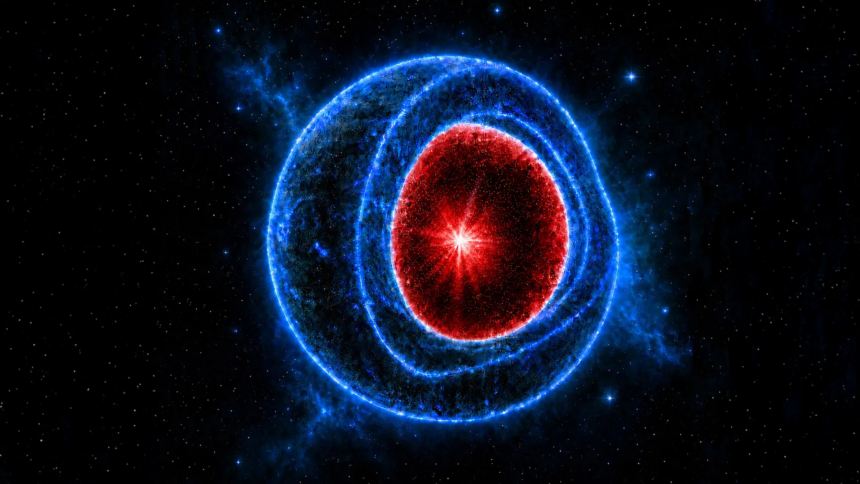
Gravastars would be nearly as dense and massive as black holes, making them extremely difficult to detect because of their intense gravitational pull. Unlike black holes, however, they would not contain a singularity or an event horizon. Instead, beneath their outer layers of ordinary matter, they would be filled with dark energy. This mysterious form of energy produces an outward pressure that counteracts gravity and prevents complete collapse.
For many physicists, gravastars offer an appealing alternative because they avoid some of the conceptual problems associated with black holes. Yet one major question has remained unanswered for decades: How could gravastars actually form?
New Solution Suggests a Mini Universe Forms
Theoretical physicists Daniel Jampolski and Professor Luciano Rezzolla have now proposed what they describe as the first dynamic solution to Albert Einstein’s equations of General Relativity that explains how a collapsing star could produce a gravastar.
According to their work, the collapse of a massive star may trigger the birth of a miniature universe within the collapsing matter itself. This newly formed universe would not be very different from the Big Bang that gave rise to our own cosmos. As in our universe, dark energy would drive its expansion.
As the mini universe expands, it pushes outward against the inward pull of gravity. This opposing force can halt the collapse before a black hole forms. The result is a stable balance between the collapsing stellar material and the expanding interior universe. That balance creates a gravastar.
The researchers say their solution provides the first explanation for a question scientists have debated for roughly 25 years: how gravastars could emerge from the collapse of ordinary matter.
Room for New Physics
Daniel Jampolski, who developed the solution during his master’s thesis under the supervision of Luciano Rezzolla, explains: "The Big Bang of the emerging universe can unfold once the star has already collapsed almost to the point of becoming a black hole."
The behavior of matter compressed to such extraordinary densities remains poorly understood, leaving open the possibility of new physical phenomena. As Jampolski notes: "It is easier to imagine that the Big Bang occurs only at a very late stage, when matter has already been compressed to an extreme degree, thereby giving rise to new effects."
Rezzolla, Professor of Theoretical Astrophysics at Goethe University, emphasizes that exploring alternatives does not mean rejecting black holes. "Looking for alternatives to black holes should not suggest a skepticism towards black holes, which still represent the most natural and simplest solution to the fate of gravitational collapse. However, as scientists in general, and as theoretical physicists in particular, it is essential to maintain an unbiased approach towards what we do not know and hence explore both the accepted wisdom and the more exotic interpretations. History teaches us that it is not unusual for the latter to become the former."
Story Source:
Materials provided by Goethe University Frankfurt. Note: Content may be edited for style and length.
Journal Reference:
Cite This Page:
MIT’s New Dual-Mode Rocket System Could Send Tiny Satellites to Mars
The Brain May Not Need Full Sleep To Recover, New Research Finds
Millions Take This Joint Supplement but Scientists Found a Concerning Alzheimer’s Link
Your Gut Microbes May Decide How Many Calories You Really Absorb
Stay informed with ScienceDaily’s free email newsletter, updated daily and weekly. Or view our many newsfeeds in your RSS reader:
Keep up to date with the latest news from ScienceDaily via social networks:
Tell us what you think of ScienceDaily — we welcome both positive and negative comments. Have any problems using the site? Questions?
A dying star could create a new universe instead of a black hole – ScienceDaily



Leave a Comment

