




News
As Yale Floats 3.0 Mean GPA, Harvard Faculty Leaders Defend Lighter-Touch Grading Proposal
News
Harvard Kennedy School Floats Visiting Faculty Program in Donor Talks on Viewpoint Diversity
News
Harvard Asks Donors to Endow $10 Million Professorships for ‘Viewpoint Diversity’ Initiative
News
Harvard Management Company Opens San Francisco Office Amid Shift Toward Tech Investments
News
In Asia Trip, Harvard Divinity School Dean Marla Frederick Pitches Global Partnerships
Days after Massachusetts House Democrats voted to narrow the scope of a voted-approved legislative audit, state Senate candidates William N. Brownsberger ’78 and Daniel A. Lander ‘14 split sharply Wednesday over how far Beacon Hill should go to open itself to outside scrutiny.
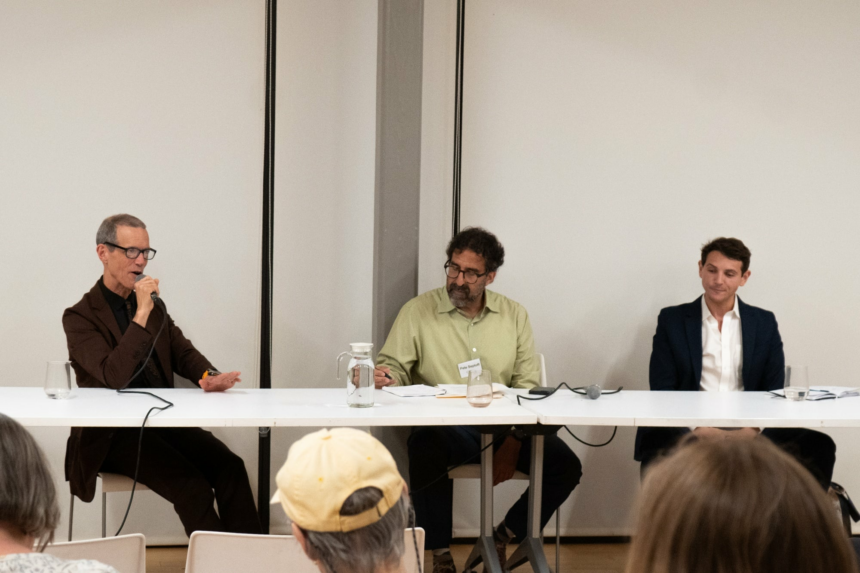
The forum, hosted by the Cambridge Committee for Transparency and Accountability, drew roughly two dozen residents and focused almost entirely on legislative transparency, public records, and the balance of power in the legislature.
The discussion came one day after Brownsberger and Lander met at a broader candidate forum centered on affordability, transportation, and education aid.
Throughout the discussion, Lander argued that lawmakers have failed to deliver the openness voters demanded, while Brownsberger defended the legislature’s transparency record and urged a more measured approach to reform.
Scrutiny of the legislature has grown since November 2024, when nearly 72 percent of Massachusetts voters approved a ballot measure explicitly authorizing the state auditor to examine the finances and operations of the legislature. Last week, however, House Democrats voted to narrow the scope of that audit and establish a formal process for public access to legislative records.
Lander, who said he voted in favor of the audit measure, said the legislature has failed to meet voters’ demands for greater openness.
“We have the least effective and least transparent legislature in the country, and my opponent is the architect of that broken status quo,” he said.
Brownsberger, who has served in the Senate since 2012, rejected the characterization, citing disclosure reforms, procurement changes, MBTA oversight measures, and a database tracking affordable housing spending.
“We’re not the least transparent,” he said. “We’re really doing a pretty good job putting information out there.”
The Society of Professional Journalists named Massachusetts the recipient of its 2026 Black Hole Award in March, citing broad exemptions, weak enforcement mechanisms, and delays in the state’s public records law. Brownsberger acknowledged the criticism and said the Senate is expected to take up legislation expanding access to public records “sometime in July.”
Lander argued that lawmakers have had ample time to enact such reforms and questioned why action had been delayed.
“I’m glad to hear that the senator now thinks that subjecting the body to public records law is a good idea. I would urge him to use his position in Senate leadership to act on that tomorrow,” he said.
Brownsberger said that while he understands the urgency behind reforms, lawmakers should take time to ensure they are implemented effectively.
“Make haste slowly,” he said. “Same with legislation, drive it, but take your time, get it right.”
The candidates also sparred over campaign fundraising after Brownsberger raised questions about some of Lander’s high-profile donors, including technology executives and entrepreneurs.
“Why are these guys given to Dan’s campaign? Is it just to perpetuate the Lander dynasty?” Brownsberger said. “Oligarchs take care of oligarchs. I don’t understand it.”
“I’m not saying I wouldn’t take it,” he added.
Lander defended his fundraising, arguing that his donors support his campaign because they want change on Beacon Hill, and he criticized Brownsberger for accepting contributions from lobbyists.
“I’m grateful for anyone who’s willing to donate to my campaign, who is interested in taking out the broken status quo,” he said. “I am not taking money from corporate PACs here. I have not taken thousands of dollars from lobbyists with business before the Senate.”
The candidates also clashed over the concentration of power in legislative leadership. Because House and Senate leaders control committee assignments and the stipends attached to them, Lander argued leadership wields outsized influence over rank-and-file lawmakers.
“What I am really opposed to is stipends from leadership for do-nothing committees,” he said. “For committees that see no bills year in, year out, where folks get $20,000 a year, like my opponent, for a committee that saw no bills this legislative session.”
Brownsberger said effective lawmakers achieve more through cooperation than confrontation, arguing that legislative leaders’ power comes from consensus-building rather than coercion.
“You don’t become speaker of the house or senate president by being a jerk and not respecting the comments,” he said. “I learned the hard way that sometimes a little bit of honey goes further than a lot of vinegar.”
—Staff writer Shawn A. Boehmer can be reached at [email protected] and on Signal at shawnb.18. Follow him on X @ShawnBoehmer.
—Staff writer Risha Sinha can be reached at [email protected] and on Signal at rishas.13.
Want to keep up with breaking news? Subscribe to our email newsletter.
Have a tip for The Crimson? Share it confidentially.
At Transparency Forum, Brownsberger and Lander Divide Over Legislative Audit – The Harvard Crimson



Leave a Comment

