


Paleontologists have identified a new species of meiolaniform turtle from northern Patagonia, Argentina, that lived during the Maastrichtian age, just before the asteroid-triggered mass extinction that wiped out all non-avian dinosaurs.
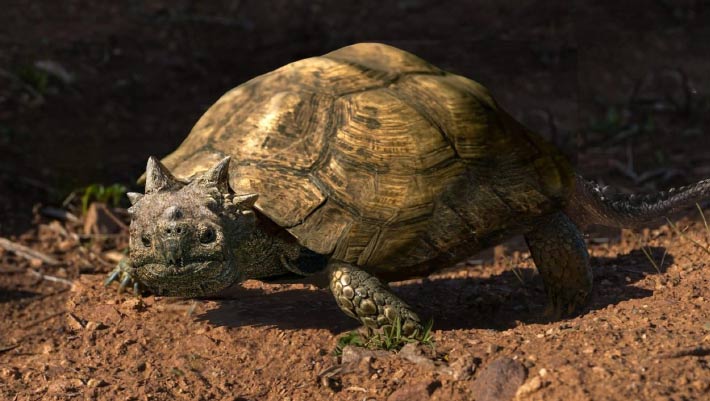
An artist’s impression of Patagoniaemys aeschyli. Image credit: Nawel Vazquez / Museo Argentino de Ciencias Naturales ‘Bernardino Rivadavia’ / CONICET.
The newly-identified turtle species lived in what is now Patagonia during the Maastrichtian age of the Late Cretaceous epoch, between 72 and 67 million years ago.
Named Patagoniaemys aeschyli, it belonged to a lineage that included some of the most unusual turtles ever known.
Meiolaniformes are famous for heavily armored bodies and, in some species, horned skulls.
“Meiolaniformes represent a group of turtles that includes the well-known horned species Niolamia argentina (Patagonia) and Meiolania platyceps (Australia),” said lead author Dr. Federico Agnolin, a paleontologist at the Museo Argentino de Ciencias Naturales ‘Bernardino Rivadavia,’ the Universidad Maimónides and CONICET, and his colleagues.
“Uncontroversial meiolaniforms are known from Early Cretaceous to Pleistocene times in southern landmasses, including South America, Australia, and New Caledonia.”
The fossilized remains of Patagoniaemys aeschyli were unearthed from the Los Alamitos Formation in Argentina’s Río Negro province.
The specimen includes portions of the skull base, shell fragments, vertebrae, and limb bones, making it one of the more informative meiolaniforms from the region.
The paleontologists estimated that the Patagoniaemys aeschyli’s shell measured about 80 cm (2.6 feet) in length.
The shell was broad and relatively low, unlike the more strongly domed shells seen in some later relatives.
“The shell is relatively thick at the base of the peripheral plates, where it shows a series of robust thick bumps, especially in the posterior parts of marginal,” the researchers said.
“The external surface of the shell ornamentation is composed of small pits and grooves.”
Beyond identifying a new species, the scientists explored how turtles fared during the end-Cretaceous mass extinction event that occurred 66 million years ago.
By examining fossil diversity in Patagonia, they found evidence that several turtle lineages persisted across the boundary separating the Cretaceous and Paleogene periods.
“The discovery of Patagoniaemys aeschyli confirms the presence of at least two meiolaniform lineages in the latest Cretaceous of southern South America,” the scientists concluded.
“The marked taxonomic continuity between Maastrichtian and Danian assemblages suggests that the end-Cretaceous extinction event did not severely impact Patagonian turtles, supporting a scenario of lineage persistence and limited faunal turnover among southern chelonians.”
A paper describing the discovery was published on March 26, 2026 in the journal Acta Palaeontologica Polonica.
_____
Federico L. Agnolin et al. 2026. A new meiolaniform turtle from the Maastrichtian of Northern Patagonia, Argentina. Acta Palaeontologica Polonica 71 (1): 173-184; doi: 10.4202/app.01268.2025
Fossil Discovery in Patagonia Reveals New Species of Horned Turtle – Sci.News



Leave a Comment