


This is read by an automated voice. Please report any issues or inconsistencies here.
Love ya, Jackie and Shadow, but no more bald eagles as Olympic mascots, period.
On drafting boards and computer screens hither and yon, a menagerie’s worth of creatures – actual and imaginary – have been created and discarded, eliminated and cast aside like luckless beauty pageant contestants, down to perhaps a dozen, then a handful, and at last a winner will be revealed: the official mascot for the 2028 Los Angeles summer Olympics.
The mystery mascot’s debut could still be six months away.
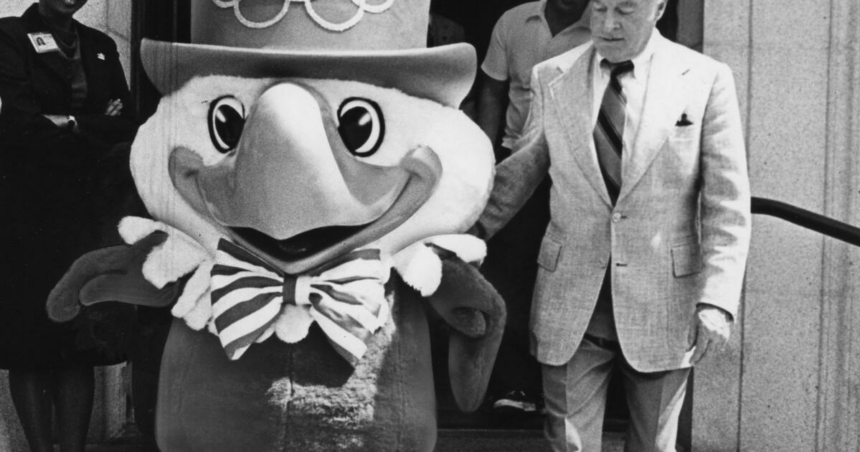
The last time L.A. hosted the summer Olympics, in 1984, the mascot stepped out four long years before the games began. He was Sam the Eagle, our national bird transformed by a Disney artist, and to some eyes bearing a slight resemblance to an earlier Disney avian character, a parrot. Peter Ueberroth, the head of the L.A. Olympics committee, allowed as how “fuzzy duck” was not an apt description for Sam.
Why did Sam get such an early hatching, back in 1980, but we’re awaiting 2028’s mascot?
First, Sam was probably stealing a march on Russia. The US had boycotted the 1980 Moscow games over the Soviet invasion of Afghanistan, and in 1984, the Soviet Union retaliated by staying home from L.A. The Moscow closing ceremonies were on a Sunday, Aug. 30, 1980; within hours, Sam the Eagle stepped out. And down.
Escorted by actor and perpetual emcee Bob Hope, Sam the Eagle descended the L.A. City Hall steps, all seven and a half feet of him, tall as a Lakers center but clumsy as a swan on dry land. Sam got a little cocky, tried a show-off spin, got his bird legs tangled and took a tumble. It required a few staff members to get him on his fuzzy feet again.
Second, to put it bald-eagly, that extra lead time gave Sam an opportunity to make money. L.A.’s 1984 games had promised not to cost Angelenos even so much as change for a penny, so they had the benefit — the necessity — of a lot of private money, some of thanks to licensing deal involving Sam.
L.A.’s games became the first to end up in the black. If you think that’s a meh deal, compare L.A. 1984 to Montreal 1976. L.A. ended up banking about a quarter-billion bucks. Montreal’s mascot was Amik, the industrious Canadian beaver. Yet even Amik needed 30 years to chew his way out of the billion dollars in red ink that the Montreal Olympics cost.
Sam commanded top dollar as an Olympic-licensed property. As a nameless licensee told The Times in 1984, a properly promoted Sam “could do $200 million.”
A pledge of at least $4 million allowed sponsors to use Sam in ads and promos. Sam and Ronald McDonald co-starred in a commercial.
And Olympic-sponsor hierarchy was guarded like vestal virginity. When the L.A.-based chicken chain Pioneer bought a few hundred thousand plastic toy Sams from an official Olympic licensee (the ranking below sponsorship) to give away with buckets of its chicken, McDonald’s and the L.A. Olympic committee asked a federal judge to stop it. The judge refused to end the toy Sam giveaway, but ordered Pioneer to stop using the Olympic rings and L.A.’s star-in-motion symbols.
At the start of the 20th century, Southern California was home to an astonishing number of military academies designed to turn boys into officers and gentlemen.
By 1980, random Americans had already offered their own notions for a mascot, but in the end, it was a pro, a Disney artist named Bob Moore, who rummaged through California’s animal and vegetable kingdoms — “rabbits, and turtles, frogs. I even had a cactus.” None of them filled the mascot-sized hole.
Moore tried a bison, that shaggy American prairie symbol. Even Moore couldn’t make the bison work. “A four-legged creature is hard to make look right because he has to stand up and do things,” he told The Times — athletic things, like performing a pirouette. And so Sam it was, but an eagle that was more comical than menacing, so as not to scare the kiddies and customers — a happy raptor.
The earliest Olympic mascot wasn’t formally a mascot, but Schuss, a stylized Z-shaped figure on skis. Schuss was created on an overnight deadline for the 1968 winter games in Grenoble, France.
In 1972, Waldi was the fetching little pastel dachshund for the Munich games, but more than 50 years later, the most lasting, haunting image from Munich is of a ski-masked Palestinian extremist outside the Israeli athletes’ quarters. That terrorist massacre by Black September militants killed 11 Israeli athletes and coaches and one West German police officer before five of the attackers were killed.
Some mascots just don’t translate. That had to be a whiff of flop-sweat from the Atlanta 1996 games’ blue blob mascot, something like an anthropomorphized teardrop, originally named Whatizit for the obvious reaction it generated, and later just Izzy. Yet the Atlanta Paralympics mascot was dazzling, a glorious phoenix arising from its own ashes.
London’s 2012 Wenlock mascot was a bottom-heavy cyclops figure named for an English village that held a kind of Olympic competition in 1850. How much better loved would it have been had Wenlock been a warlock, a creature spun from the Merlin of Arthurian legend. Abracadabra, maybe next time, London.
California
Los Angeles is a big, complicated place. Patt Morrison explaining how it works, its history and its culture in Explaining L.A. on latimes.com.
It all comes down to the merch, doesn’t it? What sells, what sinks, what stinks?
There may still be time to rescue LA2028 from another anodyne, wholly wholesome Sam clone.
An angel on a surfboard. An angel in board shorts on a surfboard jumping a great white shark. An angel in board shorts on a surfboard jumping a great white shark while taking a perfectly legal toke, which, you just know, is something a lot of Olympic visitors will want to try. The toke, not the surfboard.
None of that will happen. Mascot judges would score that one at 0.0 on the family-values rating system. Maybe one judge, perhaps a Cheech and Chong fan, will sneak in a 0.1.
Let’s have a mascot with character, stamina and initiative. Lovable, with a potential for fierceness and a proven fan base.
Runner-up: one of the Monrovia bears. Adept at suburban sidewalk loping. Very cute. Comfortable in a hot tub — perfect model for swimming events, and for after-hours partying.
But there’s one, undisputed frontrunner. She’s lithe, she’s tough but charismatic. She climbs, she crawls, she leaps, she runs like the Santa Ana wind. She’s overdue for her star on the Walk of Fame, obv.
Her face on Olympic tickets will sell thousands. Part of the money she makes has to go to wildlife preservation.
She’s the spiritual granddaughter to P-22, Griffith Park’s photogenic mountain lion … P-2028.
The cat’s meow.
Explaining L.A. With Patt Morrison
Los Angeles is a complex place. In this weekly feature, Patt Morrison is explaining how it works, its history and its culture.
Follow Us
Patt Morrison is a writer and columnist for the Los Angeles Times, where as a member of two reporting teams, she has a share of two Pulitzer Prizes. Her public broadcast programs have earned her six Emmys, her two non-fiction books were bestsellers and Pink’s, the Hollywood hot dog stand, named its veggie dog after her.
California
California
Science & Medicine
California
Author and CBS News correspondent Jonathan Vigliotti attempts to answer some questions about rebuilding communities in his new book about the Palisades Fire — and names a motive for a quick rebuild: the Olympic games coming to Los Angeles in 2028.
Today we discuss one of the pivotal events of the 1960s: the assassination of Robert F. Kennedy. Though the gunman was caught at the scene, confessed at trial, and even bragged about the shooting, his motives have largely been forgotten.
Fidel Martínez and Suzy Exposito sit down with Dominican-American singer, actress, and Latin Grammy-nominated artist Leslie Grace for a wide-ranging conversation about music, movies, and what it means to be Latino in Hollywood today.
California
California
California
California
Subscribe for unlimited access
Site Map
Follow Us
MORE FROM THE L.A. TIMES
Commentary: L.A.'s Olympics mascot — please, not for the birds – Los Angeles Times



Leave a Comment