


The healthcare industry is entering a transformative era defined by regenerative medicine, gene therapies, precision healthcare, and advanced biomedical research. As scientists develop groundbreaking treatments capable of repairing tissues, modifying genes, and creating personalized therapies, the need to safely preserve biological materials has become more important than ever.
At the center of this evolution lies the biopreservation industry, a critical yet often overlooked segment of modern healthcare infrastructure. Biopreservation enables researchers, healthcare providers, and pharmaceutical companies to maintain the integrity, viability, and functionality of biological samples for extended periods, ensuring that valuable materials remain suitable for research, diagnostics, and therapeutic applications.
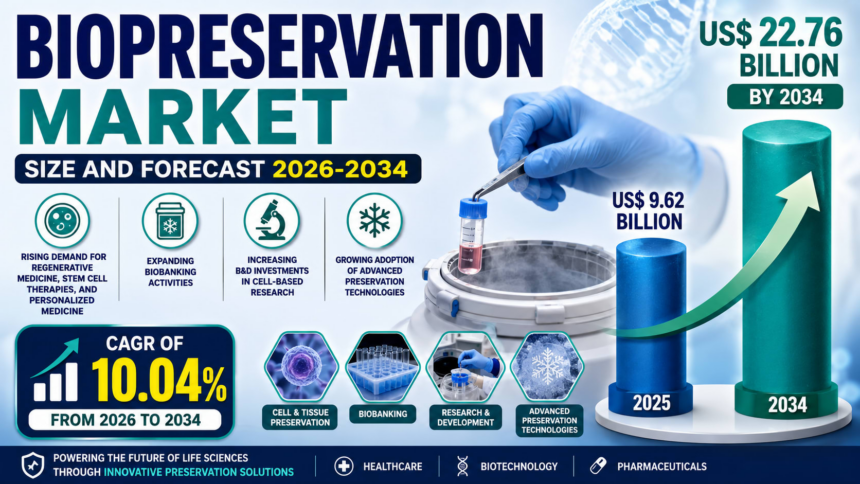
The importance of these preservation technologies continues to grow as healthcare systems increasingly rely on biological samples such as cells, tissues, organs, vaccines, DNA, and other biologics. Reflecting this demand, the global biopreservation market is expected to grow from
US$ 9.62 billion in 2025 to US$ 22.76 billion by 2034, representing a compound annual growth rate (CAGR) of 10.04% during the forecast period. Rising investments in regenerative medicine, expanding biobanking activities, and rapid advancements in cell and gene therapies are creating strong momentum across the market.
As healthcare becomes increasingly personalized and biologically driven, biopreservation is emerging as one of the most essential technologies supporting the future of medicine.
Biopreservation refers to the process of storing biological materials under carefully controlled conditions to maintain their quality and functionality over time.
These biological materials can include cells, tissues, organs, stem cells, blood samples, DNA, vaccines, and other biological products used in scientific research and clinical treatments. Without effective preservation methods, these materials would rapidly degrade, limiting their usefulness and compromising medical outcomes.
Several preservation techniques are commonly employed throughout the industry. Cryopreservation involves storing samples at extremely low temperatures, often using liquid nitrogen. Vitrification utilizes rapid freezing methods to prevent ice crystal formation that could damage cells. Hypothermic storage and freeze-drying techniques are also used depending on the specific requirements of each biological material.
These technologies play a vital role in ensuring that biological resources remain available for diagnostics, drug discovery, disease research, transplantation, and advanced therapeutic development.
As biological science continues advancing, the importance of reliable preservation systems continues to increase.
One of the strongest drivers behind the growth of the biopreservation market is the rapid expansion of regenerative medicine.
Regenerative medicine focuses on repairing, replacing, or regenerating damaged tissues and organs through innovative therapies such as stem cell treatments, gene editing technologies, tissue engineering, and cellular therapies.
These treatments depend heavily on the availability of viable biological materials that must be stored under highly controlled conditions throughout research, manufacturing, transportation, and clinical application.
Biopreservation systems ensure that these valuable biological assets remain functional throughout their lifecycle. Without advanced preservation technologies, many regenerative therapies would be impossible to develop or deliver effectively.
The growing prevalence of chronic diseases, including cancer, diabetes, cardiovascular disorders, and neurodegenerative conditions, is further accelerating investment in regenerative medicine. As healthcare providers seek more effective treatment options, demand for preserved biological materials continues to rise.
Government funding programs, academic research initiatives, and private-sector investments are also supporting the expansion of regenerative medicine infrastructure, creating additional opportunities for biopreservation providers.
Biobanking has become one of the most important pillars of modern biomedical research.
A biobank serves as a repository for biological samples that researchers use to study diseases, evaluate treatments, identify genetic variations, and develop new therapies. These collections often contain millions of samples, including blood, tissue, DNA, stem cells, and other biological materials.
The rapid growth of population-based health studies, genomic research projects, and personalized medicine initiatives has significantly increased demand for biobanking services worldwide.
Maintaining the quality and consistency of stored samples is essential for generating reliable scientific insights. Even minor variations in storage conditions can affect research outcomes and compromise data accuracy.
Advanced biopreservation technologies help ensure that samples remain stable and usable for years or even decades. As biobanks continue expanding their collections, investments in sophisticated storage systems, monitoring technologies, and preservation media are increasing accordingly.
The integration of artificial intelligence, automation, and digital sample management systems is further improving biobanking efficiency and scalability.
These developments are strengthening the relationship between biobanking and biopreservation, creating a mutually reinforcing cycle of growth.
Healthcare is moving away from generalized treatment approaches and toward personalized care strategies tailored to individual patients.
Precision medicine uses genetic, molecular, and biological information to design treatments that are specifically suited to a patient's unique characteristics. This approach promises improved outcomes, reduced side effects, and more efficient healthcare delivery.
However, precision medicine relies heavily on access to high-quality biological samples.
Researchers require extensive collections of preserved tissues, blood samples, DNA sequences, and cellular materials to understand disease mechanisms and develop targeted therapies.
Biopreservation technologies provide the foundation for these efforts by ensuring that biological materials remain viable throughout research and clinical workflows.
As precision medicine programs continue expanding across healthcare systems worldwide, demand for advanced preservation solutions is expected to increase substantially.
Technological advancements continue to play a crucial role in shaping the future of the biopreservation market.
Modern preservation systems are becoming more sophisticated, efficient, and reliable than ever before. Advances in cryogenic storage technologies, preservation media, monitoring systems, and automated storage platforms are improving sample integrity while reducing operational risks.
Innovations in cryoprotectants are helping minimize cellular damage during freezing and thawing processes. Controlled-rate freezing systems improve preservation outcomes by carefully managing temperature changes, while vitrification techniques reduce the formation of harmful ice crystals.
Recent developments have also focused on improving cell therapy manufacturing workflows. New integrated cryopreservation systems are helping organizations increase post-thaw recovery rates while reducing development timelines and operational complexity.
Meanwhile, smart sensors, cloud-based monitoring platforms, and automated inventory systems are enabling real-time oversight of storage environments. These technologies help ensure regulatory compliance while reducing the risk of sample loss.
As innovation continues, preservation systems are becoming increasingly capable of supporting complex biological applications and large-scale healthcare initiatives.
The pharmaceutical and biotechnology sectors are investing heavily in research involving biologics, immunotherapies, gene therapies, and advanced treatment platforms.
Many of these innovations require long-term storage and transportation of highly sensitive biological materials. Maintaining product quality throughout development and distribution is essential for ensuring safety and efficacy.
Biopreservation technologies support every stage of the product lifecycle, from early-stage research to commercial manufacturing and patient delivery.
As the number of cell and gene therapy programs continues to grow, demand for cryogenic storage solutions, preservation media, and specialized cold-chain logistics is increasing.
The growing commercialization of advanced therapies is expected to remain a major growth driver throughout the forecast period.
Despite strong growth prospects, the biopreservation industry faces several significant challenges.
One of the most notable obstacles is the high cost associated with preservation equipment and infrastructure. Advanced cryogenic freezers, controlled-rate freezing systems, automated storage platforms, and specialized cold-chain logistics require substantial investment.
Operating costs can also be significant due to energy consumption, liquid nitrogen requirements, maintenance expenses, and ongoing compliance obligations.
These financial barriers may limit adoption among smaller research organizations, healthcare facilities, and institutions operating in developing regions.
Regulatory complexity presents another challenge.
Biological materials used in research and therapeutic applications must meet strict quality standards and storage requirements. Regulatory agencies require extensive documentation, validation procedures, monitoring protocols, and quality assurance measures.
Failure to comply with these standards can compromise sample integrity and lead to costly setbacks in research or clinical programs.
Additionally, regulatory requirements often vary across different countries and regions, creating challenges for organizations operating internationally.
Managing compliance while maintaining operational efficiency remains a critical priority for industry participants.
The United States remains the largest and most advanced biopreservation market globally. Strong biotechnology capabilities, extensive research infrastructure, robust clinical trial activity, and significant investment in regenerative medicine continue to support market leadership.
Germany plays a central role within Europe, benefiting from a highly developed biotechnology sector, strong pharmaceutical research capabilities, and substantial investment in personalized medicine initiatives. The country's emphasis on precision engineering also supports innovation in preservation equipment and monitoring technologies.
China is emerging as one of the fastest-growing markets worldwide. Government investments in biotechnology, stem cell research, precision medicine, and biobanking infrastructure are driving substantial demand for advanced preservation solutions. Rapid healthcare modernization and growing research capabilities further support expansion.
Saudi Arabia is also experiencing increasing market activity as part of broader healthcare transformation efforts under Vision 2030. Investments in biotechnology, medical research, and advanced healthcare infrastructure are creating new opportunities for biopreservation technologies throughout the region.
Together, these markets demonstrate the increasingly global nature of demand for biological preservation solutions.
The future of the biopreservation market appears exceptionally promising.
Advances in regenerative medicine, precision healthcare, biotechnology, and pharmaceutical innovation are creating sustained demand for reliable preservation technologies. As more therapies rely on living cells, genetic materials, and biologics, preserving these resources safely and efficiently will become even more important.
Continued investment in automation, artificial intelligence, digital monitoring systems, and advanced cryogenic technologies is expected to further improve operational efficiency and preservation outcomes.
Organizations that successfully combine innovation, scalability, and regulatory compliance will be best positioned to capitalize on future opportunities.
As healthcare continues evolving toward personalized and biologically driven solutions, biopreservation will remain a foundational technology supporting medical progress worldwide.
Biopreservation has become an indispensable component of modern healthcare and life sciences. From regenerative medicine and stem cell therapies to precision medicine and large-scale biobanking initiatives, preserving biological materials is essential for advancing research and delivering innovative treatments.
With the global biopreservation market projected to grow from US$ 9.62 billion in 2025 to US$ 22.76 billion by 2034, the industry is entering a period of significant expansion. Rising healthcare innovation, growing investment in advanced therapies, and increasing demand for high-quality biological samples will continue driving market growth.
As scientific discoveries accelerate and personalized healthcare becomes more widespread, biopreservation technologies will play an increasingly critical role in shaping the future of medicine, ensuring that the biological foundations of tomorrow's treatments remain available, reliable, and effective.
How does it work?
There are no comments for this story
Be the first to respond and start the conversation.
More stories from
Mohini and writers in Trader and other communities.
Global Fixed Wireless Access Market Size & Forecast 2025–2033 The world is experiencing a profound digital transformation, and reliable internet connectivity has become as essential as electricity and water. As governments, businesses, and consumers increasingly depend on high-speed internet for communication, education, entertainment, healthcare, and commerce, the demand for innovative broadband solutions continues to rise.
By
about an hour ago in
Trader
The stock market can often feel disconnected from the real economy, driven by sentiment and complex financial engineering. However, when you dig into the underlying data, the mechanics of equity pricing are heavily dependent on physical supply and demand. By evaluating the overlap between high-frequency manufacturing indicators and future corporate profitability, Ofek Kesef Asset Management identifies a clear transmission line. Currently, the data shows a synchronized expansion between the factory floor and the forward earnings expectations of the S&P 500, suggesting that current market multiples are grounded in actual economic activity.
By Ofek Kesef Asset Management4 days ago in Trader
Most traders who attempt crypto prop firm challenges fail, and it is rarely because they lack skill. It is because they let pressure change their behavior. This article breaks down the risk rules, pair selection, and mindset shifts that separate funded traders from those who blow their accounts chasing one big win.
By Sophie8 days ago in Trader
a crucible of enlightenment in low places not all my friends stay i am living on the high road and my house stands on a pedestal
By ⸘jason alan‽4 days ago in Poets
© 2026
Creatd, Inc. All Rights Reserved.