


Home / News / CSHL Stories and Media
One computer scientist introduced the virtual patient, a “digital twin” capable of modeling different cancer treatments and their potential outcomes. Another used AI to predict how viruses like COVID might mutate, so that vaccines can be prepared in advance. A third suggested drug development steps that normally take three years could be completed in as little as six months.
There was a time when such proposals would have been dismissed outright. Today, they reflect viable avenues for academic research and biotech ventures. As AI stands poised to transform every aspect of society, many wonder what it means for human health and biology. From May 26 to May 30, scientists, students, and innovators from across the worlds of biology, tech, and medicine came together to explore these questions during the 90th Cold Spring Harbor Laboratory (CSHL) Symposium on Quantitative Biology.
They presented unpublished research. They exchanged ideas, forging collaborations from new connections across academia and industry. Most of all, they shared inspiration, creating the same kind of infectious excitement that surrounded history-making CSHL Symposia on recombinant DNA and the human genome.
With this year’s topic being AI in Biology, the timing couldn’t have been better. On day three, news broke that AI company Anthropic had been valued at $965 billion. It was the highest ever private valuation for an AI firm, beating the previous record by more than $400 billion and in about half the time. As it happened, Anthropic Head of Life Sciences Partnerships Jonah Cool was in attendance at CSHL. The next day, he’d present a talk on “Frontier AI as a thinking partner for biological discovery.”
Anthropic’s Jonah Cool speaks with openRxiv Chief Science and Strategy Officer Richard Sever at the 90th CSHL Symposium on Quantitative Biology.
Cool was one of many Symposium speakers affiliated with today’s tech giants. The introductory session alone featured presentations from Alex Rives of Chan Zuckerberg Biohub, Pushmeet Kohli of Google DeepMind, and Hoifung Poon of Microsoft Corp. Joining them was Nobel laureate Jennifer Doudna of the Innovative Genomics Institute.
“This is one of the largest gatherings of influential people using AI to accelerate biological discovery in a wide range of areas, all the way from [DeepMind subsidiary] AlphaFold to clinical medicine and everything in between,” said CSHL Professor Anthony Zador, a co-organizer. Session topics covered AI and Regulatory Genomics, AI and Evolution, AI and Cells & Tissues, AI and Clinical Translation & Precision Oncology, NeuroAI (parts I and II), Scientific Agents and Multimodal Models, and AI and Proteins.
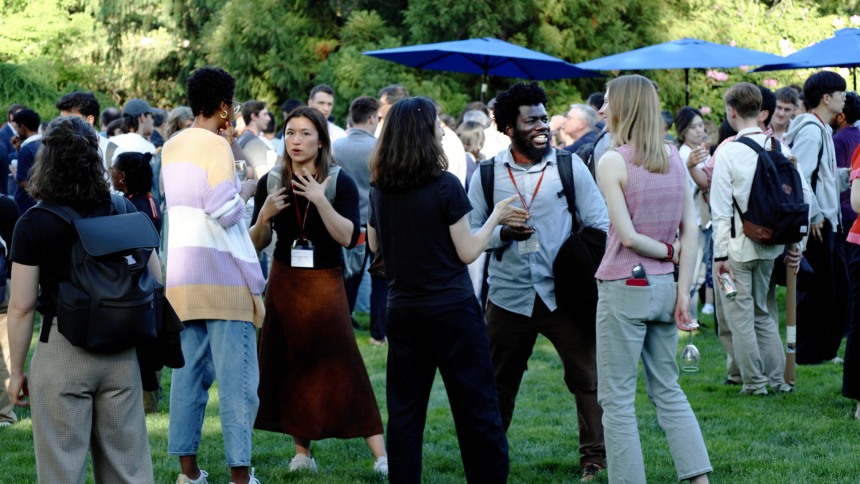
The sold-out event featured 53 invited speakers and 220 poster presentations. A total of 468 people participated in person, with another 219 joining virtually, making it the most well-attended CSHL Symposium since before the pandemic.
CSHL’s 90th Symposium on Quantitative Biology was organized by Meetings & Courses Program Executive Director David Stewart, President Bruce Stillman, Associate Professor Peter Koo, and Professor Zador. Support was provided by Google DeepMind, Protocol Labs, Noetik, Calico, and Amazon Bio Discovery, with additional contributions from corporate sponsors Amgen, New England Biolabs, and Novartis.
To find out more about AI in biology, watch the 90th Symposium playlist.
Written by: Samuel Diamond, Senior Communications Strategist | [email protected] | 516-367-5055
Sign up for our newsletter to get the latest discoveries, upcoming events, videos, podcasts, and a news roundup delivered straight to your inbox every month.
Newsletter Signup
June 1, 2023
June 11, 2024
May 22, 2025
516-367-8800
[email protected]
1 Bungtown Rd, Cold Spring Harbor, NY 11724
Get Directions
Get the latest discoveries, upcoming events, videos, podcasts & a news roundup delivered straight to your inbox every month.
© 2026 Cold Spring Harbor Laboratory. All Rights Reserved.
Sitemap | Privacy Policy | Web Accessibility
AI goes biological at 90th CSHL Symposium – Cold Spring Harbor Laboratory

Leave a Comment