




Jack Thompson, Associated Press Jack Thompson, Associated Press
Sibi Arasu, Associated Press Sibi Arasu, Associated Press
Fabiola Sanchez, Associated Press Fabiola Sanchez, Associated Press
Leave your feedback
DAKAR, Senegal (AP) — When Senegalese farmer Abou Sow first watched U.S. missiles strike Iran on social media, he had a sinking feeling it would soon affect agriculture in the West African nation. Since the war began on Feb. 28, fertilizer prices have risen by 40%.
Sow was better prepared than most. Eight years ago, he gave up chemical fertilizers for organic compost and other natural sources. He now rallies farmers in Senegal to buy manure from local herders and gives advice on how to make a rich compost, picking out wriggling worms – a healthy sign.
READ MORE: Iran war has U.S. farmers worried about the cost and availability of fertilizer
“We can’t afford to wait for a ceasefire,” Sow said. “It’s risky to depend on chemical fertilizers.” Iran’s grip on the Strait of Hormuz has affected the supply of natural gas, essential for making chemical fertilizer, as well as global shipping.
The Gulf region produces 30% of globally traded chemical fertilizer, according to the International Food Policy Research Institute, and global prices have increased by 50%, according to the World Bank’s fertilizer price index.
“The clock is ticking very hard,” said Maximo Torero, chief economist at the U.N.’s Food and Agriculture Organization, as concerns grow about food security.
Experts say a shift away from chemical fertilizer could have wider benefits, as its production and usage create significant greenhouse gas emissions, the main driver of climate change.
Natural fertilizers, by contrast, can sequester carbon in the soil and create fewer problems like runoff that can pollute waterways.
“It’s good for the planet because you’re weaning food production off fossil fuels,” said Susan Chomba, member of the International Panel of Experts on Sustainable Food Systems, a think tank.
Senegal annually imports 125,000 tons of fertilizer. The minister of agriculture, Mabouba Diagne, has said the state sourced enough chemical fertilizer for the current season, but farmers said it is increasingly difficult to find.
Farmer Aliou Fall blamed U.S. President Donald Trump for the soaring fertilizer costs. “He brings war to the world and he doesn’t even think about it. Now farmers are suffering,” Fall said.
Annually, Sow applies six tons of compost instead. He said he is fortunate to be near a town where manure is plentiful because residents rear sheep for religious holidays.
In rural areas and remote fields, however, it is challenging to source and transport large quantities of manure, and Sow fears that some people will abandon their fields in this difficult time.
READ MORE: Already under financial pressure, farmers squeezed further by tariffs and Iran war
One alternative is the industry in biofertilizers, products containing bacteria and other microorganisms to help plants absorb nitrogen, a crucial nutrient for growth, from the air and soil. A growing number of companies in Africa make industrial quantities of compost with municipal waste, decomposing food waste into fertilizer.
Senegal’s government announced in April it would subsidize and distribute 30,000 tons of organic fertilizer products to help farmers. Sow said that’s not enough.
Governments around the world spend $700 billion annually on agricultural subsidies according to the Organization of Economic Co-operation and Development, with a large share spent on providing chemical fertilizer. Chomba said that makes alternatives more expensive and less competitive.
“You’re incentivizing the wrong sort of products,” she said.
Brazil is a leading exporter of soybeans, coffee, sugarcane, beef and poultry. But the nation imports over 80% of its fertilizer, said Joana Colussi, assistant professor of agricultural economics at Purdue University.
The price of fertilizer has increased by 50% since the Iran war began, according to Luis Barbieri, founder of the Folio Institute, a Brazilian organization that connects farmers, scientists and researchers.
“Whenever we have a war, farmers’ use of biofertilizers is turbocharged,” Barbieri said.
Despite the widespread adoption of chemical fertilizers in Brazil in the 1970s, they are less effective in the tropical climate because high rainfall and high temperatures cause runoff.
WATCH: Farmers warn of food price spike as war drives up fuel and fertilizer costs
The biofertilizer sector grew 15% in Brazil from 2023 to 2024, according to the state-run Brazilian Agricultural Research Corporation, Embrapa. And patent laws mean that farmers can make their own biofertilizers at much lower cost.
In Mexico, however, very little progress has been made due to government subsidies promoting chemical fertilizer use and a lack of funding for alternatives, said Gerardo Noriega, a research professor at the Autonomous University of Chapingo and one of the country’s leading advocates for organic fertilizers.
But he suggested the current crisis “may force (farmers) to adopt organic fertilizers more quickly than they had imagined.”
In India’s southern Indian state of Telangana, Manohara Chari has been making jivamrita, a potent mix of cow dung, urine, flour, soil and sugar to replace the chemical fertilizer he used to apply.
“We do not depend on companies,” said Chari, one of 1.7 million farmers in Telangana and Andhra Pradesh states who have shifted to natural farming, which embraces natural fertilizers, integrates livestock waste and plants a diversity of crops to improve soil health.
Farmers and experts say the Iran war and chemical fertilizer shortage make the approach more attractive. On May 10, Prime Minister Narendra Modi announced a “national mission” to adopt natural farming and cut fertilizer use by 50%.
India imports 60% of its fertilizer from the Gulf. The government has rushed to source supplies and subsidized it to keep prices low, at significant expense to the state.
“There’s certainly been more interest this year in natural farming, especially after the Middle East conflict began,” said G.V. Ramanjaneyulu, agricultural scientist at the Center for Sustainable Agriculture. Some farmers have dedicated part of their land to assess the approach.
The switch requires additional labor, and farmers face a transition period. Chari said the government could help instead of subsidizing chemical fertilizers: “If even a fraction of that support is given to natural farmers, more people will shift towards it.”
___
Arasu reported from Bengaluru, India, and Sanchez from Mexico. Mauricio Savarese in São Paulo, Brazil contributed.
Support trusted journalism and civil dialogue.
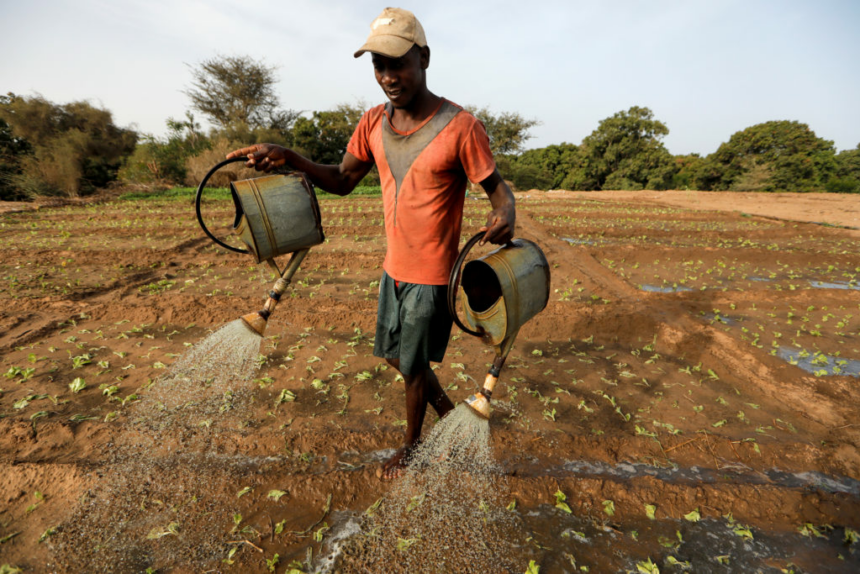
Left: A farm worker manually irrigates a salad field, amid the outbreak of the coronavirus disease (COVID-19), In Thies, Senegal June 3, 2020. Picture taken June 3, 2020. File photo by Zohra Bensemra/Reuters
By Josh Kelety, Associated Press, Eric Ferkenhoff, Lee Enterprises
By Aniruddha Ghosal, Allan Olingo, Associated Press
By Associated Press
By Jack Dura, Associated Press
By Associated Press
Jack Thompson, Associated Press Jack Thompson, Associated Press
Sibi Arasu, Associated Press Sibi Arasu, Associated Press
Fabiola Sanchez, Associated Press Fabiola Sanchez, Associated Press
Support Provided By: Learn more
Subscribe to Here’s the Deal, our politics newsletter for analysis you won’t find anywhere else.
Thank you. Please check your inbox to confirm.
© 1996 – 2026 NewsHour Productions LLC. All Rights Reserved.
PBS is a 501(c)(3) not-for-profit organization.
Sections
About
Stay Connected
Subscribe to Here’s the Deal with Lisa Desjardins
Thank you. Please check your inbox to confirm.
Support for News Hour Provided By
Farmers seek fertilizer alternatives as Iran war drives up prices – PBS



Leave a Comment

