


The government has allocated Rs2.27 billion for the Ministry of Women, Children, Gender and Sexual Minorities, and Social Security for the upcoming fiscal year 2026-27. The allocation is up from Rs2.08 billion in the current fiscal year, an increase of about Rs200 million.
Presenting the federal budget on Friday, Finance Minister Swarnim Wagle announced a series of programmes targeting Dalit communities, persons with disabilities, women, senior citizens and street children.
The government has doubled the child nutrition allowance for Dalit children under five across the country to Rs1,000 per month. A total of Rs3 billion has been allocated for the programme.
Wagle said the scheme, currently implemented in 25 districts across Madhesh, Karnali and Sudurpaschim provinces, will be expanded nationwide. These districts are among those with the lowest human development indicators in the country.
The programme is implemented through local governments and reaches households with up to two Dalit children per family via direct bank transfers.
Public health specialist Aruna Uprety said the expansion is positive but raised concerns over implementation and monitoring. She said several government-led programmes have struggled due to weak follow-up mechanisms, citing earlier initiatives in Karnali and the “Beti Bachau, Beti Padhau” campaign in Madhesh Province.
She said misuse of funds at the household level and weak oversight by local governments remain key challenges. She also said there is limited tracking of children’s nutrition outcomes, adding that in some cases, families spend cash support on unhealthy processed food rather than nutrition-improving diets.
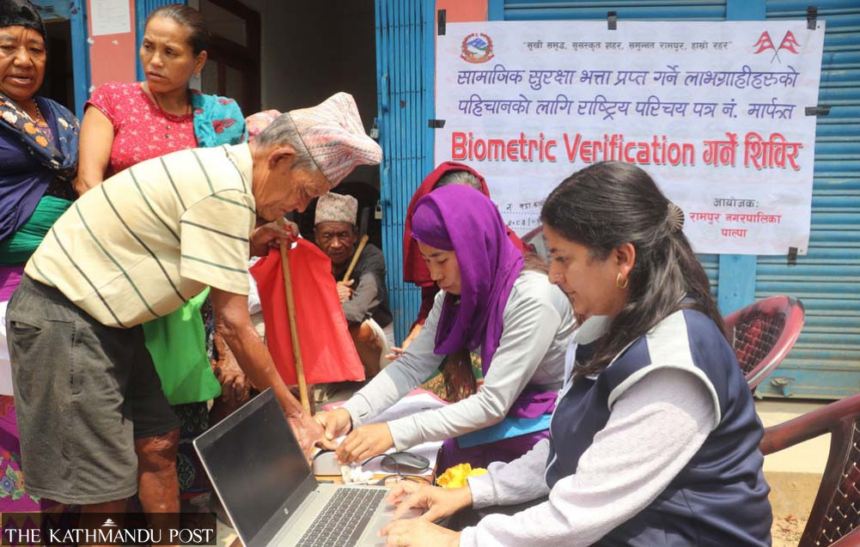
The government has kept the old-age allowance unchanged despite earlier discussions on raising the eligibility age or revising benefit structures.
Currently, single women and senior citizens in Karnali receive the allowance from the age of 65, while all other regions receive it from the age of 70, at Rs4,000 per month. The programme was first introduced in the fiscal year 1995-96 with a monthly allowance of Rs100 for senior citizens.
The ‘good governance roadmap committee’ had earlier recommended raising the eligibility age to 75 years.
Founder of Ageing Nepal, Krishna Murari Gautam, said the real value of the allowance has remained flat due to inflation and rising living costs. He said that while cash support has not increased, government steps to expand insurance coverage and geriatric staffing are positive.
The ministry said it will draft an integrated bill on gender-based violence prevention and implement programmes in coordination with provincial and local governments for the rehabilitation and family reunification of street children and senior citizens.
It has also announced plans to strengthen Dalit-focused investments by integrating traditional skills preservation, income generation and technology upgrading programmes.
Nationwide campaigns will be launched against caste-based discrimination, child labour, gender-based violence, sexual abuse, chhaupadi, menstrual discrimination and child marriage through all three tiers of government.
Accessibility of public offices, digital platforms, government websites and software will be improved for persons with disabilities. Rehabilitation centres will be established in all provinces, and model residential schools for children with autism will be set up.
The government also plans to integrate gig workers into the formal labour and social security system.
A total of Rs120 billion has been allocated for social security programmes aimed at protecting citizens from life-cycle risks. The government has set a target of declaring Nepal a street-children-free nation.
Rs310 million has been allocated for juvenile correction centres, while separate funding has been set aside for air rescue of pregnant women, new mothers and newborns in remote areas.
Despite the creation of a dedicated ministry for gender and sexual minorities, activists said the community continues to be sidelined.
Queer activist Chesang Ghising said government agencies often cite low population figures as a reason for limited budget allocation, while many transgender and queer people remain excluded due to classification issues in citizenship documents.
He said many individuals are not included in official data because their citizenship documents list them as male or female, rather than under the ‘other’ category. He called for an inclusive census conducted in consultation with the community.
“If they think our population is not enough, the government should consult us and conduct a proper population study,” he said.
He added that until accurate data is collected, gaps in budget allocation and repeated policy debates will continue.
The budget has proposed a social integration programme aimed at ensuring dignified living conditions for the community.
However, Queer activist Birat Bijay Ojha said the budget felt incomplete.
He said the symbolic recognition of the ministry was not matched by a dedicated budget for the LGBTIQ community.
“Without a budget, what work will be done for us? Will it just remain a cosmetic change?” he said.
Ojha said government action often remains symbolic rather than substantive, with limited representation of the community in policymaking processes.
“It is a recurring pattern that the government makes symbolic gestures but does not come with concrete interventions,” he said. “We are used to having limited access to the state.”
He added that a stronger representation of community voices in policymaking would be necessary to improve outcomes.
Aarya Chand is a reporter at The Kathmandu Post covering social issues. Before moving to the social beat, Chand was an intern covering culture and lifestyle for the Post.