


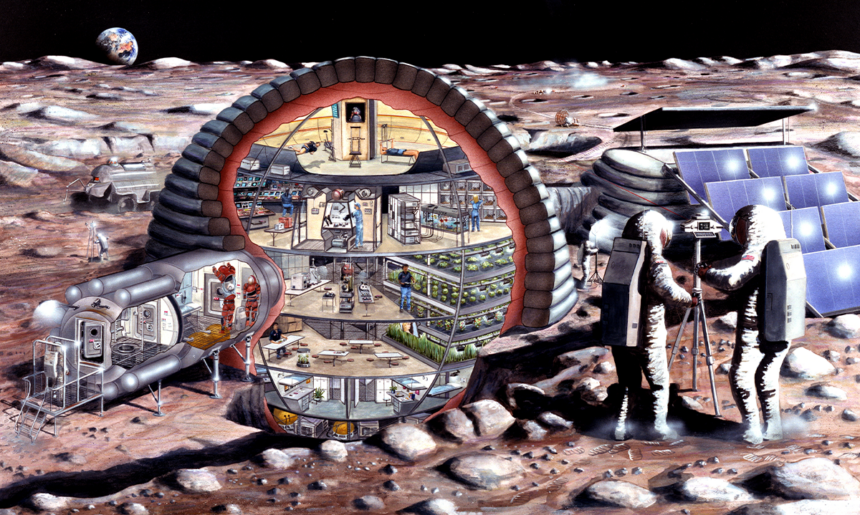
With NASA recently detailing its plans for a lunar settlement, here’s a look at how that concept has taken shape through history
5:00 PM CDT on May 28, 2026
The idea of lunar habitation is having a moment. But United States government officials have been thinking about the possibility of erecting a moon base for longer than you might suspect. Yes, NASA did lay out its most current plans for a habitable lunar facility this week. But NASA and other U.S. entities have been dreaming of housing humans on (and under!) the surface of the moon since the late 1950s.
The earliest plans for a moon base came from the U.S. Air Force, which envisioned the Lunex Project in 1958. Predating the Apollo Program, which eventually landed the first humans on the lunar surface in 1969, Lunex sought to establish an underground Air Force base on the moon by 1967-68 that could house 21 people. While crude drafts of the Lunex Lunar Lander survive, the project was eventually abandoned, as was 1959’s Project Horizon, a similar concept from the U.S. Army to establish a fort on the moon by 1967.
After the space race was won by NASA and Apollo, plans for a moon base were revived in the 1980s with the agency’s feasibility study of building an 18-person lunar outpost by sometime between 2005 and 2015. Like its predecessor concepts, the so-called Johnson Space Center Moon Base never came to fruition. But NASA would not be deterred from its dreams of lunar habitation.
Read more: “Should People Live on the Moon?”
And the next effort to imagine a moon base gave birth to the most interesting conceptual mockups of such a structure. From 1989-1993, NASA embarked on the Space Exploration Initiative at the behest of then-president George H.W. Bush, who kicked off the program in a speech on the steps of the National Air and Space Museum in Washington, D.C., on July 20, 1989, the 20th anniversary of the Apollo 11 moon landing. The decade-long effort would construct a base of operations on the moon that would facilitate “a journey into tomorrow—a journey to another planet—a manned mission to Mars,” Bush said.
The Space Exploration Initiative, which was mothballed by Bill Clinton shortly after he took office, did spawn some beautiful drawings of what a moon base and associated vehicles might have looked like if the program would have continued.
NASA has conducted additional feasibility studies and generated more conceptual mockups between then and now, and the current plan, which is part of the Artemis program, seeks to send humans back to the moon by early 2028. Then, the fixed Foundational Surface Habitat of the Artemis Base Camp is scheduled to come online, with the help of private space companies, sometime in the 2030s. If and when we see a base rise from the moon’s dusty soil (regolith, for you lunerds) it will be built on decades of ideation and experimentation. 
Enjoying Nautilus? Subscribe to our free newsletter.
Lead image: NASA / Cicorra Kitmacher
Sign up for our free newsletter
Gravitational waves point to a multifaceted assembly line for the cosmic oddities
Centuries before we started debating the transformative effect of AI on science, a new light in the sky shone the way
The spacecraft took a much-need detour en route to the asteroid of the same name
And see a vision of the past
It’s been 36 years since it beamed back the first glimpses of our universe from space
The crewman captured the light show while waiting on a supply craft
Sign up for our free newsletter
© Copyright 2026
Made in partnership with Lede