


May 26, 2026 | written by Sanjukta Mondal | edited by Robert Egan
Associate Editor
Author
This article has been reviewed according to Science X’s editorial process and policies. Editors have highlighted the following attributes while ensuring the content’s credibility:
fact-checked
peer-reviewed publication
trusted source
proofread
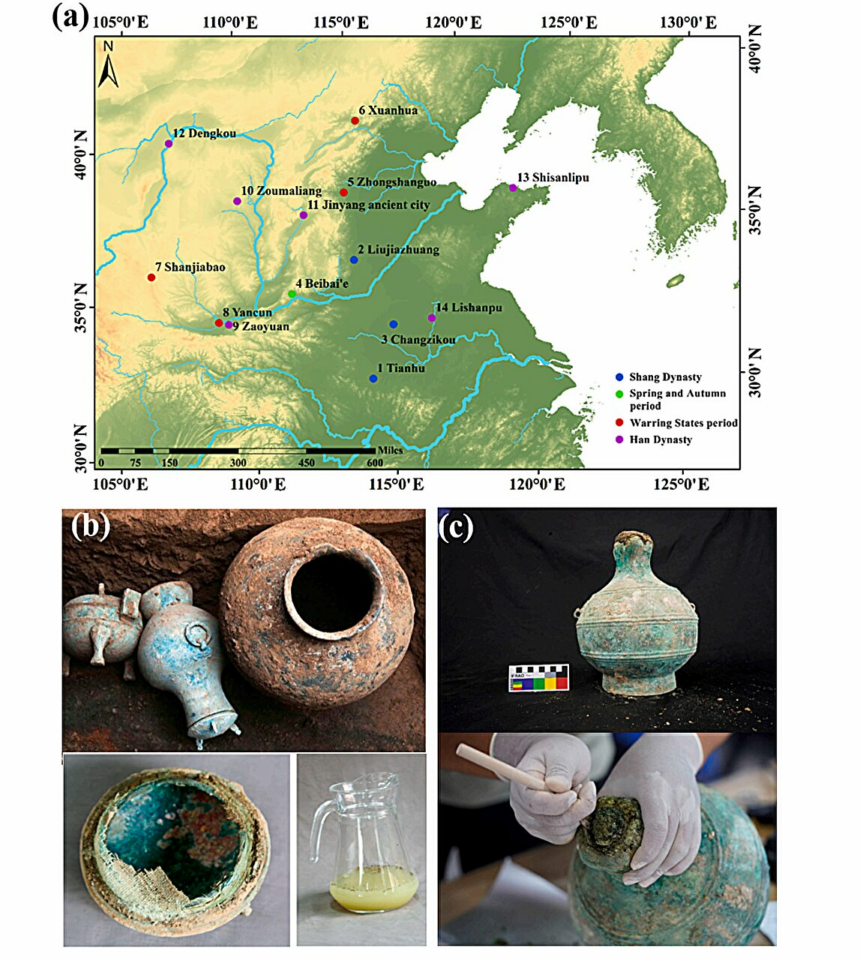
Deep inside a tomb located at the edge of the Shanjiabao cemetery in China, researchers found a tightly sealed bronze bottle with a unique garlic-shaped mouthpiece. Inside the vessel was a mysterious liquid that had sat untouched for more than 2,000 years, which turned out to be a cereal-based alcoholic drink. The chemical analysis laid out the following clues: the liquid contained high levels of lactic and oxalic acid, but barely any tartaric acid. This told the researchers that the alcoholic liquid wasn’t a fruit wine, but a drink brewed from grains.
When they took a closer look at the liquid using high-resolution microscopes, they saw hundreds of thousands of tiny grain particles, some of which they identified as broomcorn millet, wheat and barley. They also found yeast cells floating in the liquid, which indicated that it had long been used to kick-start the fermentation for the brewing process.
The findings are published in the Journal of Archaeological Science: Reports.
China’s alcohol brewing practices date back to the Stone Age. The oldest evidence of alcoholic drinks uncovered to date was found at the Shangshan site in Zhejiang Province and was 9,000–10,000 years old.
A combination of living practices, literary and archaeological evidence tells us that Chinese brewers used two main methods: the nie technique that uses sprouted grains as a starter, and the qu method that uses moldy grains or herbs. While the preferred grain of the north was broomcorn millet, the south favored rice.
For years, scientists studying ancient Chinese alcohol had to rely on faint residues left in pottery rather than the drinks themselves, leaving many details about early brewing methods and traditions unclear.
The excavation at the Shanjiabao cemetery, where archaeologists uncovered 183 tombs dating to the Warring States period (475–221 BC), struck an unexpected jackpot: a bronze bottle still holding 3,740 mL of clear, light blue-green odorless liquid, with a small layer of sediment resting at the bottom. The researchers believe that the liquid was well-preserved due to a two-layer sealing method using textile and a sticky substance called daub.
The researchers collected some of the liquid and the sediment for chemical fingerprinting, organic acid quantification using Fourier transform infrared (FTIR) spectroscopy and mass spectroscopy techniques. The researchers took six modern alcoholic beverages—two grape wines and four grain-based rice wine, huangjiu—and aged them with heat for 180 days to act as reference samples to see how their chemical signatures changed over time.
The scientists analyzed the drink’s chemical signatures and fed the results into a machine-learning model, which compared them against a database of more than 2,000 samples. The verdict was that the ancient liquid was indeed an alcoholic beverage. Apart from detecting high levels of lactic and oxalic acids, which are common in grains, the chemical analysis also identified over 2,400 organic compounds, including amino acids and sugars.
Microscopic analysis uncovered more than 100,000 starch grains, whose size and shape allowed scientists to identify the crops used in the drink. The results showed it was brewed mainly from broomcorn millet (92%), with smaller amounts of wheat or barley (8%). They also spotted over 8,500 yeast cells, providing further evidence that the liquid had been fermented into alcohol.
The wheat and barley grains showed signs of physical damage, suggesting they were ground and heated. This indicated that the brewers during the Warring States period used the qu technique, which is a traditional way of making a fermentation starter.
The findings reveal exactly which grains, the flavor profiles hidden in chemical signatures and the possible brewing technique, which brings us one step closer to understanding the full story of brewing technology used by the Qin people of ancient China. Guided by these findings, experts may find ways to better preserve cultural heritage and apply ancient brewing knowledge to modern craft brewing and heritage foods.
Ruru Chen et al, Decoding alcoholic beverage and brewing practices of the Qin state during the Warring States period (475-221 BC) based on archaeological evidence, Journal of Archaeological Science: Reports (2026). DOI: 10.1016/j.jasrep.2026.105738
© 2026 Science X Network
Science X news — your source for the latest and most interesting science updates. Follow us on Google News for updates, or set sciencex.com as your preferred source for more science stories.
Written for you by our author Sanjukta Mondal, edited by Robert Egan—this article is the result of careful human work. We rely on readers like you to keep independent science journalism alive. If this reporting matters to you, please consider a donation (especially monthly).
Master’s in Chemistry. Freelance science journalist and communicator. Published in Chemistry World, BioSpace, and The Hindu. Full profile →
Bachelor’s in mathematical biology, Master’s in creative writing. Well-traveled with unique perspectives on science and language. Full profile →
May 26, 2026
May 26, 2026
May 25, 2026
Thank you for taking your time to send in your valued opinion to Science X editors.
You can be assured our editors closely monitor every feedback sent and will take appropriate actions. Your opinions are important to us.
We do not guarantee individual replies due to extremely high volume of correspondence.