


Covering Pandemic and Seasonal Flu, Emerging Infectious Diseases, public health, community & Individual preparedness. NOTE: All AFD blogs are written by a human – any mistakes are solely mine.
#19,178
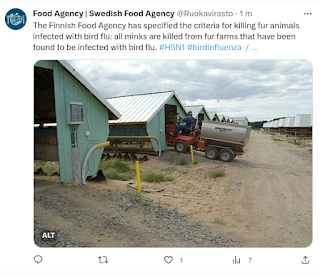
In 2023 Finland’s fur industry was hit hard by HPAI H5N1, with more than 70 fur farms infected, and > 500,000 animals culled. After an uncertain start, the Finnish Food Agency ordered an aggressive quarantine and culling program, which was strongly opposed by the fur industry.
Following on the heels of a mink-variant COVID outbreak in 2020, these HPAI outbreaks also brought renewed calls for the banning of the fur trade in the EU, and around the globe.
Although outbreaks reports from fur farms declined by the end of 2023, this epizootic – combined with increasing avian flu activity around the globe – led the EU to order a significant quantity of H5 vaccine the following summer.
(Continue . . . )
While the intent was to store these doses for use in a future outbreak, the EU carved out 20,000 doses for immediate use in Finland; specifically for the vaccination of high risk fur farmers (see Finland: MOH Announcement On Avian Flu Vaccine Availability For People At High Risk).
They call it the `most unexpected barrier’, but to anyone who has spent any time online – or actually talking to the public over the past 20 years – it can’t have been that unexpected.
This report is based in large part on 17 interviews, of which only one was actually a farmer (poultry). Since no fur farmers were willing to talk to these researchers, many of their conclusions are – by necessity – based on 3rd-party assessments.

Despite these limitations, this is a fascinating look at the growing chasm between governmental expectations and the public’s willingness to cooperate. I’ve only posted some excerpts, so follow the link to read it in its entirety.
I’ll have a bit more after the break.
(SNIP)
3.3. Trust and political tensions
(SNIP)
(SNIP)
(Continue . . . )
Although most of this is ginned up out of whole cloth by clickbait videos and deranged social media posts, some of this mistrust has been rightfully earned (see When Scientists Behave Badly).
When the next global public health threat begins its world tour, governments and health agencies are going to be desperate to find some way to regain the trust – and cooperation – of the public.
And right now, that’s not a battle they appear to be even close to winning.