By using this site, you agree to the Privacy Policy and Terms of Use.
Accept
Global News TodayGlobal News TodayGlobal News Today
  • World
  • Politics
  • Business
  • Technology
  • Science
  • Entertainment
  • Sports
  • Health
Reading: Henry C Fung: Today, It is Time for the Quiet Architect of Myeloma Biology – Trisomies – Oncodaily
Share
Notification Show More
Font ResizerAa
Global News TodayGlobal News Today
Font ResizerAa
  • World
  • Politics
  • Sports
  • Business
  • Science
  • Technology
  • Entertainment
  • Home
    • Home 1
    • Home 2
    • Home 3
    • Home 4
    • Home 5
  • Demos
  • Categories
    • Technology
    • Business
    • Sports
    • Entertainment
    • World
    • Politics
    • Science
    • Health
  • Bookmarks
  • More Foxiz
    • Sitemap
Have an existing account? Sign In
Follow US
  • Advertise
© 2022 Foxiz News Network. Ruby Design Company. All Rights Reserved.
Science

Henry C Fung: Today, It is Time for the Quiet Architect of Myeloma Biology – Trisomies – Oncodaily

Editorial Staff
Last updated: May 26, 2026 3:47 am
Editorial Staff
6 hours ago
Share
SHARE

Henry C Fung, Chair and Professor, Department of Bone Marrow Transplant and Cellular Therapy at Fox Chase Cancer Center, shared a post on X:
“We had talked about t(11;14), t(4;14), t(14;16) and even myc.
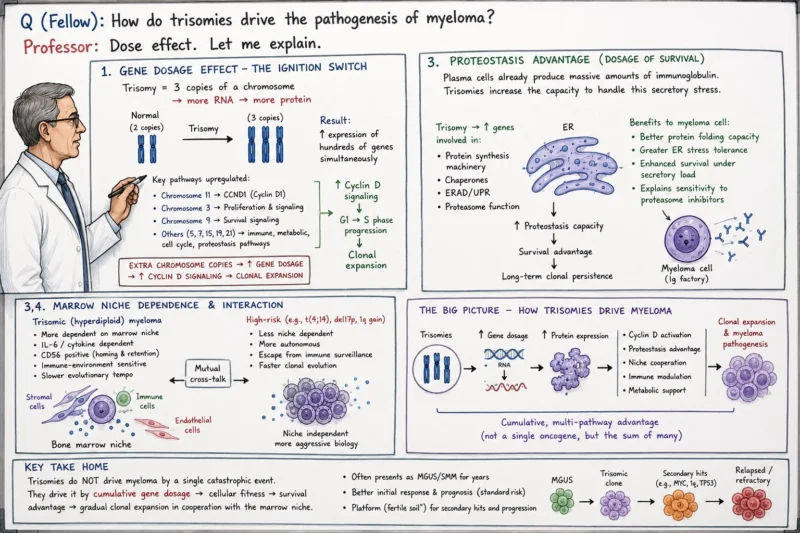
Today, it is time for the quiet architect of myeloma biology: TRISOMIES.
Not one dominant oncogene. Not genomic explosion. Just extra chromosomes – slowly turning up the volume of hundreds of survival genes at once.
Gene dosage. Cyclin D signaling. Proteostasis advantage. Marrow niche cooperation.
A biologic orchestra rather than a single guitar solo.
This may explain why many hyperdiploid myeloma patients can remain MGUS/SMM for years before evolutionary escape occurs. In biology we trust.”
Henry C Fung
While quoting one of the previous posts:
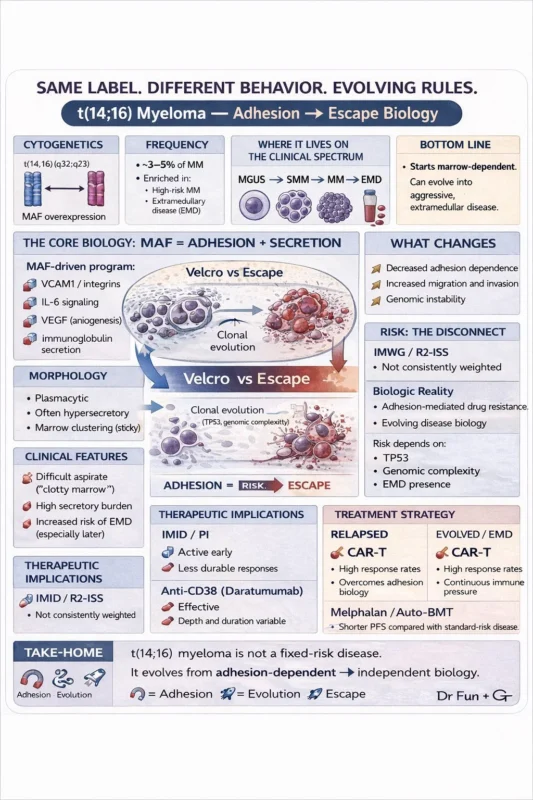
“We’ve talked about t(11;14). We’ve covered t(4;14). Today: t(14;16) myeloma.
Same disease label – Very different behavior.
Early phase (MAF-driven):
Niche-dependent biology.
-> IMiD / PI / Dara work well. But the story doesn’t end there.
With evolution:
Niche-independent biology:
-> IMiD / PI less effective
-> CAR-T & bispecifics make more sense
This is the paradox – ‘Sticky’ early… but prone to escape later.
t(14;16) isn’t just high-risk – it’s an evolving disease.
Adhesion – Evolution – Escape.
Dr. Fun + G”
Henry C Fung
Other articles featuring Henry C Fung on OncoDaily.
 
OncoDaily™ | © 2023 – 2025
All rights reserved. Unauthorized reproduction, distribution, or transmission of any content on OncoDaily.com is strictly prohibited. For permission requests or inquiries, please contact OncoDaily directly. By accessing and using OncoDaily.com, you acknowledge and agree to comply with this copyright notice, as well as our Privacy Policy, Editorial Policy, Cookie Policy, and Disclaimer. Continued use of this website constitutes acceptance of all such terms and policies.
Phone number: +1 978 717 48 84
Email: info@oncodaily.com

source

NASA releases images taken by Artemis II crew – MSN
Scientists Say Huge Dam Blocking the Bering Strait Could Slow Effects of Climate Change – Futurism
Mekorot and nT-Tao to advance pilot facility for fusion energy in critical water infrastructure – The Jerusalem Post
Weill Cornell team discovers previously unknown biological cold sensor – Fingerlakes1.com
Discovery’s ‘Naked and Afraid: Global Showdown’ airs new episode tonight – Stream for free here – MassLive.com
Share This Article
Facebook Email Print
Previous Article Iran says no deal ‘imminent’ despite progress in talks with U.S. – NBC News
Next Article Chinese Chip Stocks Rise in Hong Kong on Hopes for Huawei Tech – Bloomberg.com
Leave a Comment

Leave a Reply Cancel reply

Your email address will not be published. Required fields are marked *

  • World
  • Politics
  • Business
  • Technology
  • Science
  • Entertainment
  • Sports
  • Health
Join Us!
Subscribe to our newsletter and never miss our latest news, podcasts etc..
[mc4wp_form]
Zero spam, Unsubscribe at any time.
Welcome Back!

Sign in to your account

Username or Email Address
Password

Lost your password?