Since its founding in 1922, Foreign Affairs has been the leading forum for serious discussion of American foreign policy and global affairs. The magazine has featured contributions from many leading international affairs experts.
DAISUKE KAWAI is Project Assistant Professor and Director of the Economic Security and Policy Innovation Program at the Research Center for Advanced Science and Technology, the University of Tokyo.
Will Washington Squander Tokyo’s New Security Commitment?
Daisuke Kawai
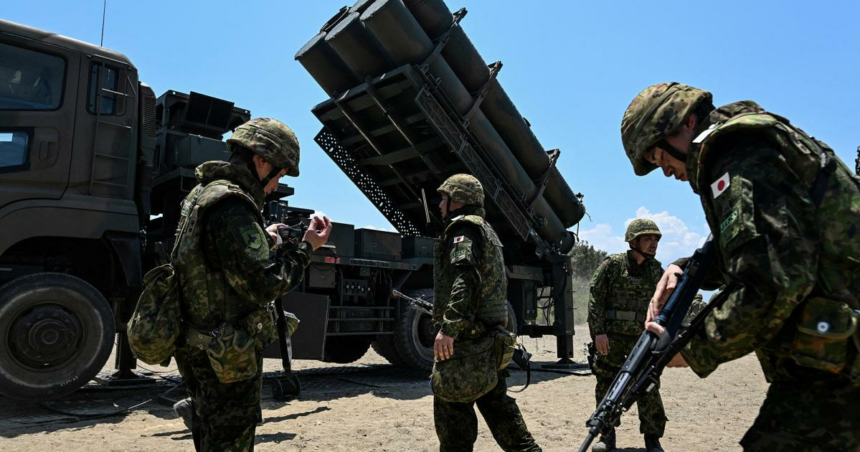
Over the last ten years, Japan has shed its pacifist identity. After promising, post–World War II, to maintain only a tiny military, Tokyo is now building up truly capable armed forces and a sizable defense industrial base. In December 2018, for example, the country announced plans to modify its Izumo-class destroyers so they could operate F-35B fighters—effectively giving Japan its first aircraft carrier since 1945—and to buy 147 F-35 fighter jets. In 2023, it allowed its companies to start selling certain offensive weapons and weapons parts. And last month, Tokyo scrapped most of the remaining limits on arms exports, including destroyers, missiles, and jets.
Japan’s pivot should be widely welcomed in Washington, which has long sought to get its wealthy East Asian ally to spend more on defense. These moves are designed to strengthen the alliance, as Japanese officials remain deeply committed to their partnership with their U.S. peers. A stronger Japan, for example, could be critical in deterring China from attacking Taiwan. Beijing is less likely to confront a coalition that features not just U.S. and Taiwanese forces but well-equipped Japanese ones, as well. And increasingly, China has to assume that Tokyo would enter a conflict over the island, meaning that any Taiwan war would involve Japanese bases, missiles, sensors, air defenses, and logistics networks, making a quick victory hard to achieve.
Still, whether Tokyo’s efforts actually end up strengthening the U.S.-Japanese partnership is an open question—and the answer is highly contingent on how Washington reacts. Ever since U.S. President Donald Trump returned to office in 2025, the United States has been casting U.S. alliances in transactional terms, the Japanese one among them. In April 2025, for instance, Trump slapped 25 percent tariffs on Japanese goods. (The two sides eventually struck a deal setting most rates to 15 percent, before the Supreme Court ruled the tariffs impermissible.) Trump also previously demanded that Japan pay roughly four times as much to the United States in exchange for continuing to host U.S. troops. He called Japan “spoiled” for “having ripped us off for 30, 40 years.” If the United States continues to lambast Japan, then Tokyo indeed might forge a more independent path. Its increased defense spending and growing strength, after all, act as an insurance policy that helps keep Japan safe in the event the United States wavers.
Washington, then, should abandon its efforts to extract as much as it can from Japanese coffers. It must instead look for ways to capitalize on Tokyo’s strength—such as by working together on military production, or better connecting their command chains in the Pacific. This might make some U.S. officials, accustomed to being by far the more powerful partner, wary. But any loss of American dominance is well worth the benefits. For years, the United States has been searching for a way to better constrain Beijing. A Japan that can hold the line early in a crisis and help the United States fight back is an excellent solution.
Japan has long toyed with the idea of shedding its pacifist posture, but its security evolution only began in earnest in 2015. That year, Japanese Prime Minister Shinzo Abe passed legislation that permitted Japan’s Self-Defense Forces to use force in limited cases of what it called “collective self-defense,” such as if an attack on the United States threatened Japan’s survival. (Previously, Japan allowed the use of force only when Japan itself was attacked.) The reform was hugely controversial at the time of passage, prompting outrage and protests. But it went into effect, and Japan has further loosened the constraints on its military in the time since. In 2017, for example, Abe signaled that Tokyo would no longer treat its informal one-percent-of-GDP ceiling on defense spending as inviolable. In 2018, Japan created the Amphibious Rapid Deployment Brigade, a marine-style unit designed to defend and retake remote islands. And Japan’s 2022 National Security Strategy and Defense Buildup Program committed the country to acquiring counterstrike capabilities, including longer-range missiles.
No one seems more committed to this shift than Japan’s current prime minister, Sanae Takaichi. An Abe protégé, Takaichi took office last October and wasted little time expanding Japan’s military posture. On November 7, she told the Japanese parliament that a Chinese attack on Taiwan could threaten Japan’s survival, signaling more clearly than any of her predecessors that Tokyo might use military force under the 2015 security laws if an assault on the island occurred. In response, a furious Beijing accused Takaichi of trying to return Japan to its colonial past and warned that the country would face serious consequences if it failed to retract the statement. Takaichi refused. China then acted on parts of its threat, discouraging Chinese citizens from traveling to Japan and suspending imports of seafood from Japan. It restricted exports of dual-use items to Japanese military entities, going as far as to threaten legal action against organizations or individuals outside of China that provided Chinese-origin dual-use items to Japan, and later placed dozens of Japanese listed companies and organizations on export-control lists and watch lists. In December, according to Japanese officials, Chinese fighter jets even locked fire-control radars on Japanese military aircraft. Takaichi has stood firm, and her refusal to back down appears to have boosted her popularity.
The outcome of this spat illustrates the paradox of Chinese coercion: the harder Beijing tries to crack down, the more it faces blowback. (Other governments, including Australia, India, and Taiwan, have also come under mounting Chinese pressure for criticizing Beijing and have also responded by holding firm.) Tokyo is now set to spend roughly two percent of its GDP on defense by 2027, and it is strengthening security on its southwestern islands by adding missile units, air defenses, ammunition depots, fuel stores, hardened shelters, and facilities that allow aircraft and ground units to disperse across the Ryukyu Islands. It is investing in munitions stocks, expanding unmanned systems, and loosening constraints on exports and defense industrial cooperation so that Japanese companies can build with partners, such as manufacturers in the United States, rather than merely buying from them.
Japan is no longer loosening restraints around the edges or making one-off purchases; it is transforming its entire defense posture. Takaichi’s successors could slow some programs or reorder some priorities, but reversing the overall trajectory of Japan’s buildup is nearly impossible. It would require canceling multiyear procurement contracts, shrinking production lines, undoing new export rules, and weakening units and bases that are being built across the country’s southwest. Moreover, given the popularity of these reforms, the country is unlikely to elect leaders who want to undo them. The debate in Tokyo among most politicians is no longer about whether Japan should bolster its own security; it is about how quickly it should do so.
Japan’s efforts are the natural response of a state squeezed by Chinese coercion. But they are also the response to fears of a possible U.S. pullback. The country is not trying to replace the United States as the region’s security provider; it is aiming to help prevent or contain a regional crisis in which Washington might hesitate—or decide that the costs of supporting its allies are too high. For Tokyo, such protection is particularly essential given its proximity to East Asia’s most dangerous flashpoints and critical supply chain chokepoints.
Tokyo’s efforts are also particularly essential because a Taiwan crisis might begin with a Chinese effort to split U.S. and Japanese decision-makers. As a prelude to a blockade or outright assault, Beijing might choke off access to the industrial inputs required to sustain deterrence: rare earths, specialty materials, sensors, drone components, semiconductor-related tools, and dual-use technologies used by both civilian industry and defense producers. That pressure could push Japan and the United States in different directions. Tokyo might feel compelled to act quickly to protect its territory, keep sea lanes open, and prevent a fait accompli around Taiwan or the East China Sea. U.S. officials, by contrast, might hesitate if intervention threatened the American economy or disrupted supply chains on which U.S. industry depends. Japan’s current efforts are an answer to that problem. By expressly committing itself to Taiwan and building up its military, Tokyo is signaling that it will not shy away from defending the island even if the United States hesitates. And by deepening day-to-day operational coordination with the United States—through more complex joint exercises, expanded intelligence sharing, and closer planning between the Self-Defense Forces and U.S. Forces Japan—Tokyo hopes to make sure Washington will ultimately get involved, too.
There are limits to how much protection Japan can offer its neighbors if the United States decides to do nothing. The goal of its recent changes is not to make Japan a regional superpower but simply to buy time. These steps could help ensure that China cannot roll over Taiwan or seize Japanese-administered territory as a fait accompli. In a crisis over Taiwan or the East China Sea, initial military posturing will matter tremendously. If Japan can keep airfields in the Ryukyus and main islands operational, disperse forces, sustain munitions, protect ports, and maintain communications before U.S. help arrives, China will have much more trouble scoring the kind of quick, decisive victory it may need. In fact, if Beijing simply believes that Tokyo can do all these things—and support eventual U.S. operations while defending its own territory—China may not make any attempt at its neighbor.
As a result, some of Japan’s most consequential investments have been in munitions, fuel, maintenance and repair supplies, shelters, logistics vessels, cyber-resilience, and other kinds of protective hardware and software. Although these kinds of investments may not make dramatic headlines, they determine whether a military can function when a crisis breaks out. Critics of Japan’s security pivot worry that these steps, although mostly defensive, will increase the risk of escalation. If Japan’s new capabilities are poorly coordinated with the United States, governed by unclear rules of engagement or imprecise role-sharing, they might. But so long as Japan builds up its forces as a complement to American power, and not a replacement for it, this buildup is unlikely to spur an attack from Beijing. In fact, doing nothing is more likely to prompt a conflict. If Japan appears weak and indecisive, after all, Beijing will be more tempted to test it.
Tokyo has also sought to strengthen deterrence by building stronger diplomatic and operational networks. Its alliance with Washington will always be at the center of its security strategy, but Japan’s government is now working more closely with Australia, India, European states, Southeast Asian states, and even South Korea—which has typically had tense relations with its former colonial master. These relationships make it harder for China to isolate Japan by creating more channels for Tokyo to plan with partners, conduct joint training to improve the readiness of Japan’s Self-Defense Forces, and diversify supply chains to bolster trade. Its partners, in turn, gain a measure of protection themselves. To them, a more capable Japan is not a threat but a ballast—a source of resources and technology, of military training and coast guard support, and of the industrial capacity that helps underpin defense manufacturing. Japan’s security buildup is therefore bigger than a bilateral story about Tokyo and Washington or Tokyo and Beijing. It is part of a global security rebalancing.
Japan’s new economic relationships are particularly essential for its partners. Tokyo knows that it is not the only country China has tried to coerce with economic restrictions, and it is aware of just how much more havoc Beijing can wreak by weaponizing economic interdependence. China, for example, dominates the mining and, particularly, refining of rare earths and various other important military materials. Its January and February export controls, which restricted exports of dual military-civilian-use goods, underscored how quickly economic dependencies can become tools of coercion.
Nevertheless, Tokyo is well placed to mitigate much of this danger and help other countries do so, as well. It plays a central role within the high-tech production networks that sustain global supplies of semiconductors, batteries, advanced manufacturing, robotics, and other defense materials. With credibility in Southeast Asia and Europe as well as in the United States, Japan can help these countries redesign and retool their supply chains when they come under duress. Tokyo can therefore help prevent the kind of expensive redundancies that might occur if these states rush to fortify their supply chains separately, rather than working together.
Tokyo’s strategic decisions are designed to benefit Washington. Yet the United States risks squandering Japan’s assistance. That is because Washington suddenly appears uninterested in its partners’ well-being. Instead, it seems more concerned with extracting financial concessions from them. Trump, for instance, insisted that if the United States’ NATO allies did not pay more for their own security, then the United States was “not going to defend them,” and his attempts to institute universal tariffs ignored long-standing, mutually beneficial U.S. trade partnerships. This approach is self-defeating. Linking security commitments to bilateral tariffs, technology carve-outs, or unrelated commercial concessions gives allies a reason to look for markets, financing channels, and supply routes that do not run through the United States.
Thus far, Japan has largely stood by Washington despite this extraordinary behavior. Nonetheless, if U.S. officials do not change course, Tokyo could use its greater capacity to bargain harder and shape more of its security policy beyond Washington’s direct influence. By shifting more defense procurement and codevelopment toward Australia and Europe, Japan would create stockpiles and supply chains that circumvent the United States and its manufacturers. Tokyo could start resisting higher host-nation support payments and coordinate more regional planning through multilateral forums that do not involve Washington. These acts would not make Japan anti-American, but they would leave the United States with less influence over Tokyo.
Washington, then, must stop pressuring Japan. Instead, it needs to work more closely with its ally. It can start by treating the country’s military investments as moves toward improved burden sharing—which is, of course, what they are. It could then work with Japanese officials to build an allied supply chain that helps strengthen both states. The two countries could use their joint manufacturing capacity, for example, to coproduce key systems such as missiles, air-defense interceptors, uncrewed vehicles, sensors, ship-repair capacity, and space-based maritime awareness technologies. They could also create shared stockpiles for munitions and critical materials. This would make it harder for China to intimidate either country or drive a wedge between them.
U.S. policymakers ought to also improve communications channels with their Japanese counterparts. The two governments should, in particular, invest in clearer pathways for joint decision-making so that they can make quick and effective choices in the event of a crisis. It behooves the U.S. military to rehearse emergency scenarios with Japan’s Self-Defense Forces, connect the upgraded U.S. Forces Japan headquarters to Japan’s Joint Operations Command, and construct joint mechanisms for managing escalation. As part of doing so, Washington should encourage Tokyo to keep its channels with Beijing open, especially when relations get tense.
As China becomes more aggressive and coercive, Japan will keep expanding its defense apparatus. For the United States, this is an opportunity to be seized, and indeed something many American officials have long demanded. If the current U.S. administration keeps treating Japan like a client, Washington may discover that its closest Asian ally has learned to work around it with the help of the very partners the United States encouraged Tokyo to cultivate. But if Washington treats a stronger Japan as a true partner and keeps it firmly within its alliance system, American influence in Asia will be greater than ever.
Subscribe to Foreign Affairs to get unlimited access.
Already a subscriber? Sign In
And What Others Can Learn From Japan’s Embrace of American Power
Michael J. Green
How Tokyo Is Adjusting to a More Dangerous World
Masataka Okano
An Unlikely Partnership Could Allow Tokyo and Seoul to Counter China
Ayumi Teraoka
Selective Proliferation Will Strengthen the Global Order, Not End It
Moritz S. Graefrath and Mark A. Raymond
With America Stepping Back, Tokyo Should Step Up
Shihoko Goto
The Region Lacks Leaders Who Connect With the U.S. President
Michael J. Green
Similar Wars End in Similar Ways
Gideon Rose
The Coming Contest for Asia’s Waterways
Lynn Kuok
How the War in Ukraine Turned Moscow Into Beijing’s Junior Partner
Alexander Gabuev
War, Empire, and the Forgotten Power of the United Nations
Thant Myint-U
The Real Test of Sheinbaum’s Security Strategy
David Mora
How U.S. Concessions Are Quietly Becoming Chinese Influence
Rebecca Lissner and Mira Rapp-Hooper
The Region Must Build Its Own Security, Not Buy It
David B. Roberts
Our editors’ top picks, delivered free to your inbox every Friday.
* Note that when you provide your email address, the Foreign Affairs Privacy Policy and Terms of Use will apply to your newsletter subscription.
Published by The Council on Foreign Relations, Inc.
© 2026. All Rights Reserved.
From the publishers of Foreign Affairs
We and third parties may collect data using cookies and similar technologies for site functionality and advertising. Choose “Accept All” to consent to optional cookies. Manage your preferences in our cookie consent form. Privacy Policy.
Our editors’ top picks from the week, delivered on Friday.
* Note that when you provide your email address, the Foreign Affairs Privacy Policy and Terms of Use will apply, and you will receive occasional marketing emails.