


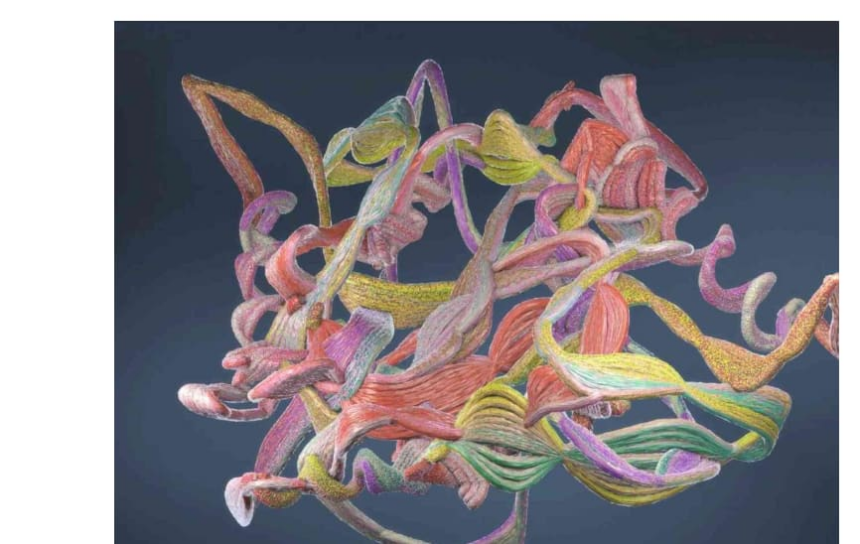
Proteins power every cell in the human body. They have been catalogued by scientists for decades, and for many years the figure has been close to 19,500, which most experts consider to be broadly accurate.
An entire layer of molecular players may have been missing from the standard parts list, according to new data from a large international investigation. A number of stragglers. Cells have been producing a novel class of molecules all along.
Counting the proteins that are absent
After searching through 95,520 protein-detection experiments, researchers from the international TransCODE Consortium found evidence for microproteins that the standard catalogue had overlooked.
They concentrated on almost 7,200 unknown DNA segments that some researchers had dismissed as quiet. Roughly one in four weren't. Of those regions, over 1,700 yielded detectable molecules that resembled proteins.
Dr. John Prensner, a paediatric neuro-oncologist at the University of Michigan Medical School, and Dr. Sebastiaan van Heesch, a research group head at the Princess Máxima Center for paediatric oncology (Máxima Center), co-led the project. Over 60 researchers from more than 30 institutions made contributions. For almost 20,000 hours, computers ran continuously. 3.7 billion raw molecular data points in total.
In the shadows
For a long time, the DNA areas the team looked for were written off as silent stretches—sections that are read by the cell's machinery but don't actually create anything the body needs. Dead ends, according to traditional wisdom.
This presumption placed them in the "dark proteome," a phrase used by researchers to describe gene products that were not included in the body's official genetic map.
The statistics showed the team that many of these areas do produce something. The molecules are consistently detected in several assays as short, unique sequences of amino acids, the chemical building blocks of proteins. The majority are small. Compared to less than 1% of the proteins currently on the standard list, almost 65% are shorter than 50 amino acids.
A third biological
This is where things started to go weird. The new molecules should resemble conventional proteins, according to Van Heesch's scientists. Most didn't. Just a dozen or so appeared to be well-known proteins.
The remainder occupied an odd middle ground: they were obviously genuine and composed of amino acids, but they had no known function in human biology. It took more than a year for researchers to decide what to label them. Annotation experts from all throughout the field agreed on their response: peptideins.
The phrase refers to a third possible outcome of a DNA sequence. By definition, a protein has a known function in the body; a peptidein is not quite a protein. In contrast, peptideins can be detected, but their function within the body is yet unknown.
The OLMALINC discovery
The researchers used CRISPR gene editing, a biological technique that enables scientists to turn off certain genetic regions, to see if any peptideins truly have any effect. Though no one had demonstrated it at scale across hundreds of human cell types, earlier research had suggested that these neglected areas might encode vital proteins.
On the screen, six peptides stood out. The most notable came from a section of DNA known as OLMALINC, which the scientific community had long assumed made no protein at all. Approximately 85% of the more than 485 cancer cell lines tested exhibited reduced survival when the researchers turned off OLMALINC.
Subsequent research verified that the loss of the peptide in itself, rather than the genetic messenger it is encoded on, caused the damage. Analysis revealed that OLMALINC is involved in two fundamental cellular functions: cell division and the reaction to DNA damage. However, it is still unclear how exactly OLMALINC fits into these processes. No one had ever demonstrated that a peptidein could be necessary for so many different types of cancer cells at once.
New immunotherapy targets
Many of the recently identified peptideins also appeared on cell surfaces, where they were delivered to the immune system in a manner similar to how cancerous or infected cells mark themselves for destruction. This directly affects immunotherapy for cancer.
Immune cells can be trained to identify and eliminate cancer cells that have similar cell-surface fragments, according to earlier studies. Drug developers and university labs now have access to a far wider pool of prospects thanks to the new catalogue. Some are already in the early stages of development as targets for immunotherapy and cancer vaccines.
The dark proteome's next stages
The database of human proteins is going to grow. Instead of waiting years for confirmation, their discoveries are being made available in an open-source format so that other labs can look into the new entries directly.
The practical image is slower but more real for patients. Because the necessary DNA sections were thought to produce nothing, several genetic disorders have been difficult to explain. Now they might.
Additionally, the new catalogue identifies dozens of novel peptides that are essential for cells to survive, which is precisely the kind of target medication that researchers have been searching for for decades.
Thousands of tiny chemicals are working inside human cells that no one was monitoring, which is something the field understands today that it did not last week.
How does it work?
There are no comments for this story
Be the first to respond and start the conversation.
More stories from
Francis Dami and writers in Earth and other communities.
Axial Seamount is a restless undersea volcano off the coast of Oregon that has been seen for decades. Seafloor instruments are used by scientists to monitor its inflation, trembling, and approximate eruption time. However, nobody had seen what was truly inside.
By
about 14 hours ago in
Earth
Many travelers arrive in Egypt with a simple plan. They want to visit famous places, take beautiful photos, and enjoy a different culture for a short time. Two weeks may feel enough at first. Travelers can see the pyramids, ride boats on the Nile, and explore old markets. Yet these quick visits often leave out the deeper side of the country. Egypt is not only about history and landmarks. It is also about people, routines, traditions, and daily life. These things take time to understand. A longer stay changes the entire travel experience. Six months allows travelers to slow down and pay attention to details they once ignored.
By Evan Weiss St Louis2 days ago in Earth
Coral reefs, created by mostly corals and algae, are some of the most extravagant, stunning, massive communities found through out the world in the waters of the four oceans. Warm and clear water attracts an assortment of organisms that inhabit these coral reefs. After so many organisms make their home, they have created an ecosystem. Coral reefs contain a bunch of diverse and different types of species living within them. With all of these species, it is comparable to a whole other world, yet it is under the sea. With each diverse organism that inhibits these coral reefs, each of them offers something a little bit different to the coral reef. With different types of coral reefs, no two of them are the same.
By Mel's Mom Lifea day ago in Earth
Content Warning: This article discusses violent hate crimes, gun violence, transphobia, and murder. Please read at your own discretion.
By choreomanias5 days ago in Pride
© 2026
Creatd, Inc. All Rights Reserved.