


This is read by an automated voice. Please report any issues or inconsistencies here.
An “unprecedented” situation was taking hold in Orange County on Friday, as a tank at an aerospace firm was at risk of exploding and releasing a highly toxic chemical that can cause severe respiratory distress and lead to hospitalization, officials said.
An estimated 40,000 residents have been asked to evacuate, affecting portions of the cities of Garden Grove, Anaheim, Buena Park, Cypress, Stanton and Westminster. Disneyland is outside of the evacuation zone.
“This is highly volatile, it’s highly toxic, it’s highly flammable,” said Craig Covey, a division chief with the Orange County Fire Authority and the incident commander. Officials said they can’t recall a similar situation happening before.
So what’s the science of the leak and why do officials say it is so dangerous?
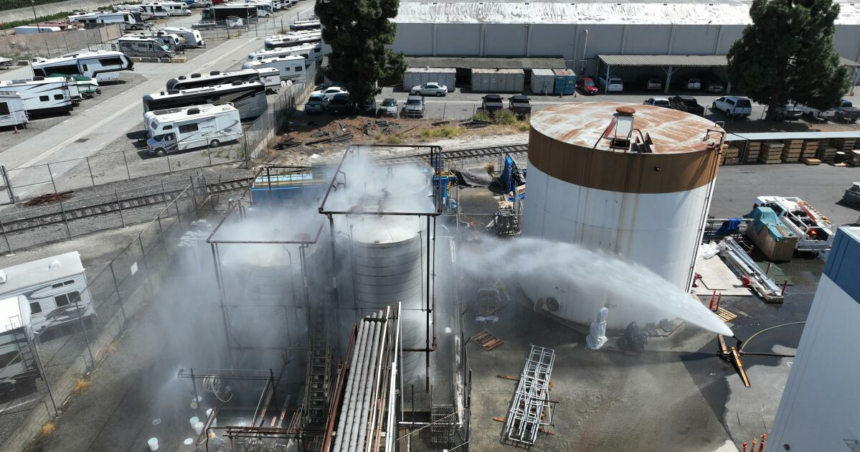
There are three large tanks with a highly toxic chemical called methyl methacrylate, or MMA, used to make plastic, around the 12000 block of Western Avenue in Garden Grove.
One tank that is the most compromised and in crisis has about 7,000 gallons of the chemical left in it, Covey said.
There are two options with what will happen to the tank, Covey said, which started experiencing a rise in temperatures Thursday.
“One, it fails and cracks, and all the product leaks out onto the ground,” Covey said, and efforts are underway to try to prevent the liquid from “getting into the storm drains and the river channels and into our oceans.”
The Garden Grove facility neighbors an elementary school and residential neighborhood.
Sean Greene LOS ANGELES TIMES
That’s the best-case scenario, because once it leaks, it’s no longer at risk of exploding. From there, teams in hazardous material suits can go in and “neutralize and mitigate the vapors that will be coming off of that.”
The worst-case scenario is an uncontrolled explosion. “If you’ve ever seen videos of tank cars on a railroad track blowing up, and that fireball it puts out, and it blows half the tank car a half a mile down the train track, that’s the incident potential we are dealing with if this suffers a catastrophic failure,” Covey said.
Those were the options: “a leaking tank or a tank that blows up,” Covey said at a briefing Friday afternoon. “This is going to happen unless some guy behind me here figures out how we can mitigate this incident. This thing is going to fail. We don’t know when.”
The incident took place at GKN Aerospace, which builds engine structures, landing gear and other products for commercial and military aircraft.
MMA is very toxic. Short-term exposure involving inhaling the chemical’s vapors “can cause significant irritation in the lungs, the nasal passages, and it can also cause nausea and it can also cause dizziness,” said Dr. Regina Chinsio-Kwong, Orange County’s health officer.
At very high levels of exposure, “it can really cause severe respiratory distress and hospitalization,” Chinsio-Kwong said.
The evacuation is large in part due to the potential of a plume of toxic vapors.
Officials said the chemical is heavier than air, so it would settle and sink into the lower areas around that facility if there’s an explosion. Officials are planning for the risk of the chemical blowing into other areas.
Methyl methacrylate can easily evaporate and linger near the ground as a dangerous vapor, according to the U.S. Environmental Protection Agency. If inhaled at high levels, these fumes can aggravate a person’s lungs, causing coughing, wheezing and chest tightness. It can also cause nausea, dizziness and skin irritation.
Although the EPA has classified the chemical as “not likely” carcinogenic to humans, long-term exposure has been linked to serious organ damage.
Of the three tanks with the toxic chemical, crews were able to add a chemical to one tank to neutralize its volatility, Covey said. They haven’t been able to do that with a second tank, but it is not in crisis.
But the tank that is most in crisis has valves that are broken and “gummed up,” and so the stabilizing chemical can’t be added to the explosive chemical, Covey said.
The broken valves also mean that crews can’t drain the tank of the explosive chemical, according to Orange County Fire Authority division chief Nick Freeman.
“We are unable to get anything out, and we were unable to get anything in to stabilize these things,” Freeman said.
Officials are trying to see if there are other ways they can resolve the situation without a spill or explosion.
“We have assembled a team to think outside the box … [we] are calling people all over the state and the country to get together with ideas how we can safely go in there and depressurize a pressurized tank and mitigate the exposure that it has,” Covey said.
The emergency started to develop Thursday, when one of three tanks started to experience an increase in temperature. A relief valve was activated and an overhead sprinkler system was activated to cool down the chemical, said interim Orange County Fire Authority Chief TJ McGovern.
The tank in greatest crisis was already bulging on Thursday. “It got to a point where it does what we call a BLEVE, which is a ‘boiling liquid expanding vapor explosion,’” Covey said.
Officials initially had success in cooling tanks with sprinklers, Covey said, but conditions worsened Friday when they discovered they could not offload a neutralizing agent in the failing tank because the valves had broken and were gummed up.
As of mid-afternoon Friday, there were no toxic chemicals leaking from the tank.
“We’ve cooled it down enough. That purge valve that is on top of it is no longer purging any kind of product,” Covey said. “There’s nothing in the air right now.”
One of the tanks on Thursday released vapor after the tank experienced an increase in temperature. In response, a relief valve was activated, and the tank was cooled down with an overhead sprinkler system.
In an update on Friday night, Covey said emergency crews have been able to maintain the temperature of the tank by continuously spraying it with water.
That “positive news” was “buying us time to continue to sort out: How do we fix this?”
Drones are monitoring the temperature of the tank, Covey said.
“We also have a set temperature where, when it reaches that point, we know the tank is going into thermal runaway, and we’re going to pull everybody out of the area, make sure it’s safe, and let the tank do what it’s going to do,” Covey said.
Garden Grove police chief Amir El-Farra said most people are evacuating, but about 15% are refusing to evacuate.
“I don’t have an answer for you on that,” El-Farra said.
The evacuation zone is roughly between one to three miles away from the failing chemical tank, which is located northeast of the corner of Western and Lampson avenues.
There are residential homes less than 400 feet east of the failing chemical tank in the city of Stanton.
The Orange County Superior Court has recommended nonessential personnel leave the courthouse in Westminster, which is outside the evacuation zone.
Follow Us
Rong-Gong Lin II is a reporter for the Los Angeles Times based in San Francisco who specializes in covering statewide earthquake safety issues and other natural disasters, public health and extreme weather. The Bay Area native is a graduate of UC Berkeley and started at The Times in 2004.
Follow Us
Hailey Branson-Potts is a state reporter who joined the Los Angeles Times in 2011. She reports on a wide range of issues and people, with a special focus on rural communities. She grew up in the small town of Perry, Okla., and graduated from the University of Oklahoma.
Follow Us
Salvador Hernandez is a reporter on the Fast Break Desk, the Los Angeles Times’ breaking news team. Before joining the newsroom in 2022, he was a senior reporter for BuzzFeed News, where he covered criminal justice issues, the growing militia movement and breaking news. He also covered crime as a reporter at the Orange County Register. He is a Los Angeles native.
Follow Us
Tony Briscoe is an environmental reporter with the Los Angeles Times. His coverage focuses on the intersection of air quality and environmental health. Prior to joining The Times, Briscoe was an investigative reporter for ProPublica in Chicago and an environmental beat reporter at the Chicago Tribune.
California
California
Music
California
Author and CBS News correspondent Jonathan Vigliotti attempts to answer some questions about rebuilding communities in his new book about the Palisades Fire — and names a motive for a quick rebuild: the Olympic games coming to Los Angeles in 2028.
Today we discuss one of the pivotal events of the 1960s: the assassination of Robert F. Kennedy. Though the gunman was caught at the scene, confessed at trial, and even bragged about the shooting, his motives have largely been forgotten.
In this specially released bonus episode, Madison McGhee and Jami Rice share some extremely opinionated opinions about everything from the Menendez Brothers to Jax Taylor.
California
California
California
Subscribe for unlimited access
Site Map
Follow Us
MORE FROM THE L.A. TIMES
Officials say a chemical explosion in Orange County could be catastrophic. Here’s why. – Los Angeles Times



Leave a Comment