


Soccer balls and bratwurst sizzled under the late-afternoon sun as dozens of United Nations ambassadors played a series of friendly, 15-minute football matches on the UN’s North Lawn Tuesday night, May 19.
For once, the diplomats were all getting along, men and women from all parts of the world, putting aside global trials and tribulations.
The festivities for World Football Day, celebrated ahead of May 25, began with a General Assembly session organized by Bahrain, Libya and Tajikistan with support from Germany, Austria, Italy, Hungary, Portugal and Rwanda.
Stéphane Dujarric, UN spokesperson, warned the gathering that impartiality was nearly impossible as he introduced the hosts, FIFA President Gianni Infantino and General Assembly President Annalena Baerbock (who also played in the scrimmages on the lawn).
“Frankly speaking, having a Frenchman put aside his national feelings on football as we march towards a third star on our jersey is a little difficult,” Dujarric said with a smile.
The messages were all about the unifying power of the beautiful game.
“Football is about happiness, it is about hope, and it is about unity,” Infantino told ambassadors and others — including kids wearing sport jerseys — in the Assembly.
Infantino said he hoped that the 2026 World Cup, which is organized by the United States, Canada and Mexico and will feature 48 national teams and “six billion spectators,” will represent a rare moment of global unity in difficult times.
Baerbock chimed in, saying that “football shows us not only what fairness can look like, but it also reminds us how much more work we can do if we do it together.”
She drew a direct parallel between the rules of football and the importance of the UN’s 193 member states “no matter how big or small, how powerful, or rich” playing by rules on the world stage.
“Football is truly universal: you can play it in a grand stadium, but you can also play it on a dusty field beside a highway … barefoot or in expensive shoes, and it doesn’t matter what language you speak, the color of your skin. Or what your parents’ earn; on the pitch everyone is alike.”
Despite Infantino’s protestations about football being for everyone, he tried to dodge questions by this reporter about dynamic pricing and FIFA’s role in sky-high ticket prices for this year’s World Cup.
After questioning him about the “extortionate” cost of tickets, he said, “There are tickets for everyone.”
Infantino was out the door before the reporter could ask him if he would be revoking US President Trump’s FIFA peace prize after the American bombing of Iran on Feb. 28, 2026.
After the General Assembly session, diplomats and guests headed out to the UN lawn to play football at the event organized by the German mission, which happens to be running for a UN Security Council seat (the election is June 3).
Diplomats enjoyed German beer from a drinks’ stand set up next to a three-slab portion of the Berlin wall on the UN grounds, with a mural on it showing two people embracing across the barrier, symbolizing unity.
Attendees tucked into grilled bratwurst and sauerkraut and cheered on the players, who ranged from youngish to older (there was no age limit).
James Kariuki, chargé d’affaires for the UK mission to the UN, was in his element on the soccer field. “This isn’t more fun than a day in the General Assembly or the Security Council, surely?” he quipped.
The 1996 “The Lions” anthem, written for the England football team by Baddiel, Skinner and the Lightning Seeds, blared over the speakers on the lawn, “Thirty years of hurt, never stopped me dreaming.”
Kariuki half-joked about organizing a watch party at the British mission should England end up in the World Cup final against Scotland.
US Ambassador to the UN, Mike Waltz, skipped the match, but he did tell this reporter that he’s not very good at the sport. He said that his daughter plays and that he is “excited” about the World Cup and hopes to go to a couple of games.
Libya’s UN Ambassador Taher El-Sonni stood out for his finesse on the field. Drenched in sweat, he spoke to the power of football on the world stage.
“We notice that in any time there is tension, conflict or any crisis, the one thing that doesn’t get affected is the game of football,” he said. “So, we see this as a unique opportunity to unite us together, to call for hope and joy.”
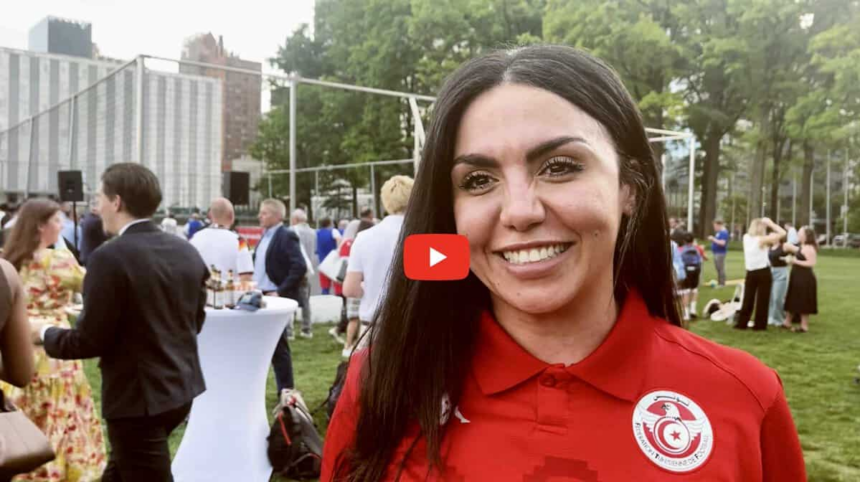
Numerous female diplomats participated in the games: Baerbock (who used to be a competitive trampoline gymnast before entering politics, winning bronze at the 1999 German championships); Maltese diplomat Vanessa Frazier; Marwa Jabou, from the Tunisian mission (the latter two both played fearlessly in goal); and the ref, Thilmeeza Hussain, a diplomat from the Maldives.
“Diplomats can learn how to share, can learn how to enjoy a game together. Finally, we have a moment to enjoy and share the values of the UN: justice, peace and fair play,” Jabou said on the sidelines.
“I think we could resolve everything in the soccer field actually,” Frazier said. “At least here we have a referee and we obey. The Security Council needs a referee!” — Text and video by JESSICA LE MASURIER
Jessica Le Masurier is a New York and UN correspondent for France 24. She has both a bachelor’s degree, with honors, and a master’s degree in modern languages and literature from Oxford University.
We would love your thoughts. Please comment:
BACK TO TOP
PassBlue is a nonprofit, independent women-led media company that covers foreign affairs and the United Nations with a focus on women’s issues and the impact of major world powers on ordinary citizens. We are strongly committed to high-quality original reporting, and our team strives to ensure that these powers are accountable for their actions and decisions.
Don’t miss a story, Subscribe to PassBlue
Understand the changing UN
Get PassBlue’s award-winning reporting on the UN and global affairs.
Yes, Ball Diplomacy Works – PassBlue



Leave a Comment