NBA
NBA Player
Tiers
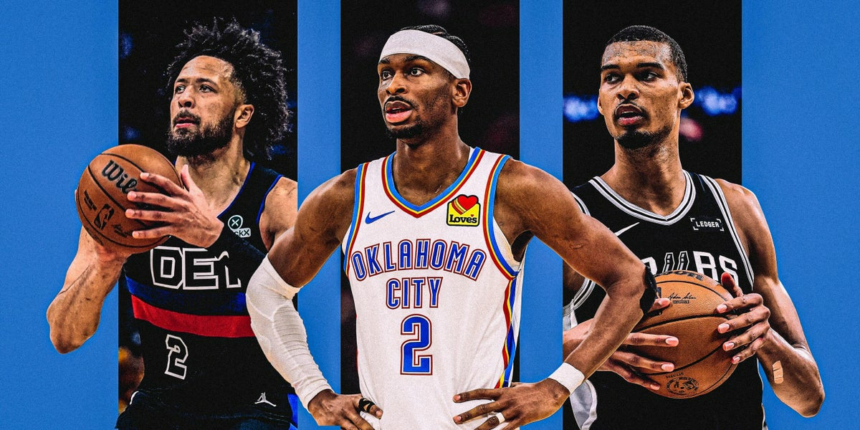
Cade Cunningham, Shai Gilgeous-Alexander and Victor Wembanyama led their teams to the NBA's three best regular-season records this season. Illustration: Demetrius Robinson / The Athletic; photos: Kenneth Richmond, Alex Slitz / Getty Images; Jim Dedmon / Imagn Images
As we reach the NBA’s summit in our Player Tiers project, there aren’t any surprises. But last year, I had 10 players in Tier 1. That’s not the case this year, even as I strived to be inclusive.
The great thing about basketball is that no player is perfect. There might be perfect stories, which is why Michael Jordan is the GOAT to many. But even Jordan had flaws (especially Washington Wizards Jordan) and needed Scottie Pippen to win in the playoffs. As great as they are, Tier 1 players have shortcomings and weaknesses that need to be accounted for when building rosters and schemes around them.
Advertisement
I tried to maintain some consistency from last year, so the number of sub-tiers remains the same. But this is the group I feel strongest about when it comes to consistency, impact, production, size and skill. Unfortunately, no acronym works for that.
We presented the previous tiers in descending order. To close this year’s project, we’ll unveil in ascending order.
I made the case last year that Anthony Edwards and Victor Wembanyama were Tier 1 players because they had shown enough to expect that they belonged there. Edwards led his Minnesota Timberwolves to a second straight Western Conference finals, while Wembanyama is leading his San Antonio Spurs on a deep playoff run. This sub-tier is where I’m projecting the most, but for different reasons.
I felt moved to promote only one player into Tier 1 this season, and that was Detroit Pistons point guard Cade Cunningham. At 6 foot 6 and 220 pounds, he’s the kind of big guard a team would be fortunate to build around. It didn’t happen immediately for Cunningham, who started 62 games for the worst team in basketball two years ago. Putting competent veterans around Cunningham allowed him to lead a playoff team a year ago. This year, he led a 60-win Pistons team, which speaks volumes about his impact, as few expected that outcome. Detroit outscored opponents by an average of 8.1 points per game with Cunningham on the floor.
Cunningham uses his size and skill to score effectively out of ball screens, isolations and post-ups. He averaged 6.0 free-throw attempts per game and has increased that number every year. Cunningham also improved his assists to 9.9 per game, second only to Nikola Jokić, while decreasing his turnovers to 3.7 per game. Turnovers are Cunningham's biggest issue, and that showed up this postseason, but he has also shown that he is a playoff riser as a scorer.
Advertisement
Though his shot is good off the bounce, the next step for Cunningham is to be better with off-the-catch 3s. While Cunningham made only 30.9 percent of those attempts, he made 35.9 percent on pull-up 3s, the shot more naturally available to him. He is a true four-level scorer, capable of getting to the paint, hitting 3s, drawing fouls and living in the midrange.
What makes Cunningham even more valuable is being an active participant in what was the best defense in the Eastern Conference this season. Cunningham is just as physical as his teammates, and he averaged a career-best 1.4 steals to go with 5.5 rebounds per game. He guards at the point of attack and holds up well in isolation. Unlike many high-usage guards, he doesn’t need to be hidden on that end.
Cunningham isn’t going to overwhelm opponents with his pace or athleticism. Durability is a yellow flag given that he’s played 70 games once in five seasons and a collapsed lung cost him three weeks this spring. But his combination of size, skill and competitiveness should have Cunningham in All-NBA First Team talks for the rest of the decade.
While Cunningham is seeking his first NBA Finals appearance, Jayson Tatum has already been there with the Boston Celtics. Jaylen Brown may have been NBA Finals MVP in 2024, but Tatum led the finals in points, rebounds and assists. Unfortunately, Tatum tore his Achilles tendon in the second round of last year's playoffs.
Tatum missed only 51 games in his first eight NBA seasons. He missed the first 62 games of this season while recovering from Achilles surgery, then four of the last 20 games. Boston took a 3-1 lead against Philadelphia in the first round, then lost Game 7 with Tatum sidelined due to left calf and knee concerns.
Tatum's return to play was encouraging, and Boston’s premature playoff exit is probably a blessing in disguise for Tatum, who gets to have a long offseason without recovering from a major surgery.
Advertisement
Tatum is in this sub-tier because he’s a Tier 1 player who needs to re-establish his pre-injury level of play. Next year is the last time Tatum could appear in the playoffs in his 20s, so there’s an interesting intersection between his injury recovery and what may be the end of his physical prime. What helps Tatum is that he is 6-8 with skill. Upon his return, he was effective playing out of ball screens and post-ups, but he needs to get his isolation game back, which made him a particularly difficult player to deal with in the previous three seasons. Tatum’s 16-game sample of regular-season play returned career lows of 41.1 percent field goals and 32.9 percent 3s, but those numbers improved to 47.5 percent from the field and 36.5 percent from 3 in the playoffs.
It’s not hard to see how Tatum gets back in the swing of things. He gets to the free-throw line, has developed into a solid playmaker who has more than twice as many assists as turnovers the last two years and launches a ton of 3s. Defensively, Tatum has a nose for the ball and can guard all five positions. It was a great sign that Tatum was healthy enough to capture 10.0 rebounds per game this regular season and 10.7 rebounds per game in the playoffs. As long as he can maintain his health and return to the level of play he previously established, Tatum is a Tier 1 player.
A year ago, this sub-tier featured Stephen Curry, Kevin Durant and LeBron James. But this isn’t a lifetime achievement award. The two players occupying this sub-tier now are now heading in opposite directions.
Anthony Edwards is the league’s best shooting guard, with an emphasis on shooting. Though Edwards’ 3-point volume dipped slightly this season from 4.1 3s made per game last year to 3.4, he made a career-high 39.9 percent of his 3s.
Edwards was one of nine players to make at least 100 pull-up 3s this season, per Second Spectrum, knocking down 128 of those attempts (fifth in the NBA) while connecting at a 35.3 percent clip. The 3s off the catch are eye-opening for Edwards, as he made 49.6 percent of his 139 attempts this season. Of the 425 players who attempted more than 20 off-the-catch 3s this season, Edwards was the most accurate.
Edwards has a tremendous workload and has improved his scoring every year, reaching 28.8 points per game. He got up to 7.2 free-throw attempts per game and 48.9 percent shooting from the field, both career bests. Edwards promised to be better in the midrange this season, and he did that, making 103 midrange field goals and shooting them at 43.3 percent. Edwards had a five-year low of 3.7 assists per game, but he was busy getting buckets, and he was proficient at getting them out of ball screens, isolations and post-ups; he scored more than a point per possession out of all three of those play types, per Synergy.
At 6-4, 225 pounds with exceptional athleticism, Edwards has the tools to be a strong defender. It doesn’t always work out that way, as he gets beaten more than he should. But he is a playmaker, averaging 1.4 steals to go with 5.0 rebounds. He also defends without fouling, though that should be expected with Rudy Gobert behind him and Edwards rarely being asked to take on primary scorers with Jaden McDaniels also on the perimeter.
Advertisement
Injuries finally caught up to Edwards this year. After missing only 19 games in his first five seasons, Edwards missed 21 this year, not including the first playoff absences of his career. The fact that Edwards returned from a hyperextended knee in nine days is incredible, though the injury zapped some of his explosiveness. Overall, Edwards, who turns 25 in August, is nearing the peak of his powers.
The same cannot be said for Milwaukee Bucks forward Giannis Antetokounmpo. Five years ago, Antetokounmpo was arguably the game’s most powerful player, decorated with the 2021 championship and the accompanying NBA Finals MVP award. That came on the heels of back-to-back MVP awards and the 2020 Defensive Player of the Year honor.
It’s basically been all downhill for the Bucks since then. Antetokounmpo led the Bucks to a first-round win against the Chicago Bulls in 2022, and they haven’t won a playoff series since. This year, the Bucks devolved into a 50-loss lottery team, snapping a nine-year playoff streak.
The conflict between Antetokounmpo and the Bucks is profound and seemed bound to happen given the loss of his co-starters from Milwaukee’s championship and the one star who was brought in over that time, Damian Lillard. Antetokounmpo dealt with more injuries than ever this season, appearing in only 36 games. Just six of those came after the All-Star break. Injury has been a growing concern for Antetokounmpo, as he missed eight playoff games in 2023 and 2024 and has only appeared in 70 games once in the last five years.
With all that said, Antetokounmpo is a problem for opponents on the court. His scoring was an eight-year low 27.6 points per game this season, but he made a career-best 62.4 percent from the field and was on pace for his third-straight 200-dunk season. Only Luka Dončić attempted more free throws per game than Antetokounmpo, only LeBron James averaged more fast-break points than Antetokounmpo, and Antetokounmpo led the league in paint points per game for the third year in a row. His assists were down, but he averaged 5.4 per game while sharing playmaking duties with Kevin Porter Jr. and Ryan Rollins. While Edwards made 49.6 percent of his catch-and-shoot 3s, Antetokounmpo attempted 20 3s off the catch this season — and made half of them. A low volume, but noteworthy.
Antetokounmpo averaged a career-low 0.7 blocks per game this season. Among 136 players who played at least 20 games, averaged at least 20 minutes and averaged at least 2.5 defended field goals at the rim, Antetokounmpo’s 51.9 percent yield rate ranked fifth. Though his streak of double-digit rebounding seasons was snapped at eight, he averaged 9.8 rebounds per game.
Antetokounmpo is by far the most likely Tier 1 player to relocate this offseason. Perhaps it is too challenging to put a contending team around him: Ideally, you need a floor-spacing center in the spirit of Brook Lopez, a strong midrange scorer in the spirit of Khris Middleton, a bulldog point-of-attack defender capable of secondary playmaking in the spirit of Jrue Holiday and plenty of shooting. Antetokounmpo has to show that he can stay on the floor, but he is still a top defender and the best interior scorer in basketball, even if he’s been surpassed as the game's best two-way big.
Advertisement
It’s all international from here. This sub-tier features the league’s best scorer and the league’s best defender.
The floor for Los Angeles Lakers point guard Luka Dončić is what keeps him out of the very top of Tier 1. Dončić was the only player in the NBA to average four turnovers per game. Even though his defense was solid, he is often hidden, and in case you’re wondering why the Lakers had the second-worst rim protection in the league, Los Angeles’ scheme had Dončić in position to be a rim protector more than anyone on the team besides starting center Deandre Ayton. Dončić was suspended for excessive technical fouls despite playing for a team that led the league in free-throw differential for the fourth year in a row. He has missed at least a dozen games each of the last five seasons and missed the entire postseason because of his second (and more severe) hamstring injury of the season.
Still, there isn’t a more feared scorer in the league. For the second time in three years, Dončić led the NBA in scoring (33.5 points per game). For the first time, Dončić led the league in free-throw attempts (10.1 per game). For the first time, Dončić led the league in both 3s made and attempted per game, balancing those turnovers with 4.0 3s per game on 36.6 percent accuracy. No player made more pull-up 3s (181) this season, per Second Spectrum, and he gets them off with or without a ball screen. He also ranked 10th by making 104 midrange field goals, and no guard made more baskets in the post than Dončić, per Synergy. When it comes to four-level scoring, Dončić was capable of buoying the Lakers' offense by himself, especially early. He averaged 12 first-quarter points per game, the most any player averaged in any quarter this season.
Defensively, Dončić was strong this season. He drew 14 charges, eighth-most in the league, and finished with a career-best 105 steals. Even though his 7.7 rebounds per game were a career low, it was third among guards behind Josh Giddey and Amen Thompson. A lot was made about Dončić’s conditioning last offseason. Next season, rest should be a priority as he attempts to participate in his first playoff series win since losing the 2024 NBA Finals with the Dallas Mavericks.
There are three No. 1 picks in Tier 1. Spurs center Victor Wembanyama is already placed atop the list, and he’s only in his third season. He’s a two-time All-Star, was a finalist for MVP and secured the first of what might be a string of Defensive Player of the Year awards. This year, he led San Antonio to its first playoff series win since 2017.
And yet, Wembanyama has much more ceiling to explore. He can be better at using his 7-4 frame in the post, and his pull-up jumper isn’t proficient outside the paint yet for a player who goes to it as often as he does. While Wembanyama makes 36.6 percent of his 3s off the catch, he only makes 28.1 percent of his pull-up 3s, per Second Spectrum. As intimidating as his defense is, he can be beaten in space when drivers can get a bump into an overextended Wembanyama, or even get under Wembanyama to get by him. It’s a unique area of improvement that doesn’t apply to mere mortals.
With all that said, there’s a reason the Spurs have gone from Western Conference road kill to legitimate contender. Wembanyama is not only a world beater on both ends of the floor, but his style of play makes it easy for his teammates to have advantages on offense while benefiting from his vast defensive presence.
Advertisement
Wembanyama scores 25.0 points per game while drawing 7.0 free throws, and there’s variety in his attacks. He can be effective on both ends of pick-and-rolls. He can roll or cut or just stand and collect dunks, with a seemingly infinite catch radius. He finally got his field goal percentage over 50 percent, and much of that was due to Wembanyama cutting down his 3-point volume for more opportunities closer to the basket. He doesn’t just shoot normal 3s, lining up with room to spare behind the arc. That kind of spacing, combined with his vertical gravity, allows for Wembanyama’s pack of high-level ballhandlers to drive and make plays. Wembanyama’s assists dropped to 3.1 per game, but his turnovers went down to 2.4 per game as well. That’s what happens when you go from Jeremy Sochan as your point guard to lead ballhandlers Stephon Castle, De’Aaron Fox and Dylan Harper.
Since Wembanyama entered the league in 2023, he has blocked 627 shots in 181 regular-season games. The next closest shot blocker over the last three seasons is Brook Lopez, with 203 fewer blocks in 53 more games. When Wembanyama was on the floor this season, San Antonio allowed 103.6 points per 100 possessions. When he was off the floor, San Antonio allowed 113.7 points per 100 possessions. That’s the difference between the league’s best defense and its 15th-ranked defense. It’s not just blocks for Wembanyama either, as he had 66 steals in 64 games, and he averaged 11.5 rebounds per game as well. Wembanyama also has had more blocks than fouls in each of his three seasons.
Durability will always be a concern for Wembanyama. He missed the second half of last season with deep vein thrombosis, and a left calf strain cost him multiple weeks. He also missed a playoff game in April due to concussion protocol. But Wembanyama has led his team to a speedy ascent in the West, and he’ll be armed with the tool of experience going forward.
Two players are at the vertex of the 2026 Player Tiers. In terms of individual talent, they’re on equal footing, but they couldn’t be more different.
Last year, I put Oklahoma City Thunder point guard Shai Gilgeous-Alexander into the upper room even though he had only been a part of one postseason win in his first six NBA seasons. He responded by winning MVP and leading Oklahoma City to a championship.
As a defending champion, Gilgeous-Alexander led the Thunder to the league’s best record again and, as of this writing, the conference finals for the second year in a row. There were 26 fourth quarters in which Gilgeous-Alexander did not play this season, and his team only lost one of those games. When Gilgeous-Alexander was on the floor, the Thunder outscored opponents by 11.6 points per game during the regular season.
Gilgeous-Alexander’s ruthless effectiveness with the ball in his hands continued. He was Oklahoma City’s top pick-and-roll ballhandler, isolation option and post-up threat. He scored more than 1.1 points per possession in all three of those actions during the season, the only player in the league who led his team in all three play types to be that proficient in all of them, per Synergy.
Advertisement
Gilgeous-Alexander is a four-level scorer who also has an impossibly high floor. He converted 71.2 percent in the restricted area, 53.1 percent in the non-restricted paint and 54.9 percent on non-paint 2s. Gilgeous-Alexander is on the ball too much to be in the corner, as he made only 6 of 18 corner 3s all season. But of the 15 players to make at least 90 pull-up 3s, Gilgeous-Alexander’s 38.4 percent clip ranked fifth behind Jamal Murray, Bub Carrington, Stephen Curry and CJ McCollum. For good measure, Gilgeous-Alexander nailed 39.3 percent of his 56 3-point attempts off the catch, per Second Spectrum.
The free-throw line has been a place of residence for Gilgeous-Alexander. He makes 87.9 percent of his free throws and led the NBA in free throws made for the third year in a row despite ranking fourth in attempts behind Dončić, Antetokounmpo and Deni Avdija. In addition to Gilgeous-Alexander’s elite free-throw generation, he compiled 2.97 assists per turnover, one of the best among starting point guards. Gilgeous-Alexander averaged 31.1 points and only 2.2 turnovers per game. Since the NBA began tracking turnovers in 1977, there have been only 13 seasons in which a player averaged at least 30 points per game and fewer than 3.0 turnovers. Gilgeous-Alexander has four of those seasons, including the two with the fewest turnovers: this season and last season.
Gilgeous-Alexander also tends to guard who guards him. At 6-6, 195 pounds, he has ideal length for the smallest defender on the floor on the team with the best defense. Per NBA Advanced Stats, his primary assignments of Collin Gillespie and Marcus Smart were held to 4-of-22 shooting from the field in Gilgeous-Alexander’s coverage this postseason. His steals, blocks and rebounds were all down this season, but he still averaged 1.4 steals, 0.8 blocks and 4.3 rebounds.
There are still things to be wary of with Gilgeous-Alexander. He missed 24 days with an abdominal strain, which isn’t his first instance of the injury, and he had only 20 dunks, his fewest in five seasons. His 3-pointer got dry last postseason, and he can be beaten defensively by big drivers in isolation. But Gilgeous-Alexander has been the best player on the league’s best team over the last three years, and that’s with one of his co-stars missing a significant part of the regular season each of the past two years.
While Gilgeous-Alexander’s Thunder have risen over the last three seasons, Nikola Jokić’s Denver Nuggets have slowly descended. Jokić won his NBA Finals MVP in 2023. The following season, the Thunder barely secured the top seed in the West over Jokić’s Nuggets. Though Jokić earned his third MVP award in 2024, both the Nuggets and the Thunder were upset in the conference semifinals. Gilgeous-Alexander edged out Jokić for the 2025 MVP, then the Thunder blew out the Nuggets in Game 7 of last year’s conference semifinals on the way to a championship. This season, the Thunder were the first defending champion to make it to the conference finals since the 2019 Warriors, while Jokić’s Nuggets were upset by the Timberwolves in the first round. Jokić posted his lowest field goal percentage (44.6) and 3-point percentage (19.4) in a playoff series.
Building a strong defense around Jokić isn’t impossible, but it’s been difficult recently. Denver has finished as a bottom-10 defense each of the last two seasons and owned the worst defense of any playoff team in both seasons. Jokić is one of the worst rim-protection starting centers in the league. There were five regular-season games in which Jokić had at least eight turnovers, tied with Cade Cunningham for most in the league and the most Jokić has ever had. Jokić is on the other side of 30 now, and he just missed a career-high 17 games, most notably due to a left knee hyperextension.
Jokić, however, remains the most dominant offensive player in basketball and the most impressive manufacturer of production. The Nuggets were the league’s top offense this season, and Jokić averaged a career-best 7.4 free-throw attempts to go with 27.7 points per game. He also averaged a career-best and league-leading 10.7 assists per game, the most ever by a center.
Advertisement
Jokić uses his 6-11, 284-pound frame to punish opponents. No player scores more points in the post. But Jokić’s skill is a weapon. He is capable of handling the ball in inverted pick-and-rolls, and he is far more effective at taking the ball screen out of it and just playing in isolation. He does the big man stuff well, such as rolling to the basket or cutting for scores, but Jokić is also comfortable spotting up or coming off off-ball screens to gain an advantage. Despite the shooting struggles this spring, Jokić is still a 38 percent 3-point shooter, a 55.6 percent midrange shooter and an 83.1 percent free-throw shooter. Jokić has some of the best touch in the league, and only Kevin Durant made more shots in the paint outside the restricted area.
Jokić’s steals were down this season, but he averaged 1.4 per game; his 92 steals led all centers. For the first time, a player led the NBA in rebounding while averaging a triple-double for a season, with Jokić averaging a league-leading 12.9 rebounds per game, and he might pass Russell Westbrook for the most triple-doubles in NBA history next season. (Westbrook has 209; Jokić has 198.)
No player touched the ball more often this season. Jokić averaged more than 100 touches per game, per Second Spectrum, and has now led the NBA in touches for eighth straight seasons. When Jokić was on the floor, Denver scored 126.1 points per 100 possessions. Without him, Denver scored only 112.7 points per 100 possessions, the same mark as the 22nd-ranked Utah Jazz offense.
All in all, these are some of the best cooks in the league. But if this project has taught us anything, it’s that it is a team game. Even though this is a player evaluation exercise, these players perform in tandem with teammates, and these rosters have to fit. You can have the food served. The cooks still need seats filled at the table.
Spot the pattern. Connect the terms
Find the hidden link between sports terms
Play today's puzzle