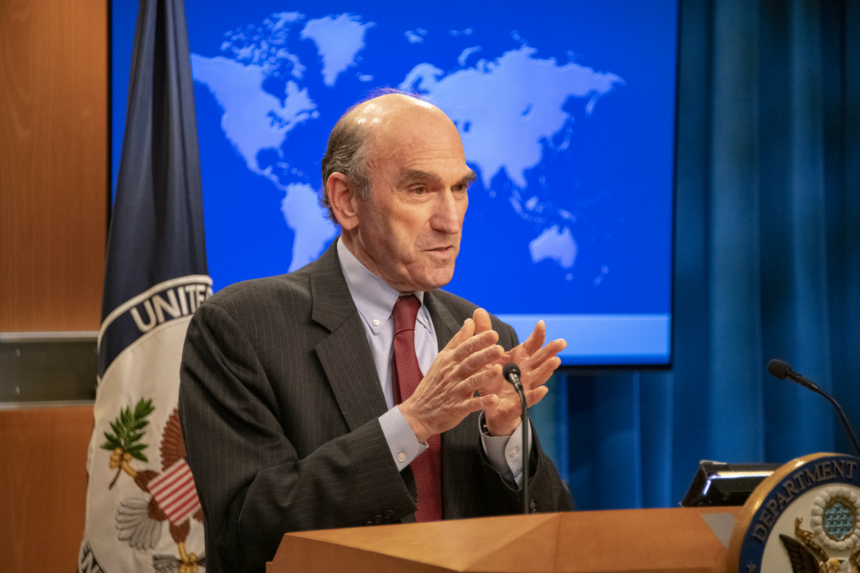
Former Iran envoy Elliott Abrams: ‘It’s a foolish and damaging failure by the Trump administration, and there’s no excuse for it’
U.S. Department of State
Elliott Abrams
Former U.S. diplomatic officials and Middle East experts called on the Trump administration to fill dozens of ambassador-level Middle East posts, warning that not doing so could carry damaging consequences for U.S. influence and diplomacy in the region, while other former Trump officials argued the administration can manage regional diplomacy in its current format.
The Wall Street Journal first reported that more than 100 U.S. ambassador posts remain vacant under the Trump administration, including several key posts in the Middle East. The U.S. currently has no formal ambassadors in Saudi Arabia, the United Arab Emirates, Qatar, Iraq or Kuwait.
The vacancies stem from a mix of factors: a slower pace of nominations from President Donald Trump, a Senate confirmation process increasingly prone to delays and holds, and Secretary of State Marco Rubio’s December decision to abruptly recall nearly 30 career ambassadors.
The Trump administration has played down the vacancies, arguing that its foreign policy operation is running smoothly despite the empty posts. But several former U.S. officials and Middle East experts told Jewish Insider that leaving the post unfilled could be a serious diplomatic error.
Elliott Abrams, who served as Iran envoy during the first Trump administration and is now a senior fellow at the Council on Foreign Relations, called the vacancies a “huge mistake.”
“It’s a foolish and damaging failure by the Trump administration, and there’s no excuse for it,” Abrams said. “There are top career diplomats, such as the ones the administration has sent to Jordan, Bahrain and Oman, who could be sent, and surely there are potential political appointees who’d love to be in Riyadh or Abu Dhabi.”
Abrams noted that ambassadors often have access to members of royal families that lower-ranking U.S. diplomats do not, a dynamic that he said is especially important in monarchies.
“There’s simply no excuse for this, and no other country leaves such important posts vacant,” he added.
Aaron David Miller, a senior fellow at the Carnegie Endowment for International Peace and former State Department negotiator, expressed similar concern over the vacancies, saying “it would be better if they were filled with people.” He stressed, however, that the openings are more than a “narrow issue,” but rather a “reflection of a broader trend” in how the administration “makes decisions.”
“It’s a lack of priority in diplomacy, and in diplomats,” Miller said. “It reflects a situation where the analytical assessments of how these countries would behave in response to a crisis like the war, what I call the ‘ground truth,’ is not getting to the president because there’s no one out there doing it.”
Miller said he believes the administration does not rely heavily on the advice of career diplomats or ambassadors, with key foreign policy decisions instead shaped by Trump’s inner circle.
“I think this reflects the fact that this administration does not rely on the advice and counsel of probably most of its ambassadors,” he said. “So does this surprise me? No, because part of the issue is that the White House and the president’s political team, including Jared Kushner and [White House Special Envoy] Steve Witkoff, seem to have more say and more influence than a Department of State led by Marco Rubio.”
Still, Miller acknowledged that filling the vacant ambassador posts likely would not have altered Trump’s broader foreign policy or prevented the Iran war.
Dan Shapiro, who served as U.S. ambassador to Israel under President Barack Obama and later as the Biden administration’s special liaison to Israel on Iran, similarly warned that relying on senior officials in Washington rather than ambassadors on the ground could limit U.S. influence and understanding of regional dynamics.
“Senior Trump administration figures may believe they can manage these relationships just fine over the phone from Washington because of their close ties with Arab officials. But there are gaps and bandwidth limits that they cannot always overcome,” Shapiro said.
“Senate-confirmed ambassadors are the only senior U.S. officials who spend all day, every day in dialogue with foreign leaders. So they simply have greater access to key players in their host governments, knowledge of how they reach decisions, and ability to ensure they hear the views of the United States than do more junior diplomats,” he added.
Edmund Fitton-Brown, a senior fellow at the Foundation for Defense of Democracies and a former British diplomat, explained that the vacancies are partly the result of a “downsizing” problem at the State Department, noting that the Bureau of Near Eastern Affairs in particular has suffered “budget cuts and lost over 80 staff since President Trump returned to office.”
“Many of those departing were senior, experienced diplomats who would have been candidates for Chief of Mission posts that were not offered to political appointees,” Fitton-Brown said.
Others who served in Trump’s first administration were less concerned, arguing instead that the White House can still conduct effective regional diplomacy through senior officials and direct relationships with Middle Eastern leaders.
Jason Greenblatt, a former White House Middle East envoy during the first Trump administration, told JI that while ambassadors “play an important role,” he does “not believe the administration is at any disadvantage … because of these vacancies.”
“The leadership and senior diplomats in those countries have strong and trusted relationships with President Trump and with the group doing much of the day-to-day work, including Steve Witkoff, Secretary Rubio, Vice President Vance and Jared Kushner,” Greenblatt said. “Just as important, that group has President Trump’s deep trust and direct access to him. In this region, those trusted relationships, direct lines of communication and confidence from the president are more valuable than having an ambassador in place.”
Alexander Gray, who served as chief of staff to the National Security Council during Trump’s first term, similarly downplayed concerns over the vacancies, and said filling such positions is “one of the most difficult parts of American foreign policy.”
“This stems from multiple causes, including the arcane Senate confirmation process and the frequent holds placed by senators on ambassadorial nominees over unrelated issues,” Gray said. “The approval process for all presidential nominees, including ambassadors, needs a major overhaul by congressional leadership. President Trump has been diligent in nominating high-quality, non-career diplomats for critical posts.”
The State Department did not respond to a request for comment.
Copyright © 2026 · All Rights Reserved · Jewish Insider
The politics and business news you need to stay up to date, delivered each morning in a must-read newsletter.
Please log in if you already have a subscription, or subscribe to access the latest updates.
Email me a link to sign in
I don’t have an account
Already a subscriber? Sign in
Become a premium subscriber